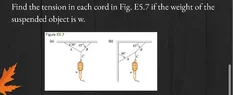
2 wires attached to another wire attached to a block

  • Thread starter Thread starter random124
  • Start date Start date
Click For Summary
SUMMARY

The discussion centers on the relationship between weight and tension in a system of cords supporting a suspended object. It establishes that the weight of the object is equal to the tension in cord C due to the absence of acceleration, as indicated by Newton's first law. The forces acting on the suspended object include gravity and the tension from the cord, leading to a net force of zero. The analysis emphasizes the importance of drawing a force diagram to visualize these relationships clearly.

PREREQUISITES
  • Understanding of Newton's laws of motion
  • Familiarity with force diagrams and free-body diagrams
  • Basic knowledge of tension in strings and cords
  • Concept of net force and equilibrium in physics
NEXT STEPS
  • Study Newton's first law of motion in detail
  • Learn how to construct and interpret free-body diagrams
  • Explore the concept of tension in multiple cord systems
  • Investigate equilibrium conditions for static objects
USEFUL FOR

This discussion is beneficial for physics students, educators, and anyone interested in understanding the mechanics of forces in static systems, particularly those involving tension and equilibrium.

random124
Messages
4
Reaction score
1
Homework Statement
Why is the weight equal to the tension of C?
Relevant Equations
Fg = Tc
Why is the weight equal to the tension of C?
 

Attachments

  • PHOTO-2025-10-02-20-51-35.webp
    PHOTO-2025-10-02-20-51-35.webp
    12.6 KB · Views: 11
Physics news on Phys.org
Draw a force diagram
 
random124 said:
Homework Statement: Why is the weight equal to the tension of C?
Relevant Equations: Fg = Tc

Why is the weight equal to the tension of C?
What forces act on the suspended object? Is the suspended object accelerating?
The "relevant equations" item in the template is for standard equations, such as Newton’s laws, that would be relevant to the question. Which of those relates forces on a body to its acceleration?
 
the object has no acceleration its suspended.
 
Draw a force diagram
 
random124 said:
the object has no acceleration its suspended.
So what does that tell you about the net force acting on it?
And what forces contribute to that total?
 
That the net force is 0 but I don't understand why is the weight and tension of the cord that's pushing the weight up equal if there are other cords attached
 
random124 said:
That the net force is 0 but I don't understand why is the weight and tension of the cord that's pushing the weight up equal if there are other cords attached
The other cords are not attached to the weight.
Each body only "knows" about the forces that act directly on it. The suspended body is only directly acted on by gravity and the vertical cord; that cord (taken as massless) is only acted upon by the suspended weight and the knot; the knot is acted on by three cords; etc.
If the knot were directly attached to a ceiling instead of to the upper two cords it would make no difference to anything below the knot.
 
random124 said:
That the net force is 0 but I don't understand why is the weight and tension of the cord that's pushing the weight up equal if there are other cords attached
DO A FORCE DIAGRAM !!!
 
  • #10
random124 said:
That the net force is 0 but I don't understand why is the weight and tension of the cord that's pushing the weight up equal if there are other cords attached
Welcome! :cool:

When your fingers are holding a suspended bad of groceries, do they feel increased or reduced weight of the groceries?
The handles of the bag are also supporting as much weight as your fingers.
 

Similar threads

Replies
17
Views
1K
  • · Replies 5 ·
Replies
5
Views
2K
  • · Replies 5 ·
Replies
5
Views
2K
Replies
2
Views
1K
Replies
21
Views
890
Replies
4
Views
906
  • · Replies 11 ·
Replies
11
Views
1K
Replies
7
Views
3K
  • · Replies 1 ·
Replies
1
Views
3K
  • · Replies 17 ·
Replies
17
Views
4K