roam
- 1,265
- 12
The orientation of frequency components in the 2-D Fourier spectrum of an image reflect the orientation of the features they represent in the original image.
In techniques such as nonlinear microscopy, they use this idea to determine the preferred (i.e. average) orientation of certain features in a given image (e.g. the orientation of collagen fibers). For example here for different regions of interest, they obtained the power spectra (shown below in binary), and using that they inferred the orientation angle.
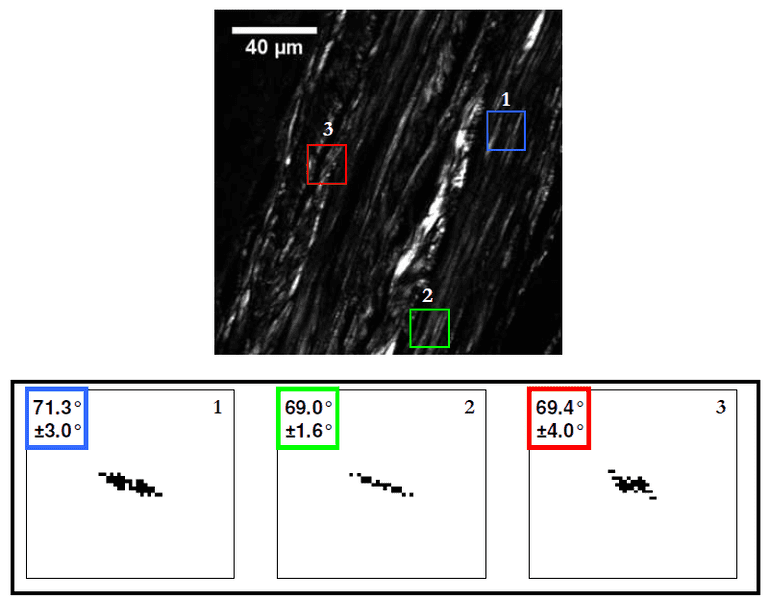
So, I am not sure how they would measure the angle of the FT. Are there equations for finding the tilt angle of a certain frequency component?
I believe when they find all the angles, they would do a fitting to get the average orientation. The ##\pm## in the picture above is the standard deviation – the number of fibers that deviate from the preferred orientation.
How would an algorithm for finding the angle look like? Unfortunately, the papers did not explain this in any detail.
Any explanation would be greatly appreciated.
In techniques such as nonlinear microscopy, they use this idea to determine the preferred (i.e. average) orientation of certain features in a given image (e.g. the orientation of collagen fibers). For example here for different regions of interest, they obtained the power spectra (shown below in binary), and using that they inferred the orientation angle.
So, I am not sure how they would measure the angle of the FT. Are there equations for finding the tilt angle of a certain frequency component?
I believe when they find all the angles, they would do a fitting to get the average orientation. The ##\pm## in the picture above is the standard deviation – the number of fibers that deviate from the preferred orientation.
How would an algorithm for finding the angle look like? Unfortunately, the papers did not explain this in any detail.
Any explanation would be greatly appreciated.

