3(x^2 + y^2)^2 = 25(x^2 - y^2) implicit differentiation

Click For Summary
SUMMARY

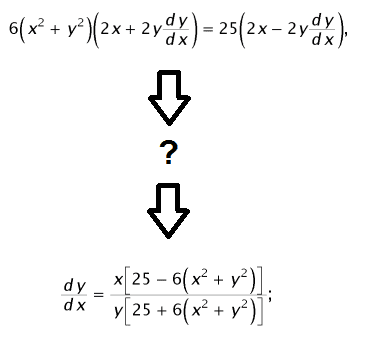
The discussion focuses on using implicit differentiation to find the slope of the tangent line for the equation 3(x² + y²)² = 25(x² - y²) at the point (2,1). Participants clarify the steps necessary to manipulate the equation into a solvable form, specifically transforming it into 6(x² + y²)(2x + 2y(dy/dx)) = 25(2x - 2y(dy/dx)). The solution involves defining variables A, B, C, and z, leading to the equation z = (B(A - 25)) / (-C(A + 25)). This method is confirmed as correct and is noted as a standard approach in calculus.

PREREQUISITES
  • Understanding of implicit differentiation
  • Familiarity with polynomial manipulation
  • Knowledge of calculus concepts such as derivatives
  • Basic algebra skills for solving equations
NEXT STEPS
  • Study implicit differentiation techniques in calculus
  • Learn about polynomial factoring methods
  • Explore the application of derivatives in finding slopes of curves
  • Review college algebra concepts relevant to calculus
USEFUL FOR

This discussion is beneficial for students studying calculus, particularly those struggling with implicit differentiation and polynomial equations. It is also useful for educators seeking to clarify these concepts for their students.

LearninDaMath
Messages
295
Reaction score
0
Use implicit differentiation to find the slope of the tangent line to the curve at the specified point.

3(x^2 + y^2)^2 = 25(x^2 - y^2) ; (2,1)

This is where I'm stuck:
algebra.png


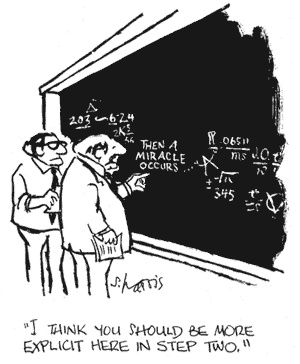
I know how to get up to the first equation...and I know how to get to the final answer from the second equation, but I have no clue how to get from the first equation in the picture to the second in the picture.It kind of reminds me of this:
miracle.gif
Please help me if you could...I tried factoring out the twos, I just can't figure out how to get the same polynomial in the numerator and denominator...i mean, how the heck do the twos disappear? How does the 25 appear in both the numerator and denominator? I don't understand what steps are being taken here.
 
Physics news on Phys.org
If you had A+ Bx= C+ Dx, how would you solve for x?
 
Hmm.
Let's make it a little more explicit (if you don't mind HoI).

You have:
$$6(x^2+y^2)(2x+2y{dy \over dx}) = 25(2x-2y{dy \over dx})$$

Let's define:
$$\begin{array}{l}A=6(x^2+y^2)\\B=2x\\C=2y\\z={dy \over dx}\end{array}$$
Then your equation becomes:
$$A(B+Cz)=25(B-Cz)$$
Do you know how to solve such an equation for z?
 
I like Serena said:
Hmm.
Let's make it a little more explicit (if you don't mind HoI).

You have:
$$6(x^2+y^2)(2x+2y{dy \over dx}) = 25(2x-2y{dy \over dx})$$

Let's define:
$$\begin{array}{l}A=6(x^2+y^2)\\B=2x\\C=2y\\z={dy \over dx}\end{array}$$
Then your equation becomes:
$$A(B+Cz)=25(B-Cz)$$
Do you know how to solve such an equation for z?

Well, i gave it a try and got \frac{B(A-25)}{-C(A+25)} = z

I multiplied A into (B+Cz) to get (AB+ACz). Then multiplied 25 into (B - Cz) to get (25B - 25Cz). Next, I got all the z terms on one side and everything else on the other. Then factored out the z from both terms and divided to isolate the z. Then I factored out B from the numerator and C from the denominator.

Is that correct?
 
Yes, that is correct.

Now replace A,B,C, and z by the definitions for them?
 
Got it, thanks much! Is the formula you presented one that fits a type of equation that comes up often? Are there like a group of general formulas such as the one you presented intended for various equations? I wonder if this is something that was covered in college algebra. My job schedule (military) pulled me out of class at the beginning of that semester for a couple weeks and so I told my professor i'd retake the course the following semester. When I went to sign up again, I found that the professor decided to pass me with a C. I was ecstatic at the time, but now it seems college algebra would make things a lot less confusing in calculus. I'm getting by, but it's taking a lot of extra studying. I really appreciate the help.
 
You're welcome. :)

It's a pretty standard method to give sub expressions names in the form of a single letters.
Then replace them by the letter, do whatever you need to, and replace the letters again by the sub expressions.

Edit: Oh, and I liked the picture with the blackboard you included. ;)
 
I like Serena said:
You're welcome. :)

It's a pretty standard method to give sub expressions names in the form of a single letters.
Then replace them by the letter, do whatever you need to, and replace the letters again by the sub expressions.

Edit: Oh, and I liked the picture with the blackboard you included. ;)


Thanks, feel free to use that picture whenever. I heard about it a while ago when watching some youtube video of a talk by an engineer turned biologist at a conference. Just search up "and then a miracle occurs" and you'll get a few variations of this picture.
 

Similar threads

  • · Replies 2 ·
Replies
2
Views
2K
  • · Replies 6 ·
Replies
6
Views
1K
  • · Replies 3 ·
Replies
3
Views
2K
Replies
9
Views
2K
Replies
49
Views
5K
Replies
7
Views
2K
  • · Replies 6 ·
Replies
6
Views
4K
  • · Replies 5 ·
Replies
5
Views
2K
  • · Replies 3 ·
Replies
3
Views
2K
  • · Replies 7 ·
Replies
7
Views
1K