A contrete block released from the rest

  • Thread starter Thread starter TheDudeTR
  • Start date Start date
  • Tags Tags
    Block Rest
Join the discussion
Ask a follow-up here, or get your own question answered by working scientists, mathematicians and engineers — people, not an autocomplete.
Real named experts · corrections over time · the nuance an AI answer skips
7 replies · 2K views
TheDudeTR
Messages
5
Reaction score
0
Homework Statement
a concrete block released from rest
Relevant Equations
F=ma
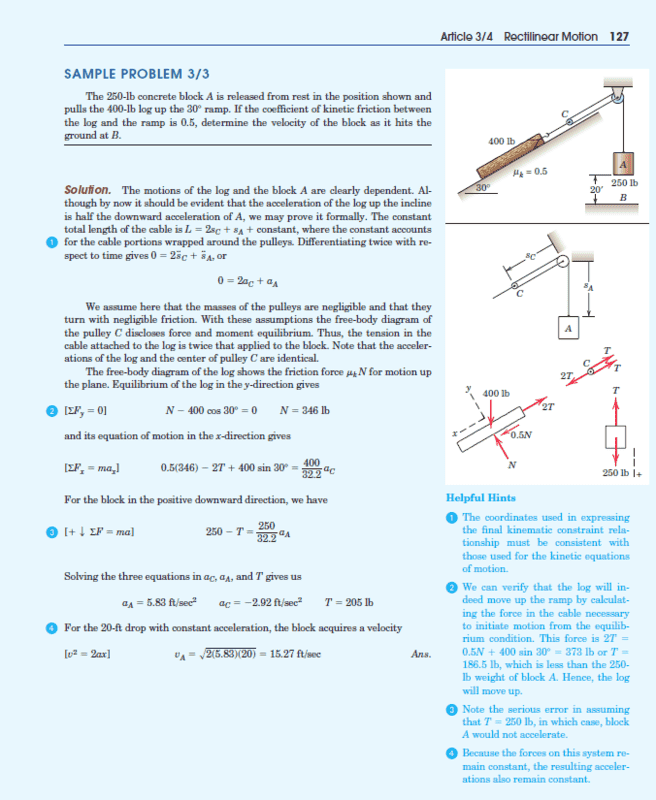
this is the question and solution given in the book
243379


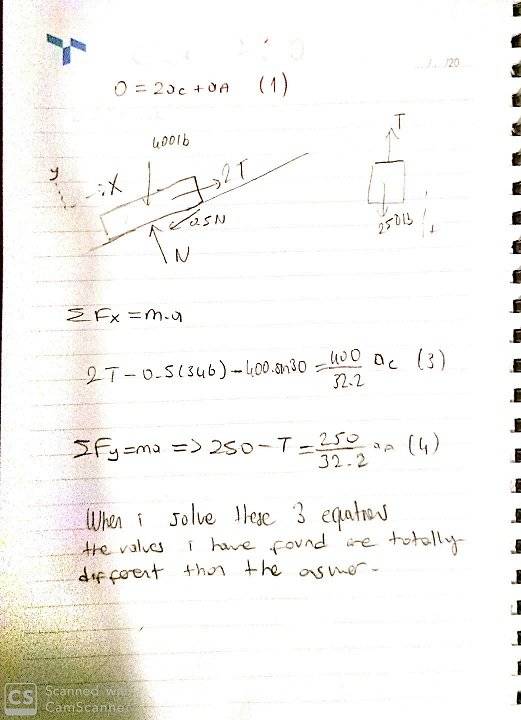
solution i made below. only difference is i took x as opposite side that given in the book and wrote F=ma equation that way. as a result the left side of equation (3) directly turned negative. that caused difference in result but why? i mean instinctly in these kind of questions i am tend to put positive axis towards sense of movement. can you please help me?
243382
 
Physics news on Phys.org
PeroK said:
You will need to show us what you did for us to see where you are going wrong.

I thought it was much easier to solve using energy and got the book answer.

i also post what have i done at the end of my post. i did not understand what else do you need? i know solution is much easier with the energy but i am trying to get concept.
 
PeroK said:
First, I can't read what you've written. Second, you say "when I solve these three equations I get a totally different answer". That could be for anyone of a hundred reasons.
here is clear version i have equation (1) (3) and (4) just as in the book.
243393
 
You need to change equation (1) if you have the accelerations both positive. The others look okay, although I'm not used to pounds and feet. Maybe equation (1) is your problem.

Just one observation. The book solution, I think, is not very good. It's very easy to mistype things when it's just a lot of numbers. But, if that's the way the book does things, who am I to argue?
 
  • Like
Likes   Reactions: TheDudeTR
PeroK said:
You need to change equation (1) if you have the accelerations both positive. The others look okay, although I'm not used to pounds and feet. Maybe equation (1) is your problem.

Just one observation. The book solution, I think, is not very good. It's very easy to mistype things when it's just a lot of numbers. But, if that's the way the book does things, who am I to argue?
yeah meriam dynamics is kinda hard to get actually. i didn't like it but at the beginning of semester prof advised this book so i bought it. personally i prefer beer for dynamics. thanks for the answer by the way.
 
Here's my energy solution, if you are interested:

Potential energy lost by falling block:

##PE_1 = mgh##

Potential energy gained by log:

##PE_2 = Mg(\frac{h}{2})\sin(30) = \frac{Mgh}{4}##

Friction force on log: ##F_F = \mu_k Mg \cos(30) = \frac{Mg\sqrt{3}}{4}##

Energy lost to friction:

##E_3 = F_F \frac{h}{2} = \frac{Mgh\sqrt{3}}{8}##

Total energy (kinetic) when block hits the ground is:

##KE = PE1 - PE_2 - E_3 = gh(m - M(\frac14 + \frac{\sqrt{3}}{8})) = \frac{gh}{8}(8m - M(2 + \sqrt{3}))##

Also,

##KE = \frac12 mv^2 + \frac12 M (\frac{v}{2})^2 = \frac18(4m + M)v^2##

Therefore:

##v^2 = gh(\frac{8m - M(2 + \sqrt{3})}{4m + M})##