Wint
- 4
- 0
[SOLVED] Block released from spring slides up a ramp
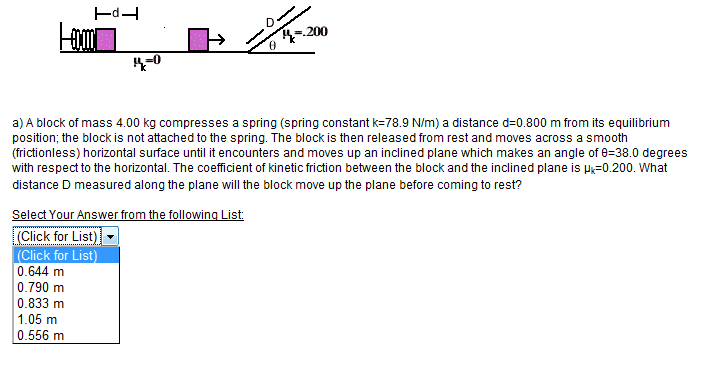
I'm thinking conservation of energy:
K1+U1+WOther=K2+U2
But really I'm not quite sure where to start here.
So far, I've calculated the velocity of the block after it leaves the spring, before it hits the ramp and I get that to be 3.553 m/s2. What is tripping me up here is the coefficient of friction, and how to apply that to the block as it travels up the ramp. If I turn the coordinate system so that the x-axis is parallel to the ramp, then we can figure the x component of the velocity to be 3.553*Cos(38) I believe, but I'm not sure if that is useful to me or not.
I think if I could get some confirmation on which direction to take with this that would be very helpful. Thanks!
Homework Statement
Homework Equations
I'm thinking conservation of energy:
K1+U1+WOther=K2+U2
But really I'm not quite sure where to start here.
The Attempt at a Solution
So far, I've calculated the velocity of the block after it leaves the spring, before it hits the ramp and I get that to be 3.553 m/s2. What is tripping me up here is the coefficient of friction, and how to apply that to the block as it travels up the ramp. If I turn the coordinate system so that the x-axis is parallel to the ramp, then we can figure the x component of the velocity to be 3.553*Cos(38) I believe, but I'm not sure if that is useful to me or not.
I think if I could get some confirmation on which direction to take with this that would be very helpful. Thanks!
Last edited: