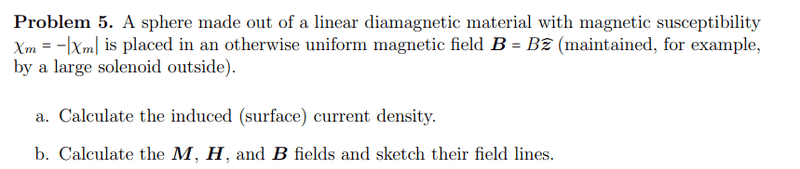
A diamagnetic sphere in a uniform magnetic field

Join the discussion
Ask a follow-up here, or get your own question answered by working scientists, mathematicians and engineers — people, not an autocomplete.
Real named experts · corrections over time · the nuance an AI answer skips
13 replies · 2K views
milkism
Messages
118
Reaction score
15
Homework Statement
a) Find the induced surface current density
b) Find the M, B and H-fields
Relevant Equations
See solution.
Problem:
c34309ccc41761c2e590be707866b514.png

Solution part a)
6d28d5d25bc62c3f53b3de748320335e.png

where formula 6.14 is just M x n.

We need to do part b without separation of variables, I'm quite stuck. Will B just be the magnetic field inside a solenoid? How can I find the other fields.
 
on Phys.org
See https://www.physicsforums.com/threa...f-homogeneous-dielectric.940015/#post-5943369

The solution is similar for the analogous magnetic problem. There are Legendre methods for solving this, but it can help to start with a simpler approach.

There is ## D=\epsilon _o E+P ## and ## B=\mu_o H+M ##. You need to watch the units on ## M ## though when transposing the two, because some books write it as ## B=\mu_o H +\mu_o M ##.
 
Reply
  • Like
Likes   Reactions: milkism
One additional input: You really need to compute the resulting magnetization ## M ## before you can do part "a" which is to compute the magnetic surface current density.

additional item: to compute the magnetic field ## B ## outside the sphere, the most practical way seems to be to use Legendre methods, although I think Griffith's in his E&M book presents an alternative way that also works. See https://www.physicsforums.com/threa...ormly-polarized-cylinder.941830/#post-5956930
The above is for a cylinder, but the method would also work for a sphere.
 
Last edited:
Reply
  • Care
Likes   Reactions: milkism
Charles Link said:
One additional input: You really need to compute the resulting magnetization ## M ## before you can do part "a" which is to compute the magnetic surface current density.

additional item: to compute the magnetic field ## B ## outside the sphere, the most practical way seems to be to use Legendre methods, although I think Griffith's in his E&M book presents an alternative way that also works. See https://www.physicsforums.com/threa...ormly-polarized-cylinder.941830/#post-5956930
The above is for a cylinder, but the method would also work for a sphere.
We need the external magnetic field to calculate the external H-field? The M-field outside is zero.
 
The ## E ## and ## H ## are corresponding fields when transposing the two. If you can follow how the ## E ## is calculated, you then convert it to ## H ## with ## \mu_o ## in place of ## \epsilon_o ##, and ## M ## in place of ## P ##.

and yes, for ## B_{outside} ##, the ## M_{outside}=0 ## so that ## B_{outside}=\mu_o H_{outside} ##.

One additional note: You might find this thread on magnetostatics to be good reading: https://www.physicsforums.com/threads/a-magnetostatics-problem-of-interest-2.971045/

and it pays to use units on ## M ## where ## B=\mu_o H+M ## in doing these problems with comparisons to the electric field, and convert afterwards, if your book uses an ## M' ## where ## B=\mu_o H+\mu_o M' ##.

See https://www.physicsforums.com/threa...iformly-polarized-sphere.877891/#post-5513730 post 7, to get ## E_{outside} ##. To this you need to add the applied field, but that part is simple. Once you have ## E_{outside} ## you can transpose to ## H_{outside} ##. (The uniform ## P ## (or ## M ##) that you get with an applied field should be a simple matter to compute, using the link of post 2 above with the demagnetizing factor ## D=1/3 ## for a sphere).
 
Last edited:
Charles Link said:
@milkism Did you get an answer for the ## M ## ?
Luckily we were allowed to use already calculated expressions for the internal- and external magnetic fields. This is what I got:
0d6a29e67c4f87316759acefefe40582.png

(The angular velocity is supposed to be bold, but I have dificulty bolding greek symbols. And "with our own given magnetic susceptibility" instead of out.).
 
I don't agree completely with your answer. Since this is really not an Introductory Physics problem, let me show you what I got for ## B_{inside} ## and ## H_{inside} ##, etc. The first part I don't agree with that ## B_{inside}=(2/3) M ## using units where ## B=\mu_o H+M ## and ## M=\mu_o \chi H=-\mu_o |\chi| H ##, because ## H_i=H_a-M/(3 \mu_o) ##, so the ## H_a ## complicates matters somewhat.

Let me show you how the ## H_i ## is obtained from ## H_a ##, where you really need a ## B_a ## with a subscript for the applied ## B ##, where ## B_a=\mu_o H_a ##.
## E_i=E_a-P/(3 \epsilon_o) ## using the demagnetizing factor ## D=1/3 ## for a sphere.
Now ##P= P_i=\epsilon_o \chi E_i ## so ## E_i=E_a/(1+\frac{\chi}{3}) ##, so that ## H_i=H_a/(1-\frac{|\chi|}{3}) ##, and ## M=-\mu_o |\chi| H_i=-|\chi|B_a/(1-\frac{|\chi|}{3}) ##, and ## B_i=\mu_o(1+\chi )H_i=B_a(1-|\chi|)/(1-\frac{|\chi|}{3}) ##.

Note: ## M=\mu_o \sigma R \omega ##, but not every formula works for that solution, because of the ## B_a ##.

Once we get agreement with the inside, then we'll take a closer look at the outside. Please let me know if you were able to follow the calculations.
 
Last edited:
Charles Link said:
I don't agree completely with your answer. Since this is really not an Introductory Physics problem, let me show you what I got for ## B_{inside} ## and ## H_{inside} ##, etc. The first part I don't agree with that ## B_{inside}=(2/3) M ## using units where ## B=\mu_o H+M ## and ## M=\mu_o \chi H=-\mu_o |\chi| H ##, because ## H_i=H_a-M/(3 \mu_o) ##, so the ## H_a ## complicates matters somewhat.

Let me show you how the ## H_i ## is obtained from ## H_a ##, where you really need a ## B_a ## with a subscript for the applied ## B ##, where ## B_a=\mu_o H_a ##.
## E_i=E_a-P/(3 \epsilon_o) ## using the demagnetizing factor ## D=1/3 ## for a sphere.
Now ##P= P_i=\epsilon_o \chi E_i ## so ## E_i=E_a/(1+\frac{\chi}{3}) ##, so that ## H_i=H_a/(1-\frac{|\chi|}{3}) ##, and ## M=-\mu_o |\chi| H_i=-|\chi|B_a/(1-\frac{|\chi|}{3}) ##, and ## B_i=\mu_o(1+\chi )H_i=B_a(1-|\chi|)/(1-\frac{|\chi|}{3}) ##.

Note: ## M=\mu_o \sigma R \omega ##, but not every formula works for that solution, because of the ## B_a ##.

Once we get agreement with the inside, then we'll take a closer look at the outside. Please let me know if you were able to follow the calculations.
Yes I was able to follow the calculations.
Would B_outside be $$-\frac{M_0 R^3}{3 \mu_0 r^2} \left( \cos(\theta) \mathbf{\hat{r}} + \frac{\sin(\theta)}{r}\mathbf{\hat{\theta}} \right)$$?
 
milkism said:
Would B_outside be
See the last link of post 5. It's post 7 of the "link". I would need to study this in detail=I don't have extra time at the moment, but don't forget to include ## B_a ## besides the contribution to ## B ## from the magnetization. For the magnetization, you of course need to use what I just computed in post 8.
 
and a follow-on: For the ## \hat{a}_r ## component, when you take the derivative of ## 1/r^2 ##, you get ##-2/r^3 ##, (using the gradient per the link I mentioned above). I'm not going to check all of the signs, but what you have looks almost correct, but both terms are with a ## 1/r^3 ##. Don't forget to include the original ## B_a ## though.
 
Last edited:
Charles Link said:
and a follow-on: For the ## \hat{a}_r ## component, when you take the derivative of ## 1/r^2 ##, you get ##-2/r^3 ##, (using the gradient per the link I mentioned above). I'm not going to check all of the signs, but what you have looks almost correct, but both terms are with a ## 1/r^3 ##. Don't forget to include the original ## B_a ## though.
True, also forgot to take the negative when doing the gradient it should be this ##\frac{M_0 R^3}{3 \mu_0 r^3} \left( 2\cos(\theta) \mathbf{\hat{r} + \sin(\theta)}\mathbf{\hat{\theta}} \right)##. So we have ##B_i = B_a - \frac{M}{3 \mu_0} ##
 
Last edited by a moderator:
Looks good for ## B_{outside} ##, but add ## B_a=B_o \hat{z} ##.

For ## B_i ##, what I have in post 8 is complete. (You don't need to add any ## B_a ## to that). The expression ## B_i=B_a-M/(3 \mu_o) ## is not correct though=we have ## H_i =H_a-M/(3 \mu_o) ##, but ## B_i=\mu_o H+M=\mu_o H_a-M/3+M=B_a+(2/3)M ##.
 
Last edited:
Reply
  • Care
Likes   Reactions: milkism
One additional item=I put the "link" in post 5 above, but I think this one is worth repeating=this "link" ties together the magnetic surface current method and the magnetic pole method with a simple example. You should find it good reading. See https://www.physicsforums.com/threads/a-magnetostatics-problem-of-interest-2.971045/
It should be noted that currents in conductors also contribute to ## H ## in the pole method, with a calculation using Biot-Savart divided by ## \mu_o ##. I may have mentioned this later in the thread, but I don't see it in the first couple of posts.
 
Reply
  • Care
Likes   Reactions: milkism