A Guide to the Best Beaches in California

  • Thread starter Thread starter Differentiate it
  • Start date Start date
  • Tags Tags
    california
Click For Summary

Homework Help Overview

The discussion revolves around the concepts of static friction and its relationship to forces acting on an object on a conveyor belt, particularly in the context of Newton's laws of motion.

Discussion Character

  • Conceptual clarification, Assumption checking

Approaches and Questions Raised

  • Participants explore the conditions under which static friction can be greater than the gravitational component acting along the belt. Questions arise regarding the understanding of Newton's third law and the implications of static friction being equal to the opposing force.

Discussion Status

Some participants express confusion about the nature of static friction and its maximum value, while others clarify the conditions under which static friction must exceed gravitational forces. There appears to be a productive exchange of ideas, with some participants acknowledging their misunderstandings.

Contextual Notes

There is mention of specific scenarios involving conveyor belts, including constant velocity and acceleration, which influence the static friction dynamics. Additionally, the discussion touches on the coefficients of friction for different material pairs.
Differentiate it
Messages
63
Reaction score
2
Homework Statement
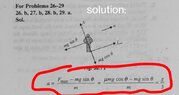
The book is stating that the force of static friction is greater than the force acting against it. I'm pretty sure the book the wrong. You can view the pictures for reference. Help would be appreciated!
Relevant Equations
W = ∆KE
Screenshot_2022-11-23-16-30-23-80_e2d5b3f32b79de1d45acd1fad96fbb0f.jpg
 

Attachments

  • 20221123_162907.jpg
    20221123_162907.jpg
    27.2 KB · Views: 127
Physics news on Phys.org
Differentiate it said:
Homework Statement:: The book is stating that the force of static friction is greater than the force acting against it. I'm pretty sure the book the wrong. You can view the pictures for reference. Help would be appreciated!
Relevant Equations:: W = ∆KE

View attachment 317589
Why would you think that the static friction cannot be larger than the component of gravity in the direction along the belt? Those do not form a third-law pair.
 
Orodruin said:
Why would you think that the static friction cannot be larger than the component of gravity in the direction along the belt? Those do not form a third-law pair.
Because static friction is equal to the force it is acting against (well, until the force becomes large enough).
 
Differentiate it said:
Because static friction is equal to the force it is acting against (well, until the force becomes large enough).
It seems to me you are misunderstanding Newton's third law.
 
Orodruin said:
It seems to me you are misunderstanding Newton's third law.
Could you explain where I am going wrong?
 
Differentiate it said:
Because static friction is equal to the force it is acting against (well, until the force becomes large enough).
If you were on a conveyor belt that moves at a constant velocity ( like conveyor belts typically move objects) then, if the object is not slipping the static friction must be equal/opposite the component of weight. However, if the conveyor belt is accelerating ( maybe on a startup ) and the object is being carried up without slipping, the static friction must be greater than the component of weight in the direction of motion.
 
erobz said:
If you were on a conveyor belt that moves at a constant velocity ( like conveyor belts typically move objects) then, if the object is not slipping the static friction must be equal/opposite the component of weight. However, if the conveyor belt is accelerating ( maybe on a startup ) and the object is being carried up without slipping, the static friction must be greater than the component of weight in the direction of motion.
Ah, yes I get it. Thank you
 
  • Like
Likes   Reactions: erobz
Differentiate it said:
Ah, yes I get it. Thank you
Is it possible that the confusion comes from seeing static friction quoted as a maximum ##f_s = \mu_s N ## where ## \mu_s < 1 ##?

If it is, I would say that confusion is justified. I don't have an explanation for what that applies too (but I too would like to hear it),
other than to just know that if the conditions of acceleration up the ramp are met without slipping, it MUST be the case that the static force is greater than the component of weight in the direction of motion.

EDIT: I went back in the intro physics text book. I don't actually see it quoted as that. There is a table of material - material coefficients of static and kinetic friction. All but one of material pairs listed ##\mu_s < 1 ##, But I see that "Rubber- Other Material" can range from ##1\leq \mu_s \leq 4 ##.

I think I was just selectively remembering that most pairs of common materials ##\mu_s < 1 ##.

This application would be "Rubber on Rubber" - which is probably (apparently expected to be) more than 1.
 
Last edited:
The confusion that I see in this thread is a common one. And apparently cleared up now.

The mistaken intuition is that forces are "transitive". For instance, if you push on a rod with a force of 100 N then intuition says that the rod must push on the next thing with an equal force of 100 N.

Similarly, if gravity is pulling backward on a fellow with a force of <whatever> then intuition says that the force of static friction on the fellow's shoes must be resisting exactly that amount of force.

Of course, this intuition is wrong, wrong, wrong. Newton's second law is the tool that tells you how hard the rod or the fellow's shoes will be pushing on the next thing.
 
  • #10
jbriggs444 said:
The confusion that I see in this thread is a common one. And apparently cleared up now.

The mistaken intuition is that forces are "transitive". For instance, if you push on a rod with a force of 100 N then intuition says that the rod must push on the next thing with an equal force of 100 N.

Similarly, if gravity is pulling backward on a fellow with a force of <whatever> then intuition says that the force of static friction on the fellow's shoes must be resisting exactly that amount of force.

Of course, this intuition is wrong, wrong, wrong. Newton's second law is the tool that tells you how hard the rod or the fellow's shoes will be pushing on the next thing.
Yes, I get it. Thanks to you and @erobz for the explanation
 

Similar threads

Replies
2
Views
2K
  • · Replies 3 ·
Replies
3
Views
3K
Replies
3
Views
3K
  • · Replies 125 ·
5
Replies
125
Views
7K
  • · Replies 54 ·
2
Replies
54
Views
10K
  • · Replies 5 ·
Replies
5
Views
2K
Replies
2
Views
2K
  • · Replies 2 ·
Replies
2
Views
2K
  • · Replies 5 ·
Replies
5
Views
3K
  • · Replies 4 ·
Replies
4
Views
2K