A kind of strange Underwater Air Bubble question

Click For Summary

Discussion Overview

The discussion centers around the behavior of air bubbles found in underwater caves, particularly how their size and pressure are affected by water depth. Participants explore theoretical implications and practical experiences related to pressure changes in different depths, including comparisons between 50 feet and 1000 feet underwater.

Discussion Character

  • Exploratory
  • Technical explanation
  • Conceptual clarification
  • Debate/contested
  • Experimental/applied

Main Points Raised

  • Some participants suggest that the air pressure in a bubble at 50 feet underwater is greater than at sea level due to the addition of water pressure.
  • It is proposed that at greater depths, such as 1000 feet, the bubble would be significantly smaller due to the increased water pressure, potentially compressing the air within it.
  • One participant notes that gases can dissolve in water, which may affect the size and longevity of the bubble, especially at high pressures.
  • Another participant mentions that a bubble released from depth would increase in volume as it rises, although it may break into smaller bubbles due to the pressure changes.
  • There is a discussion about the implications for SCUBA diving, where air consumption is affected by depth due to pressure differences.
  • One participant shares a personal experience of feeling air pressure changes while diving, indicating the practical effects of pressure on air bubbles.

Areas of Agreement / Disagreement

Participants express various viewpoints on how depth affects air bubbles, with some agreeing on the principles of pressure changes while others raise different implications and experiences. The discussion remains unresolved regarding the exact behavior of bubbles at extreme depths.

Contextual Notes

Limitations include assumptions about gas behavior under pressure, the effects of gas solubility in water, and the specific conditions of the underwater environment that may not be fully explored.

Who May Find This Useful

This discussion may be of interest to those studying fluid dynamics, underwater physics, SCUBA diving practices, or anyone curious about the behavior of gases under pressure in aquatic environments.

CS_SJ
Messages
5
Reaction score
1
Hello,

Something I’ve wondered about is those amazing air bubbles that are sometimes found in underwater caves. In particular, I was wondering how the depth of the water does or does not affects them.

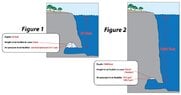
In my Figure 1 example, the water is 50 feet deep and air bubble in the cave has 3 feet of air from the top of the cave to the water, and the air pressure in the bubble is the same as sea level.

Well, what would happen if the same cave was 1000 feet deep? (see Figure 2.) Would the bubble still have 3 feet of air from the top of cave to the water? Or would the tremendous weight of the water make the bubble much smaller like just 3 inches tall or something? And what about the air pressure? Would the air be super compressed?

If this is the wrong place to ask this question, I apologize in advance, and if you could direct me where I could get an answer for this, I would appreciate it.

Thank you,

- SJ
 

Attachments
  • question-file.jpg
    question-file.jpg
    25.5 KB · Views: 171
Physics news on Phys.org
Hello @CS_SJ ,
:welcome: ##\qquad## !
There is a law of communicating vessels having to do with static fluid pressure. At 50 feet below sea level (the bottom arrow in the left picture) the pressure is sea level pressure + ##\rho g h \ \approx ## 2.5 times sea level pressure (100000 + 1000 * 10 * 15). Going horizontally to the left the pressure is the same, so NOT 14.7 "psi" but two and a half times as much.

With 300 m depth the same calculation gives about 31 times atmospheric pressure :woot: !

##\ ##
 
  • Like
Likes   Reactions: BillTre
The air pressure in a bubble 50 feet down below the water's surface will be greater than air pressure at sea level. If it weren't, the water pressure would push in the bubble surface (making a smaller volume) until the pressures are equal.
The water pressure at that depth will add to the surface air pressure to give you the pressure in the bubble at depth.

At greater depth, the bubble would be reduced in size, proportional to the amount of pressure the water is putting on the bubble.
The bubble size will be reduced until the air pressure in the bubble equals the water pressure.

However, gasses can dissolve in water. This can change the size of the bubble. Some gasses (CO2) dissolve in water quite readily. This could affect how much bubble is left, and for how long, in some of these conditions.
It might be that, at really high pressures (which 1,000 feet of water seems like to me), the gas may just very quickly dissolve (or be forced) into the water.

For similar reasons, this is why, when SCUBA diving, your air lasts longer closer to the surface. Less pressure, fewer air molecules per breath (per volume).

Here's another example: a bubble released at some great depth, will increase in volume as it raises in the water column. It might not be easy to see this, because big bubble raising in a column water to tends to break up into many smaller bubbles.
However, if you invert a calibrated cylinder, trapping some air in it, and move it down deeper into the water column, the volume of air in the cylinder will decrease as the water pressure goes up. You could easily measure that.
 
  • Informative
  • Like
Likes   Reactions: collinsmark, Klystron and BvU
CS_SJ said:
Well, what would happen if the same cave was 1000 feet deep? (see Figure 2.) Would the bubble still have 3 feet of air from the top of cave to the water? Or would the tremendous weight of the water make the bubble much smaller like just 3 inches tall or something? And what about the air pressure? Would the air be super compressed?
That air bubble at 1000 feet will be at 30 atmospheres. If you captured a bit of it in a bag and brought it to the surface, it would expand by thirty times.

Yes, you could swim into that cave and breathe that air, but it still acts like the compressed in your tank. You must observe proper ascent techniques to avoid the bends or worse.
 
Thank you for your reply!
 
BvU said:
Hello @CS_SJ ,
:welcome: ##\qquad## !
There is a law of communicating vessels having to do with static fluid pressure. At 50 feet below sea level (the bottom arrow in the left picture) the pressure is sea level pressure + ##\rho g h \ \approx ## 2.5 times sea level pressure (100000 + 1000 * 10 * 15). Going horizontally to the left the pressure is the same, so NOT 14.7 "psi" but two and a half times as much.

With 300 m depth the same calculation gives about 31 times atmospheric pressure :woot: !

##\ ##
Thank you!
 
Been there, done that while diving. When the waves (longer period ocean swells) pass over head you can easily feel the air pressure change in your ears. Water is quite heavy compared to air. In one cave you could see fog form in the air pocket whenever the pressure dropped.
 
  • Like
Likes   Reactions: BillTre

Similar threads

  • · Replies 2 ·
Replies
2
Views
2K
  • · Replies 11 ·
Replies
11
Views
3K
Replies
14
Views
4K
  • · Replies 3 ·
Replies
3
Views
2K
Replies
4
Views
2K
  • · Replies 13 ·
Replies
13
Views
7K
  • · Replies 5 ·
Replies
5
Views
2K
  • · Replies 16 ·
Replies
16
Views
6K
Replies
9
Views
5K
  • · Replies 9 ·
Replies
9
Views
4K
