A problem about non-separable Hilbert space

Click For Summary
SUMMARY

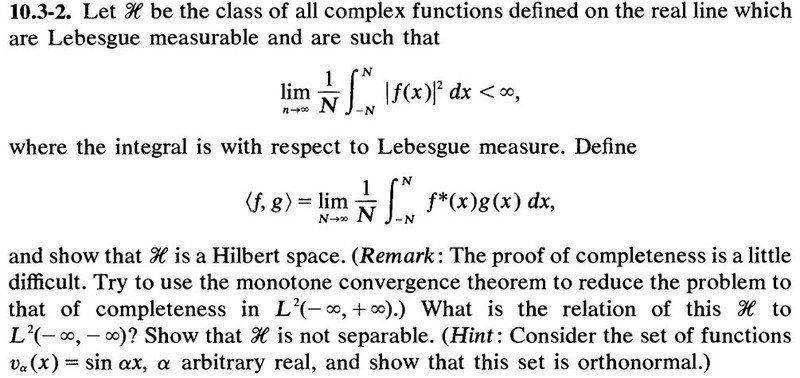
The discussion centers on the properties of non-separable Hilbert spaces, specifically addressing the completeness of such spaces. It establishes that a space is complete if every absolutely convergent series converges, using a sequence in a pre-Hilbert space denoted as ##H##. The proof involves demonstrating that the limit of a series converges to a function in ##L^2##, utilizing the monotone convergence theorem and the concept of limits superior (limsup) to handle potential issues with exchanging limits and series. Key insights include the necessity of using limsup in certain steps to ensure valid conclusions about convergence.

PREREQUISITES
  • Understanding of Hilbert spaces and their properties
  • Familiarity with the concept of completeness in metric spaces
  • Knowledge of the monotone convergence theorem
  • Basic understanding of limits and series in functional analysis
NEXT STEPS
  • Study the properties of non-separable Hilbert spaces in detail
  • Learn about the application of Fatou's lemma in functional analysis
  • Explore the implications of completeness in various types of spaces
  • Investigate the differences between limits and limits superior in convergence proofs
USEFUL FOR

Mathematicians, particularly those specializing in functional analysis, graduate students studying advanced mathematical concepts, and researchers exploring the properties of Hilbert spaces.

prophetlmn
Messages
18
Reaction score
0
also see
http://planetmath.org/exampleofnonseparablehilbertspace
QQ??20130704175847.jpg


the main difficulty is about the completeness, which is hard to prove, the author's hint seems don't work here, for you can not use the monotone convergence theorem directly , f(x)χ[-N,N]/sqrt[N] is not monotone
 
Physics news on Phys.org
Let your pre-Hilbert space be ##H## with norm ##\|~\|##. It is known that a space is is complete iff every absolute convergent series is convergent.
Thus let ##(f_n)_n## be a sequence in ##H## such that ##\sum_n \|f_n\|## converges (to a number ##A##). Thus by monotone convergence:

\lim_{N\rightarrow +\infty} \frac{1}{\sqrt{N}}\sum_n \|f_n \chi_{[-N,N]}\|_2 = A

Thus for each ##N##, we have that the series ##\sum_n \|f_n\chi_{[-N,N]}\|_2## converges. Since ##L^2## is complete, we have that ##\sum_n f_n\chi_{[-N,N]} = g_N## for some ##g_N\in L^2##.

Now, if ##M>N##, then ##g_N\chi_{[-N,N]} = g_M\chi_{[-N,N]}##. Thus we can glue the ##g_N## to a big function ##g##. Now

\begin{eqnarray*}
\|g - \sum_{n=1}^m f_n\|
& = & \lim_{N\rightarrow +\infty} \frac{1}{\sqrt{N}}\left\| g\chi_{[-N,N}] - \sum_{n=1}^m f_n\chi_{[-N,N]}\right\|_2\\
& = & \lim_{N\rightarrow +\infty} \frac{1}{\sqrt{N}}\left\| \sum_{n=m}^{+\infty} f_n\chi_{[-N,N]}\right\|_2\\
&\leq & \limsup_{N\rightarrow +\infty} \frac{1}{\sqrt{N}} \sum_{n=m}^{+\infty} \|f_n\chi_{[-N,N]}\|_2 \\
&\leq & \sum_{n=m}^{+\infty} \|f_n\|\\
& \rightarrow & 0
\end{eqnarray*}[/tex]
 
micromass said:
Let your pre-Hilbert space be ##H## with norm ##\|~\|##. It is known that a space is is complete iff every absolute convergent series is convergent.
Thus let ##(f_n)_n## be a sequence in ##H## such that ##\sum_n \|f_n\|## converges (to a number ##A##). Thus by monotone convergence:

\lim_{N\rightarrow +\infty} \frac{1}{\sqrt{N}}\sum_n \|f_n \chi_{[-N,N]}\|_2 = A

Thus for each ##N##, we have that the series ##\sum_n \|f_n\chi_{[-N,N]}\|_2## converges. Since ##L^2## is complete, we have that ##\sum_n f_n\chi_{[-N,N]} = g_N## for some ##g_N\in L^2##.

Now, if ##M>N##, then ##g_N\chi_{[-N,N]} = g_M\chi_{[-N,N]}##. Thus we can glue the ##g_N## to a big function ##g##. Now

\begin{eqnarray*}
\|g - \sum_{n=1}^m f_n\|
& = & \lim_{N\rightarrow +\infty} \frac{1}{\sqrt{N}}\left\| g\chi_{[-N,N}] - \sum_{n=1}^m f_n\chi_{[-N,N]}\right\|_2\\
& = & \lim_{N\rightarrow +\infty} \frac{1}{\sqrt{N}}\left\| \sum_{n=m}^{+\infty} f_n\chi_{[-N,N]}\right\|_2\\
&\leq & \limsup_{N\rightarrow +\infty} \frac{1}{\sqrt{N}} \sum_{n=m}^{+\infty} \|f_n\chi_{[-N,N]}\|_2 \\
&\leq & \sum_{n=m}^{+\infty} \|f_n\|\\
& \rightarrow & 0
\end{eqnarray*}[/tex]

thanks for your help,the proof is very clear,the key point is 'a space is is complete iff every absolute convergent series is convergent',I don't know this before, it's again the old truth 'take a different approach'
 
I still have two little problems
(1)what do you mean by 'Thus by monotone convergence',I mean don't you just use the definition of
##\sum_n \|f_n\|##

(2)why you use limsub in the last three steps
\begin{eqnarray*}
\lim_{N\rightarrow +\infty} \frac{1}{\sqrt{N}}\left\| \sum_{n=m}^{+\infty} f_n\chi_{[-N,N]}\right\|_2\\
&\leq & \limsup_{N\rightarrow +\infty} \frac{1}{\sqrt{N}} \sum_{n=m}^{+\infty} \|f_n\chi_{[-N,N]}\|_2 \\
&\leq & \sum_{n=m}^{+\infty} \|f_n\|\\
\end{eqnarray*}

what's wrong with
\begin{eqnarray*}
\lim_{N\rightarrow +\infty} \frac{1}{\sqrt{N}}\left\| \sum_{n=m}^{+\infty} f_n\chi_{[-N,N]}\right\|_2\\
&\leq & \lim_{N\rightarrow +\infty} \frac{1}{\sqrt{N}} \sum_{n=m}^{+\infty} \|f_n\chi_{[-N,N]}\|_2 \\
&= & \sum_{n=m}^{+\infty} \|f_n\|\\
\end{eqnarray*}
 
Last edited:
prophetlmn said:
I still have two little problems
(1)what do you mean by 'Thus by monotone convergence',I mean don't you just use the definition of
##\sum_n \|f_n\|##

You exchange a series and a limit. This is not always allowed.

(2)why you use limsub in the last three steps
\begin{eqnarray*}
\lim_{N\rightarrow +\infty} \frac{1}{\sqrt{N}}\left\| \sum_{n=m}^{+\infty} f_n\chi_{[-N,N]}\right\|_2\\
&\leq & \limsup_{N\rightarrow +\infty} \frac{1}{\sqrt{N}} \sum_{n=m}^{+\infty} \|f_n\chi_{[-N,N]}\|_2 \\
&\leq & \sum_{n=m}^{+\infty} \|f_n\|\\
\end{eqnarray*}

Because if ##x_n\leq y_n##, then this does not imply ##\lim_n x_n\leq \lim_n y_n##. This is only true if the limits exist. To solve this, we use limsup.
 
micromass said:
You exchange a series and a limit. This is not always allowed.


Because if ##x_n\leq y_n##, then this does not imply ##\lim_n x_n\leq \lim_n y_n##. This is only true if the limits exist. To solve this, we use limsup.

so you mean here we should use something like Fatou's lemma?
 
prophetlmn said:
so you mean here we should use something like Fatou's lemma?

Yes.
 
micromass said:
Yes.
So we have
\begin{eqnarray*}
\lim_{N\rightarrow +\infty} \frac{1}{\sqrt{N}}\sum_n \|f_n \chi_{[-N,N]}\|_2\\
&\leq & \sum_n\lim_{N\rightarrow +\infty} \frac{1}{\sqrt{N}} \|f_n \chi_{[-N,N]}\|_2\\
\end{eqnarray*}
?
if so how to prove it?i.e. how you get the following

\begin{eqnarray*}
\limsup_{N\rightarrow +\infty} \frac{1}{\sqrt{N}} \sum_{n=m}^{+\infty} \|f_n\chi_{[-N,N]}\|_2 \\
&\leq & \sum_{n=m}^{+\infty} \|f_n\|\\
\end{eqnarray*}

and I think when you say'You exchange a series and a limit. This is not always allowed' you mean an exchange like this kind?i.e how you get
\lim_{N\rightarrow +\infty} \frac{1}{\sqrt{N}}\sum_n \|f_n \chi_{[-N,N]}\|_2 = A
 
Last edited:

Similar threads

  • · Replies 2 ·
Replies
2
Views
874
  • · Replies 2 ·
Replies
2
Views
2K
  • · Replies 11 ·
Replies
11
Views
5K
  • · Replies 13 ·
Replies
13
Views
3K
  • · Replies 43 ·
2
Replies
43
Views
4K
  • · Replies 59 ·
2
Replies
59
Views
7K
  • · Replies 30 ·
2
Replies
30
Views
3K
  • · Replies 2 ·
Replies
2
Views
3K
  • · Replies 1 ·
Replies
1
Views
838
Replies
7
Views
4K