SUMMARY
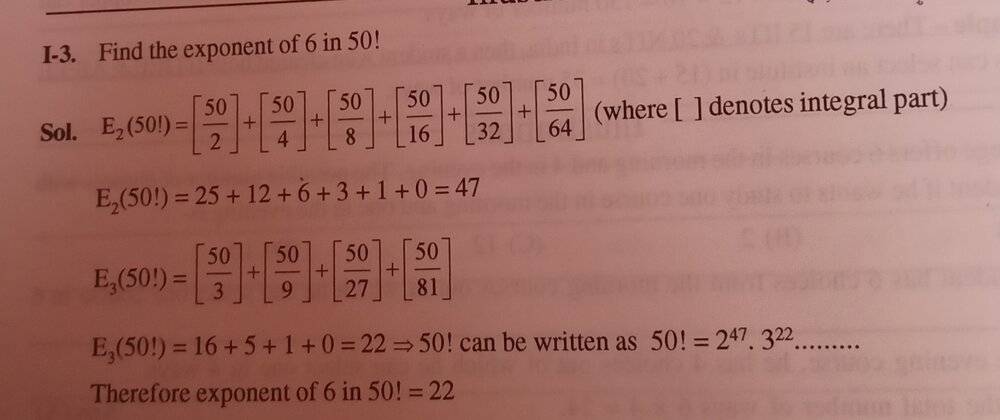
This discussion focuses on solving combinatorial problems by breaking them down into smaller examples, specifically using factorials. The participants analyze the factors of 10! and how to count the factors of primes like 2, 3, 5, and 7. The method of dividing numbers by powers of primes is emphasized as a clear approach to understanding larger problems. The conclusion is that simplifying complex problems into manageable parts enhances comprehension and verification of solutions.
PREREQUISITES
- Understanding of factorial notation (e.g., 10!)
- Basic knowledge of prime factorization
- Familiarity with combinatorial mathematics
- Ability to perform arithmetic operations with powers
NEXT STEPS
- Study the concept of prime factorization in depth
- Learn about the properties and applications of factorials in combinatorics
- Explore the method of counting factors in factorials for larger numbers
- Investigate combinatorial problem-solving techniques using smaller examples
USEFUL FOR
Mathematicians, students studying combinatorics, educators teaching factorial concepts, and anyone interested in enhancing their problem-solving skills in mathematics.