A question regarding Heliocentric Latitude

  • Context: High School 
  • Thread starter Thread starter Mikael17
  • Start date Start date
Join the discussion
Ask a follow-up here, or get your own question answered by working scientists, mathematicians and engineers — people, not an autocomplete.
Real named experts · corrections over time · the nuance an AI answer skips
1 reply · 2K views
Mikael17
Messages
43
Reaction score
5
TL;DR
Are lower / higher points of Heliocentric Latitude always taking place same time ervery year.?
By following the link below you can see (an animation) showing how the planets that orbiting the Sun each year have their lowest / highest position (relative to the Sun's equator).

The lowest point of the Earth is seen every year in the month of September, (and the highest position of the Earth occurs in March).

My question is whether these "points" over time are immovably fixed, or whether they "move" / "rotate" - in the same way that perihelion also moves (for example Mercury's perihelion precession).

If these "points" move over time, what is the reason and how much do they move?
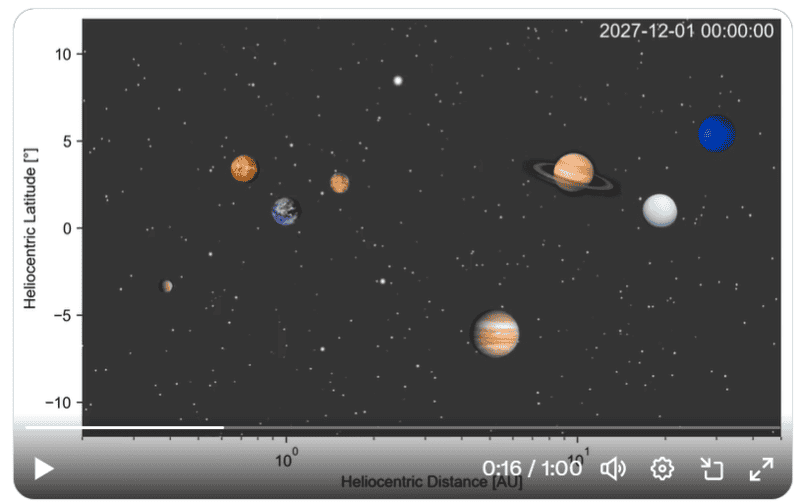


1712483306396.png
 
Astronomy news on Phys.org
Mikael17 said:
The lowest point of the Earth is seen every year in the month of September, (and the highest position of the Earth occurs in March).

My question is whether these "points" over time are immovably fixed, or whether they "move" / "rotate" - in the same way that perihelion also moves (for example Mercury's perihelion precession).

If these "points" move over time, what is the reason and how much do they move?
The plane of each orbit is close to the ecliptic. The latitudinal movement modelled in the graphics is a function of the planet's movement on those tilted orbital planes.

The axis of planet rotation is independent of the planet's orbital plane about the Sun. For that reason, the timing of the two effects will be asynchronous.

The periods are not so much determined, as they are described by polynomials having hundreds of complex coefficients.

The year is different for each planet. Apsidal precession is the rotation of the long axis of the orbit in the planet's orbital plane.
https://en.wikipedia.org/wiki/Apsidal_precession
Cause: "The apsidal precessions of the Earth and other planets are the result of a plethora of phenomena, of which a part remained difficult to account for until the 20th century when the last unidentified part of Mercury's precession was precisely explained. "