A very simple moments question

  • Thread starter Thread starter physicals
  • Start date Start date
  • #31
physicals said:
Now that we have come to the end of the discussion, Im not sure how you end a tread, do you just stop replying, or do you click something to end it?
Just stop replying if you so desire. You cannot "click something to end it" because others may wish to continue the discussion with or without you. Only the gods, a.k.a. mentors, can close threads.
 
Physics news on Phys.org
  • #32
kuruman said:
I am not sure what the system "as a whole is."
I am not sure either what @Lnewqban means by that, but it sounds like both bars + attached weight.

kuruman said:
I have considered two separate systems
But in either case Fy was the force by the wall on the horizontal bar only.
 
  • #33
A.T. said:
I am not sure either what @Lnewqban means by that, but it sounds like both bars + attached weight.


But in either case Fy was the force by the wall on the horizontal bar only.
Yes, of course. The horizontal bar doesn't give a hoot about what we choose as "the system" as long as the "gallows" configuration remains unchanged. If the diagonal piece just touched the wall without being fastened and the contact were frictionless, then ##F_y## would be equal to the hanging weight.
 
  • #34
kuruman said:
To answer part (b) we choose our system to be the horizontal bar only.
Is the net couple zero in this system? The couple produced by the two forces in the x-direction is zero. However, it seems that the three forces in the y-direction do not cancel to give a zero couple.
 
  • #35
anuttarasammyak said:
Is the net couple zero in this system? The couple produced by the two forces in the x-direction is zero. However, it seems that the three forces in the y-direction do not cancel to give a zero couple.
Seems like you are asking the same question as @physicals,
physicals said:
... there would clearly be a net clockwise moment so the system wont be in equilibrium. Am i correct or am i missing something?
which has been answered:
A.T. said:
The arrow in the diagram just indicates the positive direction for a force component (sign convention), not the actual force direction, which is often unknown when the diagram is drawn. Since the magnitude derived for Fy is negative for L1 < L2, Fy is indeed opposite to its arrow direction for the geometry shown in the diagram.
 
  • #36
I mean couple not moment. Thanks to #6 in usual case
1773152268897.webp

Blue forces couple and red forces couple cancel. My #16 confirms it. In the calculation of forces for horizontal bar system shown, I do not find such couple cancellation. This net zero couple seems the point of the exam in OP.
 
Last edited:
  • #37
anuttarasammyak said:
I mean couple not moment.
Why does it have to be a couple? All that matters is that the net moment is zero, even if it is a triple.
 
  • #38
A.T. said:
Why does it have to be a couple? All that matters is that the net moment is zero, even if it is a triple.
Moments_4.webp
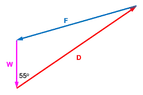
Having the net force equal to zero also matters, of course. The forces acting on the horizontal bar arise from three external entities, the vertical piece (or wall), the diagonal piece and the Earth. There can be no couple because with three forces, there is always an odd one out.

However, if we are allowed to move their point of application, the forces can be arranged to form a closed triangle because their vector sum is zero. The diagram on the right is the geometric solution to this question drawn to scale.
 

Similar threads

  • · Replies 12 ·
Replies
12
Views
2K
  • · Replies 7 ·
Replies
7
Views
1K
  • · Replies 7 ·
Replies
7
Views
2K
Replies
11
Views
2K
  • · Replies 8 ·
Replies
8
Views
3K
  • · Replies 2 ·
Replies
2
Views
2K
  • · Replies 2 ·
Replies
2
Views
1K
  • · Replies 1 ·
Replies
1
Views
5K
  • · Replies 21 ·
Replies
21
Views
5K
  • · Replies 15 ·
Replies
15
Views
4K