A very simple moments question

  • Thread starter Thread starter physicals
  • Start date Start date
  • #31
physicals said:
Now that we have come to the end of the discussion, Im not sure how you end a tread, do you just stop replying, or do you click something to end it?
Just stop replying if you so desire. You cannot "click something to end it" because others may wish to continue the discussion with or without you. Only the gods, a.k.a. mentors, can close threads.
 
Physics news on Phys.org
  • #32
kuruman said:
I am not sure what the system "as a whole is."
I am not sure either what @Lnewqban means by that, but it sounds like both bars + attached weight.

kuruman said:
I have considered two separate systems
But in either case Fy was the force by the wall on the horizontal bar only.
 
  • #33
A.T. said:
I am not sure either what @Lnewqban means by that, but it sounds like both bars + attached weight.


But in either case Fy was the force by the wall on the horizontal bar only.
Yes, of course. The horizontal bar doesn't give a hoot about what we choose as "the system" as long as the "gallows" configuration remains unchanged. If the diagonal piece just touched the wall without being fastened and the contact were frictionless, then ##F_y## would be equal to the hanging weight.
 
  • #34
kuruman said:
To answer part (b) we choose our system to be the horizontal bar only.
Is the net couple zero in this system? The couple produced by the two forces in the x-direction is zero. However, it seems that the three forces in the y-direction do not cancel to give a zero couple.
 
  • #35
anuttarasammyak said:
Is the net couple zero in this system? The couple produced by the two forces in the x-direction is zero. However, it seems that the three forces in the y-direction do not cancel to give a zero couple.
Seems like you are asking the same question as @physicals,
physicals said:
... there would clearly be a net clockwise moment so the system wont be in equilibrium. Am i correct or am i missing something?
which has been answered:
A.T. said:
The arrow in the diagram just indicates the positive direction for a force component (sign convention), not the actual force direction, which is often unknown when the diagram is drawn. Since the magnitude derived for Fy is negative for L1 < L2, Fy is indeed opposite to its arrow direction for the geometry shown in the diagram.
 
  • #36
I mean couple not moment. Thanks to #6 in usual case
1773152268897.webp

Blue forces couple and red forces couple cancel. My #16 confirms it. In the calculation of forces for horizontal bar system shown, I do not find such couple cancellation. This net zero couple seems the point of the exam in OP.
 
Last edited:
  • #37
anuttarasammyak said:
I mean couple not moment.
Why does it have to be a couple? All that matters is that the net moment is zero, even if it is a triple.
 
  • #38
A.T. said:
Why does it have to be a couple? All that matters is that the net moment is zero, even if it is a triple.
Moments_4.webp
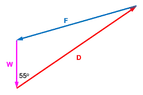
Having the net force equal to zero also matters, of course. The forces acting on the horizontal bar arise from three external entities, the vertical piece (or wall), the diagonal piece and the Earth. There can be no couple because with three forces, there is always an odd one out.

However, if we are allowed to move their point of application, the forces can be arranged to form a closed triangle because their vector sum is zero. The diagram on the right is the geometric solution to this question drawn to scale.
 
  • #39
1773178859677.webp|D|,|F| > |W|. The weight gravity generates larger y force. F is downward, however 1773179826189.webpred force on screw is upward.”Only horizontal bar” model has something different from the original model. If D is parallel transport of the force the diagonal bar get from the wall, such a transport breaks the couple cancellation achieved in the original model.
 
Last edited:
  • #40
anuttarasammyak said:
View attachment 370092|D|,|F| > |W|. The weight gravity generates larger y force. F is downward, however View attachment 370094red force on screw is upward.”Only horizontal bar” model has something different from the original model. If D is parallel transport of the force the diagonal bar get from the wall, such a transport breaks the couple cancellation achieved in the original model.

This

Screen Shot 2026-03-10 at 6.11.33 PM.webp

is not the same as this which is the figure found in the original post.
Screen Shot 2026-03-10 at 6.12.43 PM.webp

The answers using the free body diagram and the equations in post #13 are
1773184853494.webp
 
  • #41
kuruman said:
is not the same as this which is the figure found in the original post.
No, not the same in a exact sense. My post #16 based on your figure deals it.

Your case can be interpreted that we pull the horizontal bar tilt upward by the rope tagged in a mid point with greater force than gravity force W.

Are the both two models (with or without diagonal bar) to explain the OP case ?
 
Last edited:
  • #42
anuttarasammyak said:
Your case can be interpreted that we pull the horizontal bar tilt upward by the rope tagged in a mid point with greater force than gravity W.
It seems you missed what post #13 shows.

I chose as system the horizontal bar only.

The physical situation says that the items exerting external forces on this system are
  1. The wall at the point of contact which could be a screw.
  2. The diagonal piece pushing from underneath up and to the right at an angle of 55o.
  3. The flower pot (assuming a massless horizontal bar) exerting its weight down at the point where the string is attached to the bar.
These external forces are represented as arrows in my post #13 diagram with force ##\mathbf F## resolved into its components.

Your drawing shows no diagonal piece and no diagonal force up and to the right. You can choose as system anything you like. However, if you remove an item from your system, and consider a reduced system, you must replace the item you removed with the force that it exerts on this reduced system. If you don't do this replacement, you have a different physical situation.
 
  • #43
kuruman said:
The diagonal piece pushing from underneath up and to the right at an angle of 55o.
The blue length is important. The angle itself does not matter. Alternative orange rods are OK.
1773201387242.webp

The diagonal rod tansmit not only force along it but also shearing force to the horizontal rod connected to it. In the original model it is an inner force of the rigid body which should be cancelled by another inner force so we do not have to go into the detail. We can concentrate on external forces.
 
Last edited:
  • #44
anuttarasammyak said:
No, not the same in a exact sense.
Then maybe you should not refer to the model proposed in post #6 by @Lnewqban as the 'original model', because this can create confusion with the 'original post' (OP).

anuttarasammyak said:
Are the both two models (with or without diagonal bar) to explain the OP case ?
As far I can see, the two models interpret the OP differently, but should give the same result for Fx (called F in the OP).

- The model by @Lnewqban assumes sliding contact with the wall at point P and torque transmitting joints.

- The model by @kuruman assumes a torque free hinge connection to the wall at point P and at the other joints.

anuttarasammyak said:
The diagonal rod tansmit not only force along it but also shearing force
If the diagonal rod has torque free hinges at both ends (as assumed by @kuruman) it doesn't transmit a shear force (perpendicular to itself), just an axial force (along itself).
 
Last edited:
  • #45
A.T. said:
As far I can see, the two models interpret the OP differently, but should give the same result for Fx (called F in the OP).
My answer #16 which is same as the exam answer has sec, however post #13 answer has tan as coefficient to $$W\frac{L_2}{L_1}$$.
 
Last edited:
  • #46
anuttarasammyak said:
My answer #16 which is same as the exam answer has sec, however post #13 answer has tan as coefficient to $$W\frac{L_2}{L_1}$$
Your equation ##~L_2w=hF_x~## in #16 gives $$F_x=\frac{L_2}{h}W.$$ If you cast it in terms of the given quantities, namely ##L_1## (0.16 m) and ##\theta## (55o), you would substitute ##~h=\dfrac{L_1}{\tan\theta}~## to get $$F_x=W\left(\dfrac{L_2}{L_1}\right)\tan\theta.$$That is exactly my expression in post #13. :rolleyes:
 
Last edited:
  • Like
Likes   Reactions: A.T. and anuttarasammyak
  • #47
My bad! So we have same F.
 
  • Agree
Likes   Reactions: kuruman

Similar threads

  • · Replies 12 ·
Replies
12
Views
2K
  • · Replies 7 ·
Replies
7
Views
1K
  • · Replies 7 ·
Replies
7
Views
2K
Replies
11
Views
2K
  • · Replies 8 ·
Replies
8
Views
3K
  • · Replies 2 ·
Replies
2
Views
2K
  • · Replies 2 ·
Replies
2
Views
1K
  • · Replies 1 ·
Replies
1
Views
5K
  • · Replies 21 ·
Replies
21
Views
5K
  • · Replies 15 ·
Replies
15
Views
4K