SUMMARY
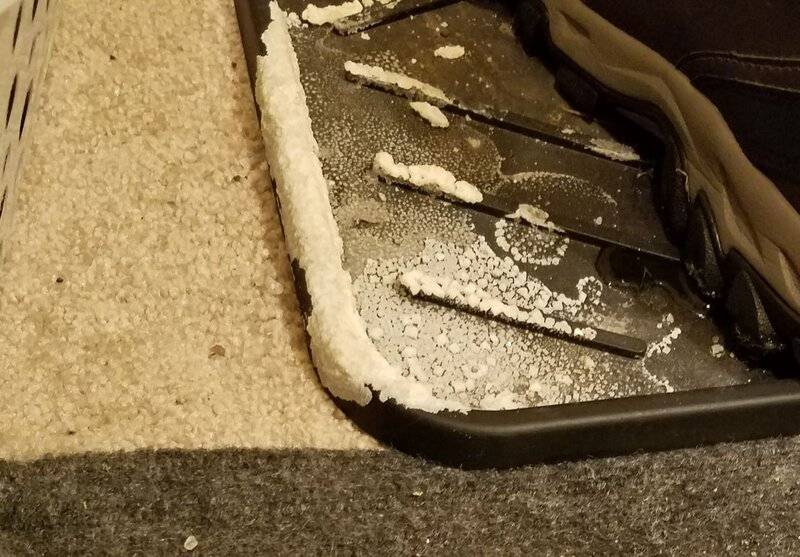
The phenomenon of salt appearing to "climb" out of a tray where boots are stored can be attributed to several factors, including temperature gradients, air movement, and the hydrophobic or hydrophilic properties of the tray's surface. The crystallization of salt can create a wicking effect, which, combined with the specific placement of the tray near heat sources, contributes to this unusual behavior. Understanding these interactions is essential for explaining the observed salt migration.
PREREQUISITES
- Understanding of thermodynamics related to temperature gradients
- Knowledge of material properties, specifically hydrophobicity and hydrophilicity
- Familiarity with crystallization processes of salts
- Basic principles of fluid dynamics and air movement
NEXT STEPS
- Research the effects of temperature gradients on crystallization processes
- Explore the properties of hydrophobic and hydrophilic materials
- Investigate the principles of wicking in solid materials
- Study the impact of air movement on evaporation and drying rates
USEFUL FOR
Individuals interested in material science, environmental scientists, and anyone studying the physical properties of salts and their interactions with different surfaces.