About changes in a magnetic field

Click For Summary
SUMMARY

This discussion focuses on applying Faraday's Law to determine the rate of change of the magnetic field (B) in a rectangular loop. Participants highlight the importance of calculating the electromotive force (EMF) around the loop using the line integral of the electric field (E) and the magnetic flux through the loop. The discussion emphasizes that while typical problems provide the rate of change of B, this scenario requires deriving it from the given E-field. The approach involves drawing the rectangular loop and performing the necessary calculations.

PREREQUISITES
  • Understanding of Faraday's Law of Electromagnetic Induction
  • Knowledge of line integrals in vector calculus
  • Familiarity with magnetic flux concepts
  • Basic principles of electromotive force (EMF)
NEXT STEPS
  • Study the application of Faraday's Law in various geometries, focusing on rectangular loops
  • Learn how to perform line integrals of electric fields in electromagnetic contexts
  • Explore examples of calculating magnetic flux through different shapes
  • Investigate the relationship between electric fields and changing magnetic fields in dynamic systems
USEFUL FOR

Physics students, electrical engineers, and anyone interested in electromagnetic theory and applications of Faraday's Law.

bhaskarporey
Messages
1
Reaction score
0
Homework Statement
A uniform magnetic field points into the page.In the same region an electric field point straight up, but increases with position at the rate of 10 V/m as you move to the right. Apply Faraday’s Law to a rectangular loop find charge in magnetic field.
Relevant Equations
dE/dx = 10 V/m.
Here i tried this way (see picture)
Please tell me am i right or wrong.
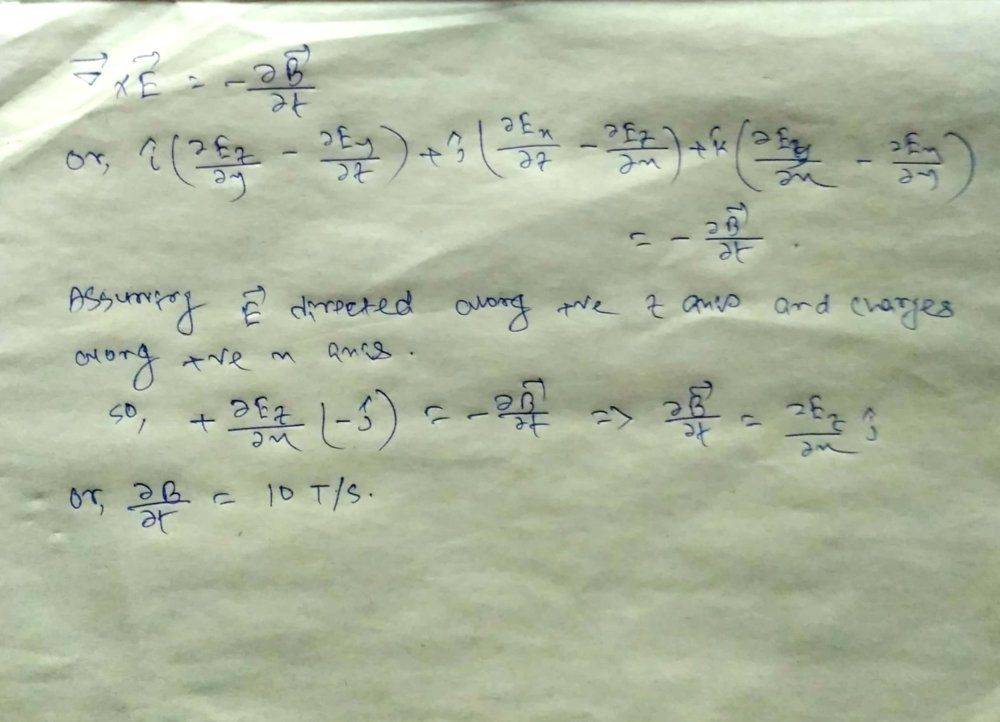
New Doc 2020-03-18 11.39.50_1.jpg


Also they says find the change in magnetic field with time using Faraday's law in a rectangular loop.
How can i solve that??
 
Physics news on Phys.org
Do you know how to apply Faraday's law to a rectangular loop? This hyperphysics page shows some examples. Usually, you are given the rate of change of the B field and asked to calculate the EMF around the loop, but this problem turns it around and gives you the E-field and asks you to calculate the rate of change of B. But the principle is the same. Try drawing a rectangular loop and calculating the line integral of E around the loop and the flux of B through the loop.
 

Similar threads

Replies
10
Views
2K
  • · Replies 2 ·
Replies
2
Views
2K
Replies
1
Views
2K
Replies
2
Views
1K
  • · Replies 1 ·
Replies
1
Views
1K
  • · Replies 8 ·
Replies
8
Views
2K
  • · Replies 1 ·
Replies
1
Views
1K
Replies
1
Views
1K
Replies
1
Views
2K
  • · Replies 5 ·
Replies
5
Views
1K