About groups and continuous curves

Click For Summary
SUMMARY

The discussion focuses on the transformation $$\phi(A)$$ acting on a vector $$x$$, defined as $$AxA^{*}$$, which preserves the metric when $$A$$ belongs to the group $$SL(2,C)$$, thus qualifying as a Lorentz transformation. The concept of a continuous curve in the space of matrices is explored, specifically how a curve $$C(t)$$ can connect the identity matrix to any matrix $$M$$ in $$SL(2,\mathbb{C}$$. The topology induced by the standard inner product on $$\mathbb{C}^{4}$$ is essential for understanding the continuity of these curves. The discussion emphasizes the geometric interpretation of curves in higher-dimensional spaces and their algebraic representations.

PREREQUISITES
  • Understanding of Lorentz transformations in the context of linear algebra.
  • Familiarity with the special linear group $$SL(2,\mathbb{C})$$.
  • Knowledge of complex-valued functions and their continuity.
  • Basic concepts of topology as applied to vector spaces.
NEXT STEPS
  • Study the properties of the special linear group $$SL(2,\mathbb{C})$$ in detail.
  • Learn about the geometric interpretation of curves in higher-dimensional spaces.
  • Explore the concept of continuous functions in the context of complex analysis.
  • Investigate the relationship between algebraic forms and geometric representations in linear algebra.
USEFUL FOR

Mathematicians, physicists, and students studying linear algebra, particularly those interested in the applications of group theory and geometry in complex vector spaces.

LCSphysicist
Messages
644
Reaction score
163
TL;DR
Lorentz transformations
Homomorphism
Determinant
Continuous curve
Define $$\phi(A)$$ a transformation which, acting on a vector x, returns $$AxA^{*}$$, in such way that if A belongs to the group $$SL(2,C)$$, $$||\phi(A)x||^2 = ||x||^2$$, so it conserves the metric and so is a Lorentz transformation. $$\phi(AB)x = (AB)x(AB)^{*} = ABxB^{*}A^{*} = A(BxB^{*})A^{*} = \phi(A)\phi(B)x$$ so we have homomorphism too. Now:
1603188206340.png

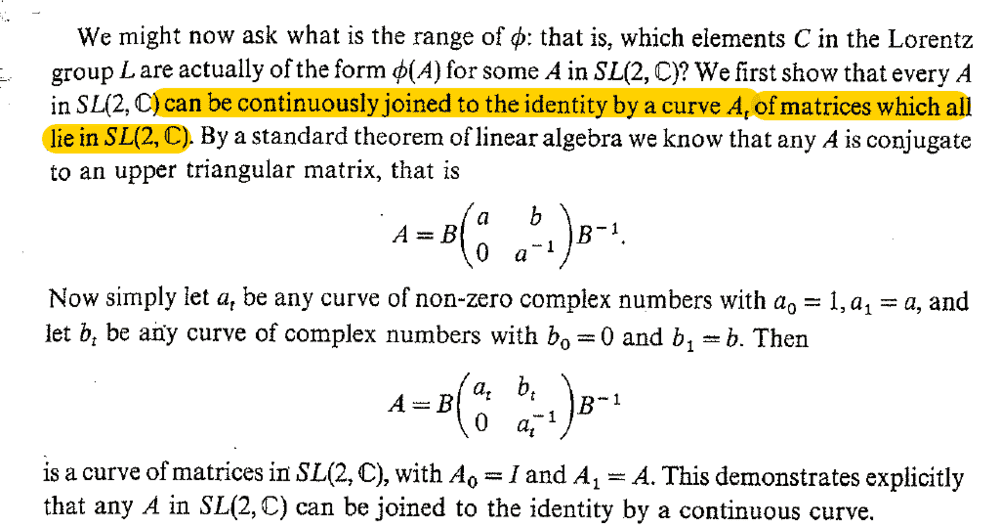
What does it means by "be continuously joined to the identity by a curve A of matrices"? It is a geometric interpretation of what? What is the meaning of curve here? I don't get this proof
 
Physics news on Phys.org
There is a natural topology on SL(2, \mathbb{C}): regard a 2x2 matrix with complex entries as a vector in \mathbb{C}^{4} and use the toplogy induced by the standard inner product (which is equivalent to the topology induced by any norm on \mathbb{C}^4). A continuous curve from A to B in SL(2,\mathbb{C}) is then a function f: [0,1] \to SL(2,\mathbb{C}) with f(0) = A and f(1) = B which is continuous with respect to this topology.
 
  • Like
Likes   Reactions: LCSphysicist
LCSphysicist said:
What is the meaning of curve here?
You could think of a curve in the space of 2x2 matrices with complex entries as function that maps a real valued parameter ##t## to a matrix of the form:
## C(t) = \begin{pmatrix} c_{1,1}(t)&c_{2,2}(t) \\ c_{2,1}(t)&c_{2,2}(t) \end{pmatrix}##

where each ##c_{i,j}## is a continuous function (using the definition of "continuous function" that is appropriate for complex valued functions).

A curve in the space ##SL(2,\mathbb{C})## must also satisfy the condition that ## C(t) \in SL(2,\mathbb{C}) ## for each value of the parameter ##t##.

What does it means by "be continuously joined to the identity by a curve A of matrices"?

It means for each matrix ##M \in SL(2,\mathbb{C})## we can find a curve ##C(t)## in ##SL(2,\mathbb{C})## such that ##C(0) = I## and ##C(1) = M##

I don't get this proof

I don't like the notation it uses. A clearer way to denote things is that we can express ##M## as ##B \begin{pmatrix} c&d\\0&1/c\end{pmatrix} B^{-1}##.

We assert we can find continuous complex valued functions ##a(t), b(t)## such that
##a(0) = 1, a(t) =c,\ b(0) = 0, b(1) = d##
and such that for ## 0 \le t \le 1## the matrix
##C(t) = B \begin{pmatrix} a(t) & b(t) \\ 0 & 1/a(t) \end{pmatrix} B^{=1} ##
is in ##SL(2,\mathbb{C})##. (For example, we can let ##a(t)## ever be zero.)

This constructs a curve ##C(t)## in ##SL(2,\mathbb{C})## such that ##C(0) = B^{-1}IB = I## and ##C(1) = M##.
It is a geometric interpretation of what?
I don't have a good grasp of geometry in the space of complex valued 4-tuples! To me, geometry in higher dimensional spaces is only understandable in terms of algebra - as a generalization of the algebraic forms of things used to describe geometry in lower dimensional spaces.
 

Similar threads

  • · Replies 26 ·
Replies
26
Views
1K
  • · Replies 13 ·
Replies
13
Views
2K
Replies
4
Views
2K
  • · Replies 4 ·
Replies
4
Views
1K
  • · Replies 0 ·
Replies
0
Views
1K
  • · Replies 15 ·
Replies
15
Views
2K
  • · Replies 4 ·
Replies
4
Views
2K
  • · Replies 0 ·
Replies
0
Views
4K
  • · Replies 12 ·
Replies
12
Views
2K
  • · Replies 4 ·
Replies
4
Views
2K