About lift equation -- Trying to build a miniature helicopter

  • Thread starter Thread starter daraphy
  • Start date Start date
  • Tags Tags
    Aerodynamics
Click For Summary
SUMMARY

The discussion centers on the application of the lift equation for designing a miniature helicopter. The user calculated a lift of 12.25 Newtons per wing using a coefficient of lift (CL) of 0.5, air density of 1.225 kg/m³, velocity of 20 m/s, and wing area of 0.1 m². However, it was pointed out that a propeller's aerodynamics differ from a wing, as the velocity and angle of attack vary along the blade's length. The user was advised to consider the twisted profile of blades and the effects of tip vortices on lift, which are not accounted for in the basic lift equation.

PREREQUISITES
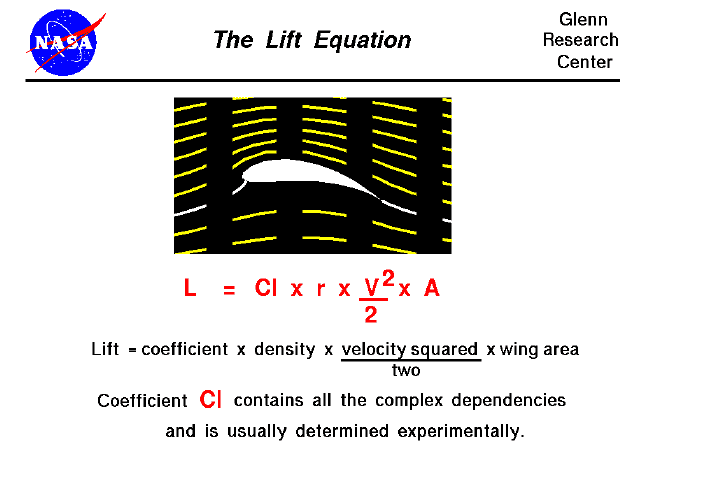
  • Understanding of the lift equation: F = CL * ρ * (v²/2) * A
  • Basic knowledge of aerodynamics, particularly regarding wings and propellers
  • Familiarity with units of measurement in physics, specifically Newtons and kilograms
  • Concept of angle of attack and its effect on lift
NEXT STEPS
  • Research the aerodynamics of propellers and their design considerations
  • Learn about the effects of tip vortices on lift in rotorcraft
  • Study the importance of blade twist in rotor design for RC helicopters
  • Explore advanced resources on helicopter aerodynamics, such as NASA's tutorials
USEFUL FOR

Aerospace engineers, hobbyists building RC helicopters, and students studying aerodynamics will benefit from this discussion. It provides insights into the practical application of the lift equation and the complexities involved in rotorcraft design.

daraphy
Messages
13
Reaction score
2
TL;DR
Lift Equation gives me 12.25 Newtons per wing. Am I using it right?
Saw this equation on Nasa's website about lift equation:
1714777498904.png

I'm trying to build a miniature helicopter and decided to test that equation.

For CI I used 0.5 because I saw a graph where flat air foils gets 0.5 CI when placed at around 10 degrees.
For air density I went with 1.225 because I live near sea levels.
For Velocity I used 20m/s and for A I used 0.1 m^2.

0.5 * 1.225 * (20^2)/2 * 0.1 = 12.25 N (I'm guessing the output is in newtons)

If multiplied by 4 wings, it gives 49N. Divided by gravity, around 5Kg.

Am I doing this right? Does that mean 3 0.1m^2 wings can lift around 5Kg?
 
Physics news on Phys.org
daraphy said:
TL;DR Summary: Lift Equation gives me 12.25 Newtons per wing. Am I using it right?

I'm trying to build a miniature helicopter and decided to test that equation.
daraphy said:
For Velocity I used 20m/s and for A I used 0.1 m^2.
I'm not going to be of much help except to ask for clarification on the velocity number. A propeller is not a wing. The air velocity varies with radius, and the angle of the "wing" for a propeller usually varies with radius because of this. Are you taking this into account?
 
  • Like
Likes   Reactions: Lnewqban and FactChecker
daraphy said:
TL;DR Summary: Lift Equation gives me 12.25 Newtons per wing. Am I using it right?

Am I doing this right? Does that mean 3 0.1m^2 wings can lift around 5Kg
Did you read the Nasa tutorial?
 
berkeman said:
I'm not going to be of much help except to ask for clarification on the velocity number. A propeller is not a wing. The air velocity varies with radius, and the angle of the "wing" for a propeller usually varies with radius because of this. Are you taking this into account?
I converted the RPM's of my motor to m/s using 0.1 as the radius. I did not understand the angle part
 
hutchphd said:
Did you read the Nasa tutorial?
I dont see any tutorial at the page
 
daraphy said:
I did not understand the angle part
You haven't yet looked at the aerodynamics of propellers and their shapes?
 
berkeman said:
You haven't yet looked at the aerodynamics of propellers and their shapes?
I saw a flat air foil can do the work so I sticked with that
 
  • #12
daraphy said:
I dont see any tutorial at the page
https://www.grc.nasa.gov/www/k-12/VirtualAero/BottleRocket/airplane/lifteq.html

Do you only want to build a miniature helicopter, or to learn about aerodynamics in general, or both?

Building a sufficiently light and controllable RC helicopter is very difficult.
Regarding design, I would like you to consider the following:

Three blades of ##0.1 m^2## will make the span of the rotor to be around 2 meters, which will require a very powerful engine to make the tips of the blades to spin at ##20 m/s## (at 190 rpm).

All the weight is going to be hanging from the blades, reason for which their cross section must be robust and thick, which makes your flat blade a poor choice.

That tangential velocity (and associate lift) will decrease to close to zero as you move towards the root of the blade.

Consider that the NASA simulator is for a wing of infinite span, which does not suffer the tip vortices of a real wing that decrease the lift.

Also, the maximum lift is achieved around 10° of angle of attack.
The wing or blade will stall and loose most of the lift if that angle increases.

Therefore, the root of your blade can have that maximum angle, but it must decrease as moving towards the tip, reason for which your blade should have a twisted profile.

Because of that, you will not be able to have the values of max velocity and max angle of attack and max CL that you have input into your equation for all the sections of your blade.

Root of the blade: Lift is associate to slowest tangential velocity and maximum CL or AOA.

Tip of the blade: Lift is associate to fastest tangential velocity and small CL or AOA.

Please, visit this website for discussions and debates on designing, building an dflying successful miniature RC helicopters:
https://www.rcgroups.com/aircraft-fuel-helis-39/

https://www.rcgroups.com/aircraft-electric-helis-217/

https://www.rcgroups.com/aircraft-misc-130/

😎
 
  • Informative
  • Like
Likes   Reactions: Klystron and berkeman
  • #13
Lnewqban said:
https://www.grc.nasa.gov/www/k-12/VirtualAero/BottleRocket/airplane/lifteq.html

Do you only want to build a miniature helicopter, or to learn about aerodynamics in general, or both?

Building a sufficiently light and controllable RC helicopter is very difficult.
Regarding design, I would like you to consider the following:

Three blades of ##0.1 m^2## will make the span of the rotor to be around 2 meters, which will require a very powerful engine to make the tips of the blades to spin at ##20 m/s## (at 190 rpm).

All the weight is going to be hanging from the blades, reason for which their cross section must be robust and thick, which makes your flat blade a poor choice.

That tangential velocity (and associate lift) will decrease to close to zero as you move towards the root of the blade.

Consider that the NASA simulator is for a wing of infinite span, which does not suffer the tip vortices of a real wing that decrease the lift.

Also, the maximum lift is achieved around 10° of angle of attack.
The wing or blade will stall and loose most of the lift if that angle increases.

Therefore, the root of your blade can have that maximum angle, but it must decrease as moving towards the tip, reason for which your blade should have a twisted profile.

Because of that, you will not be able to have the values of max velocity and max angle of attack and max CL that you have input into your equation for all the sections of your blade.

Root of the blade: Lift is associate to slowest tangential velocity and maximum CL or AOA.

Tip of the blade: Lift is associate to fastest tangential velocity and small CL or AOA.

Please, visit this website for discussions and debates on designing, building an dflying successful miniature RC helicopters:
https://www.rcgroups.com/aircraft-fuel-helis-39/

https://www.rcgroups.com/aircraft-electric-helis-217/

https://www.rcgroups.com/aircraft-misc-130/

😎
thx for the info ill check the websites to :)
 
  • Like
Likes   Reactions: Lnewqban
  • #14
You don't need to guess the units of the answer, you need to work with units.

##F = CI \rho \frac{v^2}{2} A = 0.5 \frac{1.225 kg}{m^3} \frac{(20 m/s)^2}{2} 0.1 m^2 = 12.25 kg \frac{m}{s^2} = 12.25 N##

This formula is assuming all of the wing has the same velocity relative to the air. Your helicopter blades won't. Most of the lift will come from the area near the end, while the slower parts in the center will provide less lift. The formula also assumes a single wing that goes through undisturbed air, which isn't necessarily the case for your helicopter.
daraphy said:
I converted the RPM's of my motor to m/s using 0.1 as the radius.
You cannot have an area of 0.1 m^2 with a radius of 0.1 m.
 

Similar threads

  • · Replies 1 ·
Replies
1
Views
3K
Replies
13
Views
5K
  • · Replies 30 ·
2
Replies
30
Views
4K
  • · Replies 6 ·
Replies
6
Views
17K
  • · Replies 7 ·
Replies
7
Views
3K
Replies
24
Views
14K
  • · Replies 1 ·
Replies
1
Views
8K
  • · Replies 5 ·
Replies
5
Views
11K
  • · Replies 4 ·
Replies
4
Views
4K
  • · Replies 11 ·
Replies
11
Views
5K