Discussion Overview
The discussion revolves around solving the absolute value equation |3x - 2|/|2x - 3| = 2. Participants explore different methods for finding solutions, including algebraic manipulation and squaring both sides of the equation. The conversation includes attempts to reconcile differing results with textbook answers.
Discussion Character
- Exploratory, Technical explanation, Debate/contested, Mathematical reasoning
Main Points Raised
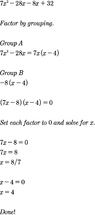
- One participant presents an initial solution leading to x = 4 but notes the existence of another solution, 8/7, as indicated in the textbook.
- Another participant emphasizes the importance of not dropping absolute value signs without considering both cases, leading to the equation 3x - 2 = -2(2x - 3) as a necessary step.
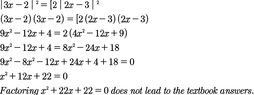
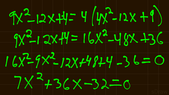
- There is a discussion about squaring both sides of the equation, with a participant questioning whether the constant 2 must also be squared, prompting clarification on the need to square it.
- Some participants point out errors in the algebraic manipulation, particularly regarding the squaring of terms and the resulting quadratic equations.
- A later reply suggests that the final quadratic equation derived does not factor, which raises concerns about reaching the textbook solutions.
- Another participant mentions a sign error in the quadratic equation that was formed, indicating that the algebraic process is still under scrutiny.
Areas of Agreement / Disagreement
Participants express differing views on the correct approach to solving the equation, particularly regarding the treatment of absolute values and the squaring process. There is no consensus on the final solutions or the correctness of the derived equations.
Contextual Notes
Some participants note unresolved mathematical steps and errors in sign or squaring, which may affect the outcomes. The discussion reflects a variety of approaches and interpretations of the problem.
Who May Find This Useful
Readers interested in algebraic methods for solving absolute value equations, as well as those looking to understand common pitfalls in manipulating such equations.