Acute Triangle ABC: Proving Perpendicular Lines AD and EF

  • Level: High School 
  • Thread starter anemone
  • Start date
  • Tags Tags
    2017
1 reply · 2K views · last reply
anemone
Gold Member
MHB
POTW Director
Messages
3,851
Reaction score
115
Here is this week's POTW:

-----

Acute triangle $ABC$ has $\angle BAC <45^\circ$. Point $D$ lies in the interior of triangle $ABC$ such that $BD=CD$ and $\angle BDC=4\angle BAC$. Point $E$ is the reflection of $C$ across line $AB$, and point $F$ is the reflection of $B$ across line $AC$. Prove that lines $AD$ and $EF$ are perpendicular.

-----

Remember to read the http://www.mathhelpboards.com/showthread.php?772-Problem-of-the-Week-%28POTW%29-Procedure-and-Guidelines to find out how to http://www.mathhelpboards.com/forms.php?do=form&fid=2!
 
No one answered last week's problem.(Sadface)

You can find the suggested brilliancy award-winning solution by Evan O'Dorney below:

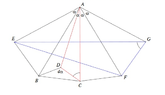
We begin by reflecting $C$ over $AF$ to point $G$, as shown in the diagram:

View attachment 6596

As usual we denote $\alpha=\angle BAC,\,\beta=\angle ABC$ and $gamma=\angle ACB$.

In order to prove that $AD=\perp EF$, we will show that $\triangle ADC\sim \triangle EFG$ and that $AC\perp EG$.

To begin with the easier part, by reflection, the four angles marked $\alpha$ are congruent, and $AE=AC=AG$. Thus $AC$ is the angle bisector of isosceles triangle $AEG$ and therefore $AC \perp EG$.

Next, to take the first step towards showing $\triangle ADC\sim \triangle EFG$, we see that $BD=CD$ and $\angle BDC=4\alpha$, so triangles $AEG$ and $BDC$ are similar isosceles triangles with base angle $90^\circ-2\alpha$.

Furthermore, $\angle AGF=\angle ACF =\angle ACB=\gamma$ by reflection.

Combining these facts, we have $\angle DCB=90^\circ -2\alpha$, and thus $\angle ACD= \gamma -(90^\circ-2\alpha)=\angle EGF$.

Again, by using the similar triangles $EAG$ and $BDC$, we have

$\dfrac{AG}{EG}=\dfrac{DC}{BC}$

and because of the reflection $\triangle ABC\cong \triangle AFG$, we have

$\dfrac{FG}{AG}=\dfrac{BC}{AC}$

Multiplying these two equations gives $\dfrac{FG}{EG}=\dfrac{DC}{AC}$.

Consequently, $\triangle ADC \sim \triangle EFG$ by SAS similarity.

Since $AG\perp EG$ and both $\angle DAC$ and $\angle FEG$ are oriented in the same direction, the transformation that takes $\triangle ADC$ to $\triangle EFG$ is a $90^\circ$ rotation, combined with some dilations and/or translations. This transformation also takes $AD$ to $EF$, which implies that these lines are perpendicular.
 
Attachments
  • Geometry diagram of a polygon with vertices A, B, C, D, E, F and G, with apex A at the top. Equal angles marked alpha at A, angle 4alpha at D, and an angle mark at C. Red lines AD and AC and blue lines EF and EG are drawn.
    POTW262.png
    17.2 KB · Views: 189