Hello Alex,
We want to determine the amount $y(t)$ in grams of chlorine present in the tank at time $t$ in seconds. So, let's begin with:
$$\text{time rate of change of chlorine = time rate of chlorine coming in minus time rate of chlorine going out}$$
$$\text{time rate of chlorine coming in=concentration of solution coming in times the time rate of volume coming in}$$
$$\text{time rate of chlorine going out=concentration of solution going out times the time rate of volume going out}$$
Let:
$$C_I$$ = the constant concentration of solution coming in.
$$R_I$$ - the constant rate of incoming solution.
$$C_O$$ = the variable concentration of solution going out.
$$R_O$$ - the constant rate of outgoing solution.
Hence, stated mathematically, we may write:
$$\frac{dy}{dt}=C_IR_I-C_OR_O$$
Concentration equals amount per volume, and the volume of solution is a function of $t$, let's call it $V(t)$. So, we have:
$$\frac{dy}{dt}=C_IR_I-\frac{y(t)}{V(t)}R_O$$
To find the volume of solution present in the tank at time $t$, consider the IVP:
$$\frac{dV}{dt}=R_I-R_O$$ where $$V(0)=V_0$$
Separating variables, and integrating, we have:
$$\int\,dV=\left(R_I-R_O \right)\int\,dt$$
$$V(t)=\left(R_I-R_O \right)t+C$$
Using the initial values, we may determine the parameter $C$:
$$V(0)=C=V_0$$
Hence:
$$V(t)=\left(R_I-R_O \right)t+V_0$$
Thus, we may now write:
$$\frac{dy}{dt}=C_IR_I-\frac{y(t)}{\left(R_I-R_O \right)t+V_0}R_O$$
Arranging the ODE in standard linear form, we may model the amount of chlorine present in the tank at time $t$ with the following IVP:
$$\frac{dy}{dt}+\frac{R_O}{\left(R_I-R_O \right)t+V_0}y(t)=C_IR_I$$ where $y(0)=y_0$
Computing the integrating factor, we find:
$$\mu(t)=e^{\int \frac{R_O}{\left(R_I-R_O \right)t+V_0}\,dt}=\left(\left(R_I-R_O \right)t+V_0 \right)^{\frac{R_O}{R_I-R_O}}$$
Multiplying the ODE by this integrating factor, we obtain:
$$\left(\left(R_I-R_O \right)t+V_0 \right)^{\frac{R_O}{R_I-R_O}}\frac{dy}{dt}+R_O\left(\left(R_I-R_O \right)t+V_0 \right)^{\frac{R_O}{R_I-R_O}-1}y(t)=C_IR_I\left(\left(R_I-R_O \right)t+V_0 \right)^{\frac{R_O}{R_I-R_O}}$$
Observing that the left side of the equation is now the differentiation of the product $\mu(t)\cdot y(t)$, we may write:
$$\frac{d}{dt}\left(\left(\left(R_I-R_O \right)t+V_0 \right)^{\frac{R_O}{R_I-R_O}}\cdot y(t) \right)=C_IR_I\left(\left(R_I-R_O \right)t+V_0 \right)^{\frac{R_O}{R_I-R_O}}$$
Integrating with respect to $t$, we have:
$$\int\,d\left(\left(\left(R_I-R_O \right)t+V_0 \right)^{\frac{R_O}{R_I-R_O}}\cdot y(t) \right)=C_IR_I\int\left(\left(R_I-R_O \right)t+V_0 \right)^{\frac{R_O}{R_I-R_O}}\,dt$$
$$\left(\left(R_I-R_O \right)t+V_0 \right)^{\frac{R_O}{R_I-R_O}}\cdot y(t)=\frac{C_IR_I}{R_I-R_O}\left(\left(R_I-R_O \right)t+V_0 \right)^{\frac{R_O}{R_I-R_O}+1}+C$$
Solving for $y(t)$ we find:
$$y(t)=\frac{C_IR_I}{R_I-R_O}\left(\left(R_I-R_O \right)t+V_0 \right)+C\left(\left(R_I-R_O \right)t+V_0 \right)^{-\frac{R_O}{R_I-R_O}}$$
Using the initial conditions, we may determine the parameter $C$:
$$y(0)=\frac{C_IR_I}{R_I-R_O}\left(V_0 \right)+C\left(V_0 \right)^{-\frac{R_O}{R_I-R_O}}=y_0$$
$$C=V_0^{\frac{R_O}{R_I-R_O}}\left(y_0-\frac{C_IR_IV_0}{R_I-R_O} \right)$$
Thus, the solution satisfying the IVP is:
$$y(t)=\frac{C_IR_I}{R_I-R_O}\left(\left(R_I-R_O \right)t+V_0 \right)+V_0^{\frac{R_O}{R_I-R_O}}\left(y_0-\frac{C_IR_IV_0}{R_I-R_O} \right)\left(\left(R_I-R_O \right)t+V_0 \right)^{-\frac{R_O}{R_I-R_O}}$$
$$y(t)=\frac{C_IR_I}{R_I-R_O}\left(\left(R_I-R_O \right)t+V_0 \right)+\left(y_0-\frac{C_IR_IV_0}{R_I-R_O} \right)\left(\frac{V_0}{\left(R_I-R_O \right)t+V_0} \right)^{\frac{R_O}{R_I-R_O}}$$
Using the given data for this problem:
$$C_I=0\,\frac{\text{g}}{\text{L}},\,R_I=16\, \frac{\text{L}}{\text{s}},\,R_O=40\, \frac{\text{L}}{\text{s}},\,V_0=1600\text{ L},\,y_0=0.0125\, \frac{\text{g}}{\text{L}}\cdot1600\text{ L}=20\text{ g}$$
we have:
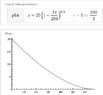
$$y(t)=20\left(1-\frac{3}{200}t \right)^{\frac{5}{3}}$$
Here is a plot of the solution on the relevant domain $$0\le t\le\frac{200}{3}$$:
View attachment 1601