mathdad
- 1,280
- 0
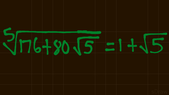
Verify that both sides of the radical equation agree without using a calculator. See picture. How can this be done algebraically?
View attachment 7968
MarkFL said:I would first observe that $1+\sqrt{5}$ is a root of:
$$x^2-2x-4=0$$
And so, the coefficients of the expansion:
$$(1+\sqrt{5})^n$$
Can be found recursively via:
$$A_{n}=2A_{n-1}+4A_{n-2}$$
For the rational term, we have:
$$A_0=1,\,A_1=1$$
Hence:
$$A_2=2(1)+4(1)=6$$
$$A_3=2(6)+4(1)=16$$
$$A_4=2(16)+4(6)=56$$
$$A_5=2(56)+4(16)=176$$
And for the irrational term, we have:
$$A_0=0,\,A_1=1$$
$$A_2=2(1)+4(0)=2$$
$$A_3=2(2)+4(1)=8$$
$$A_4=2(8)+4(2)=24$$
$$A_5=2(24)+4(8)=80$$
And so we may conclude:
$$(1+\sqrt{5})^5=176+80\sqrt{5}$$
And the result follows. :)
Well, you'd have quite a few terms to manipulate; as example:RTCNTC said:What if I decided to raise both sides to the 5th power? Can it be done this way as well?
Wilmer said:Well, you'd have quite a few terms to manipulate; as example:
(a + b)^5 = a^5 + 5 a^4 b + 10 a^3 b^2 + 10 a^2 b^3 + 5 a b^4 + b^5
Wilmer said:Didn't "introduce" anything...
YOU asked about raising to 5th power...
Gave you an example.
HOKAY?!
Will do; pleasure is all mine. All yours Mark...RTCNTC said:2. I would like for you to stop commenting in my posts. To you everything is a joke.
RTCNTC said:What if I decided to raise both sides to the 5th power? Can it be done this way as well?