Spinnor
Gold Member
- 2,234
- 419
Unique Fingerprints of Alternatives to Inflation in the Primordial Power Spectrum
"Massive fields in the primordial universe function as standard clocks and imprint clock signals in the density perturbations that directly records the scale factor of the primordial universe as a function of time, a(t). A measurement of such signals would identify the specific scenario of the primordial universe in a model-independent fashion. In this Letter, we introduce a new mechanism through which quantum fluctuations of massive fields function as standard clocks. The clock signals appear as scale-dependent oscillatory signals in the power spectrum of alternative scenarios to inflation."
From, https://arxiv.org/abs/1809.02603
From, https://www.quantamagazine.org/a-new-test-for-the-leading-big-bang-theory-20180911/
"The leading hypothesis about the universe’s birth — that a quantum speck of space became energized and inflated in a split second, creating a baby cosmos — solves many puzzles and fits all observations to date. Yet this “cosmic inflation” hypothesis lacks definitive proof. Telltale ripples that should have formed in the inflating spatial fabric, known as primordial gravitational waves, haven’t been detected in the geometry of the universe by the world’s most sensitive telescopes. Their absence has fueled underdog theories of cosmogenesis in recent years. And yet cosmic inflation is wriggly. In many variants of the idea, the sought-after ripples would simply be too weak to observe."
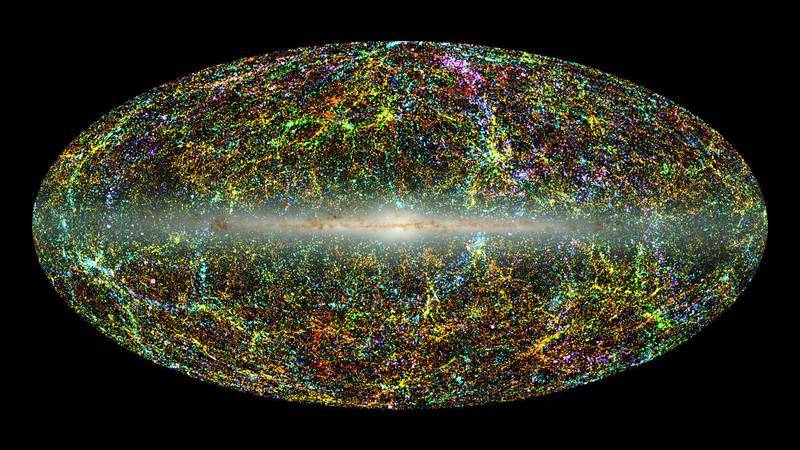
An all-sky map of the local universe derived from the 2MASS Extended Source Catalog of more than 1.5 million galaxies. The Milky Way is shown at the center, and other galaxies are color-coded by their distances, obtained from several different galaxy surveys.
See also, https://dailygalaxy.com/2018/09/the...xes-the-big-bang-todays-top-science-headline/
"Massive fields in the primordial universe function as standard clocks and imprint clock signals in the density perturbations that directly records the scale factor of the primordial universe as a function of time, a(t). A measurement of such signals would identify the specific scenario of the primordial universe in a model-independent fashion. In this Letter, we introduce a new mechanism through which quantum fluctuations of massive fields function as standard clocks. The clock signals appear as scale-dependent oscillatory signals in the power spectrum of alternative scenarios to inflation."
From, https://arxiv.org/abs/1809.02603
From, https://www.quantamagazine.org/a-new-test-for-the-leading-big-bang-theory-20180911/
"The leading hypothesis about the universe’s birth — that a quantum speck of space became energized and inflated in a split second, creating a baby cosmos — solves many puzzles and fits all observations to date. Yet this “cosmic inflation” hypothesis lacks definitive proof. Telltale ripples that should have formed in the inflating spatial fabric, known as primordial gravitational waves, haven’t been detected in the geometry of the universe by the world’s most sensitive telescopes. Their absence has fueled underdog theories of cosmogenesis in recent years. And yet cosmic inflation is wriggly. In many variants of the idea, the sought-after ripples would simply be too weak to observe."
An all-sky map of the local universe derived from the 2MASS Extended Source Catalog of more than 1.5 million galaxies. The Milky Way is shown at the center, and other galaxies are color-coded by their distances, obtained from several different galaxy surveys.
See also, https://dailygalaxy.com/2018/09/the...xes-the-big-bang-todays-top-science-headline/
Attachments
