Amazing Photo of M51-Whirlpool Galaxy
- Thread starter Drakkith
- Start date
-
- Tags
- Galaxy
Join the discussion
Registration is free. Start your own thread to ask a follow-up.
38 replies · 7K views
Physics news on Phys.org
Discussion
- 20,002
- 11,121
Wow! What telescope?
turbo
Gold Member
- 3,181
- 57
You managed to get a pretty good likeness of that little barred spiral, too (below M51's companion the way your image is oriented).
Topher925
- 1,563
- 7
Fantastic work. Can you post your equipment and settings?
Mentor
- 23,212
- 7,701
Greg Bernhardt said:Wow! What telescope?
Topher925 said:Fantastic work. Can you post your equipment and settings?
Scope: Astrotech 8" Ritchey-Chrétien
Camera: SBIG ST2000XM
Mount: Orion Atlas
Approximately 3 hours of exposures for luminance and 30 min each RGB. The exact numbers are hard to pin down, as I've been imaging this over 3 different nights from the 26th of Feb through last night, and had to throw out many sub exposures. Full moon, light pollution, plus a large light dome makes it hard to know which ones to keep.

DaveC426913
Gold Member
2025 Award
- 24,697
- 9,101
Wow. That is double plus good.
- 7,832
- 4,174
awesome! It's been cloudy here for 3 months straight :(
drizzle
Gold Member
- 202
- 58
Wow! That's great.
Mentor
- 23,212
- 7,701
Andy Resnick said:awesome! It's been cloudy here for 3 months straight :(
Yeah when I finally started on M51, I turned on my mount, and since it saves the last date that you used it, I noticed it said January 29th. The night I started on M51 was February 26th. Freaking terrible weather for almost an entire month. I'd hate to have 3 months of it...
Mentor
- 23,212
- 7,701
Borg said:Great photo Drakkith.
I really need to get a computerized drive one of these days.
I've got an Atlas EQ-G. It works pretty well for me. My buddy was testing his Atlas out after getting it souped up with new gears and such, in preparation for writing an review in a magazine, and he noticed his new gears were actually worse than the original ones. Not that the new ones were bad, but he jokes that, by chance, he has the most accurate stock Atlas gears in the world.
- 7,832
- 4,174
Nowhere near as good, but here's what I have so far: 5 minutes worth of exposure (0.8s at a time), cropped and re-sized, etc. etc.
http://img20.imageshack.us/img20/1015/m513.jpg
For some reason, the image stacking lowers the overall color saturation. I'm hopeful that at some point I'll be able to pick out a low-surface brightness galaxy located in the lower left area of the image
http://img20.imageshack.us/img20/1015/m513.jpg
For some reason, the image stacking lowers the overall color saturation. I'm hopeful that at some point I'll be able to pick out a low-surface brightness galaxy located in the lower left area of the image
Last edited by a moderator:
- 7,832
- 4,174
getting better- 20 minutes total exposure time- cropped and re-sized:
http://img688.imageshack.us/img688/1779/m51combinedallfiltereds.jpg
and 1:1 crop:
http://img685.imageshack.us/img685/973/m51combinedallfilteredc.jpg
It's kind of crazy- these images represent 120 GB of data. There are some magnitude 14 and 15 objects visible, but NGC 5229 hasn't appeared yet.
http://img688.imageshack.us/img688/1779/m51combinedallfiltereds.jpg
and 1:1 crop:
http://img685.imageshack.us/img685/973/m51combinedallfilteredc.jpg
It's kind of crazy- these images represent 120 GB of data. There are some magnitude 14 and 15 objects visible, but NGC 5229 hasn't appeared yet.
Last edited by a moderator:
DaveC426913
Gold Member
2025 Award
- 24,697
- 9,101
Drakkith said:Andy why are you using 0.8 sec exposures? Those are crazy short.
Short exposure times mean you don't have to move the camera to compensate for Earth motion. But you take many, many (20 min = 1200) short exposures, then stack them.
- 7,832
- 4,174
Drakkith said:Andy why are you using 0.8 sec exposures? Those are crazy short.
Don't have a tracking mount.
Topher925
- 1,563
- 7
Andy Resnick said:Don't have a tracking mount.
I tried shooting M51 last night as well but like Andy, I don't have a tracking mount. Well, I do, but its not very good and never works the way it should as its under sized, even for my small 80mm scope. Anyway, below is a shot of M51 I took last night using a tripod.
4x45sec and 6x60sec subs at ISO 3200 ISO using my K-5 with a DA 55-300mm lens
and a cropped image...
BTW, Andy I think you lose color saturation when you stack because the RGB levels need to be significantly lowered in the process. Otherwise when stacking so many images you hit the limits of the color/brightness scale. I always bump up the saturation after stacking and it seems to work ok although it can bring out a lot of noise.
- 7,832
- 4,174
Nice!
I think I understand what you mean re: color saturation... I'll have to poke around in DeepSkyStacker. Recently tho, I've just been shooting in B&W- I can fit 2x the images on a memory card that way. The lab computer is crunching M53 as we speak, if the weather holds out tonight I'm going to try M3.
I think I understand what you mean re: color saturation... I'll have to poke around in DeepSkyStacker. Recently tho, I've just been shooting in B&W- I can fit 2x the images on a memory card that way. The lab computer is crunching M53 as we speak, if the weather holds out tonight I'm going to try M3.
- 7,832
- 4,174
I apologize in advance for 'thread creep'- I guess we could start a generic 'astrophotography' thread...
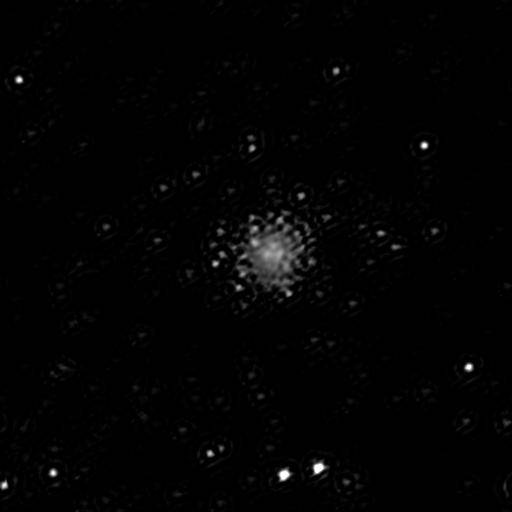
In any case, it's been an excellent time at my location for seeing deep sky objects- the constellation Virgo is well-placed, Saturn is clearly visible near Spica, and there are *tons* of galaxies and clusters in that region of the sky. Naturally, once I figured out how to stack and post-process images efficiently, I am now taking data faster than the lab computer can handle- call it 3000 frames per night (300GB data per night). Hopefully on Monday I will have some final results- today I prep everything for a batch run over the weekend. I'm posting the full-size images on my blog, here I will only post 1:1 crops of 'things of interest;- for example M53:
and preliminary images of the siamese galaxies- this is a tiny section of (I think) the Virgo supercluster- there are hundreds of galaxies in the total field of view (one of them is upper center-left in the frame), I'm hoping to pull some of them out of the background with the thousands of images I'm stacking this weekend- this was a result of 700 frames (about 10 minutes exposure time, ISO 3200)
http://img69.imageshack.us/img69/6195/maxtotalnobkg2.jpg
M3 is still chugging along- getting those images was a challenge because the cluster was located directly overhead- if my tripod had a center column I couldn't have gotten the camera vertical enough. In a few weeks the globular cluster in Hercules comes into view, so that should be interesting as well.
In any case, it's been an excellent time at my location for seeing deep sky objects- the constellation Virgo is well-placed, Saturn is clearly visible near Spica, and there are *tons* of galaxies and clusters in that region of the sky. Naturally, once I figured out how to stack and post-process images efficiently, I am now taking data faster than the lab computer can handle- call it 3000 frames per night (300GB data per night). Hopefully on Monday I will have some final results- today I prep everything for a batch run over the weekend. I'm posting the full-size images on my blog, here I will only post 1:1 crops of 'things of interest;- for example M53:
and preliminary images of the siamese galaxies- this is a tiny section of (I think) the Virgo supercluster- there are hundreds of galaxies in the total field of view (one of them is upper center-left in the frame), I'm hoping to pull some of them out of the background with the thousands of images I'm stacking this weekend- this was a result of 700 frames (about 10 minutes exposure time, ISO 3200)
http://img69.imageshack.us/img69/6195/maxtotalnobkg2.jpg
M3 is still chugging along- getting those images was a challenge because the cluster was located directly overhead- if my tripod had a center column I couldn't have gotten the camera vertical enough. In a few weeks the globular cluster in Hercules comes into view, so that should be interesting as well.
Last edited by a moderator:
Topher925
- 1,563
- 7
Andy Resnick said:...Naturally, once I figured out how to stack and post-process images efficiently, I am now taking data faster than the lab computer can handle- call it 3000 frames per night (300GB data per night)...
 How are you doing this? I'm hoping you have some type of intervolemeter that automates most of this. If you're putting this much work into your astro shots it may be worth buying an equatorial mount.
What lens are you using to take these shots?
- 7,832
- 4,174
Heh- no, I'm out there enjoying a quiet evening with my wife and beer(s). It sounds like a lot of time and effort, but it's really only a 2-3 hour commitment per night. I'm shooting through a 400mm f/2.8 lens, and yes- an equatorial mount would be appreciated- but a decent one is out of my price range and frankly, the seeing conditions here are so awful that I can't justify it.
One thing that does suck is that all the meteors I catch in each frame (I estimate about 1% of the frames have a meteor track) get lost in the stacking process.
One thing that does suck is that all the meteors I catch in each frame (I estimate about 1% of the frames have a meteor track) get lost in the stacking process.
- 7,832
- 4,174
I posted the full frames elsewhere, but here are some recent 1:1 images taken last week:
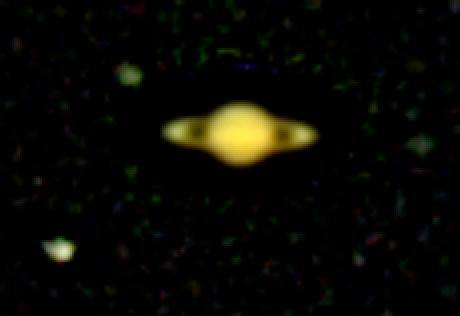
Saturn & Titan, and 72 Vir, 74 Vir, 30 x 1/30s, ISO 100 (saturn) and 20 x 0.4s, ISO 6400 (everything else):
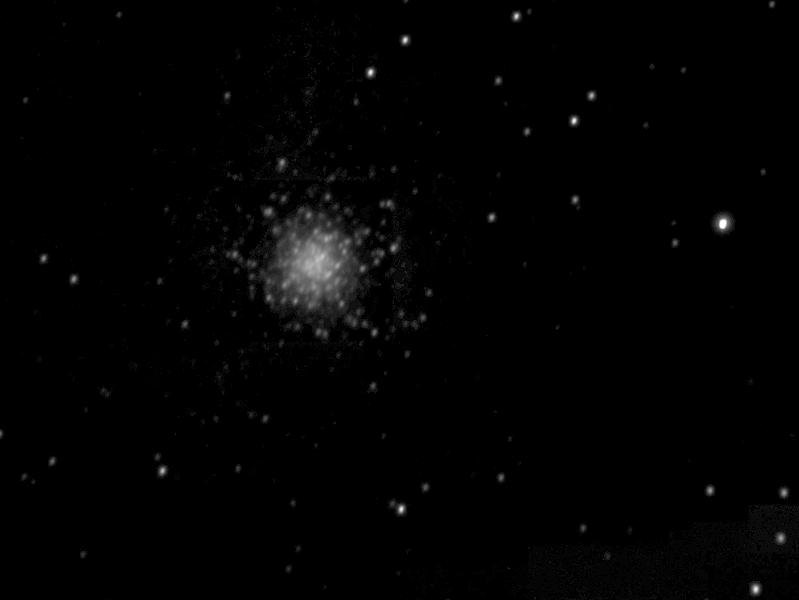
M13, about 800 x 0.8s, ISO 3200:
The 'Nikonian Deep Field' is still processing but should be done in another day or so. These images are nearly diffraction-limited (FWHM ratio of Airy/actual = 0.87+/- 0.03), but only have 4 or 5 stellar magnitudes in dynamic range ( say +7.5 -> +13). I still have substantial room for improvement before approaching the limit of a 16-bit image (11 stellar magnitudes). [Edit]- here's where going from jpg to RAW may be worth it- starting off with 14 bits of dynamic range instead of 8 bits may balance out the increased file size and decreased number of images acquired.
Saturn & Titan, and 72 Vir, 74 Vir, 30 x 1/30s, ISO 100 (saturn) and 20 x 0.4s, ISO 6400 (everything else):
M13, about 800 x 0.8s, ISO 3200:
The 'Nikonian Deep Field' is still processing but should be done in another day or so. These images are nearly diffraction-limited (FWHM ratio of Airy/actual = 0.87+/- 0.03), but only have 4 or 5 stellar magnitudes in dynamic range ( say +7.5 -> +13). I still have substantial room for improvement before approaching the limit of a 16-bit image (11 stellar magnitudes). [Edit]- here's where going from jpg to RAW may be worth it- starting off with 14 bits of dynamic range instead of 8 bits may balance out the increased file size and decreased number of images acquired.
Last edited:
- 7,832
- 4,174
Drakkith said:Interesting to see diffraction rings around your stars in your picture above in post 20. Usually those are washed out by seeing effects.
Good catch- those are actually artifacts from post-processing (deconvolution). For whatever reason, unsharp masking works better for these images.
In any case, here's the Deep sky survey, with Messier and NGC objects circled blue-ish and yellow-ish, respectively:
http://img16.imageshack.us/img16/3159/presentation2ds.jpg
Hubble it ain't, but not bad for what I have to work with...
Last edited by a moderator:
- 7,832
- 4,174
Last night I took a bunch of images in RAW+JPG mode to compare the two, and the results are very counter-intuitive. If the weather holds out, I'll try another run tonight to compare.
For individual frames, RAW has a much larger signal-to-noise ratio: 20:1 for jpg, 200:1 for RAW at ISO2000. However, after stacking together 180 frames, the jpg stack had a better SNR and a smaller FWHM than the RAW stack. As I said, it's counter-intuitive, so I'm hoping to try again tonight...
For individual frames, RAW has a much larger signal-to-noise ratio: 20:1 for jpg, 200:1 for RAW at ISO2000. However, after stacking together 180 frames, the jpg stack had a better SNR and a smaller FWHM than the RAW stack. As I said, it's counter-intuitive, so I'm hoping to try again tonight...
Topher925
- 1,563
- 7
Andy Resnick said:Last night I took a bunch of images in RAW+JPG mode to compare the two, and the results are very counter-intuitive. If the weather holds out, I'll try another run tonight to compare.
For individual frames, RAW has a much larger signal-to-noise ratio: 20:1 for jpg, 200:1 for RAW at ISO2000. However, after stacking together 180 frames, the jpg stack had a better SNR and a smaller FWHM than the RAW stack. As I said, it's counter-intuitive, so I'm hoping to try again tonight...
Are you sure there's no NR going on with the jpegs? Also RAWs have a much higher dynamic range which could be a cause.
- 7,832
- 4,174
I ran the test again, with two sets of (RAW+ jpg) images. The results surprised me at first, but now I think I understand what image stacking does a little better. All in-camera noise reduction was turned off for this.
The data: one set, call it '3200' as a reference to the ISO, consisted of 185 individual frames, and there was no clipping at the high end. The other, call it '6400', consisted of 85 frames and there was clipping.
SNR metric: I simply divided the peak value by the mean, as averaged over the entire frame. For reference, an ideal 8-bit image has an SNR of 6 stellar magnitudes, 14-bit = 10.5, and 16-bit = 12.
Individual frames: dataset '3200'- jpg frame had an SNR of 23 (3.4 stellar magnitudes), while the RAW had an SNR of 826 (7.3). Dataset '6400'- jpg SNR = 13.4 (2.8) and the RAW SNR = 14 (2.87). The message here is quite clear- no clipping!
The surprise was what happened after stacking together the frames- dataset '3200' : jpg = 2.9 (1.16), RAW = 30 (3.71). dataset '6400': jpg = 2.4 (0.96) and RAW = 3.6 (1.4).
I have come to understand that image stacking is similar to gamma compression- the idea is to compress a wide range of stellar magnitudes into 8-bits of data. In a way, it's similar to adjusting 'gamma' to be << 1. So in a way, stacking *has* to reduce the SNR.
The take-home message, for me, is that the increased file size of RAW does not balance the SNR benefit after stacking together a few hundred images. If I could get away with acquiring fewer images (say 60-second exposures), then I may see a benefit due to the increased bit depth of RAW.
The data: one set, call it '3200' as a reference to the ISO, consisted of 185 individual frames, and there was no clipping at the high end. The other, call it '6400', consisted of 85 frames and there was clipping.
SNR metric: I simply divided the peak value by the mean, as averaged over the entire frame. For reference, an ideal 8-bit image has an SNR of 6 stellar magnitudes, 14-bit = 10.5, and 16-bit = 12.
Individual frames: dataset '3200'- jpg frame had an SNR of 23 (3.4 stellar magnitudes), while the RAW had an SNR of 826 (7.3). Dataset '6400'- jpg SNR = 13.4 (2.8) and the RAW SNR = 14 (2.87). The message here is quite clear- no clipping!
The surprise was what happened after stacking together the frames- dataset '3200' : jpg = 2.9 (1.16), RAW = 30 (3.71). dataset '6400': jpg = 2.4 (0.96) and RAW = 3.6 (1.4).
I have come to understand that image stacking is similar to gamma compression- the idea is to compress a wide range of stellar magnitudes into 8-bits of data. In a way, it's similar to adjusting 'gamma' to be << 1. So in a way, stacking *has* to reduce the SNR.
The take-home message, for me, is that the increased file size of RAW does not balance the SNR benefit after stacking together a few hundred images. If I could get away with acquiring fewer images (say 60-second exposures), then I may see a benefit due to the increased bit depth of RAW.
- 7,832
- 4,174
Some preliminary results (160 jpg frames): a tight crop of the Great cluster in Virgo, prominently showing (clockwise from left) M87, 'The Eyes' (NGC4438 and 4435), M86 and M84. Above and below M86, both NGC4438 and NGC4402 are visible.
http://img825.imageshack.us/img825/7642/maxentropy21.jpg
There are hints of a helf-dozen others in the frame (NGC 4461 is at the very top edge, for example), I'm curious if I can pull them out. I used the stacking parameter 'entropy' in DeepSkyStacker, and then performed additional post-processing in ImageJ (two iterations of background subtraction, normalization and gamma adjustment) to get here.
I'm batch stacking groups of 200 over the weekend, and will try different stacking parameters when combining the stacked images. Progress...?
http://img825.imageshack.us/img825/7642/maxentropy21.jpg
There are hints of a helf-dozen others in the frame (NGC 4461 is at the very top edge, for example), I'm curious if I can pull them out. I used the stacking parameter 'entropy' in DeepSkyStacker, and then performed additional post-processing in ImageJ (two iterations of background subtraction, normalization and gamma adjustment) to get here.
I'm batch stacking groups of 200 over the weekend, and will try different stacking parameters when combining the stacked images. Progress...?
Last edited by a moderator:
Topher925
- 1,563
- 7
Looks good Andy. You sure are putting a lot of work into these shots. What level skies are you shooting in?
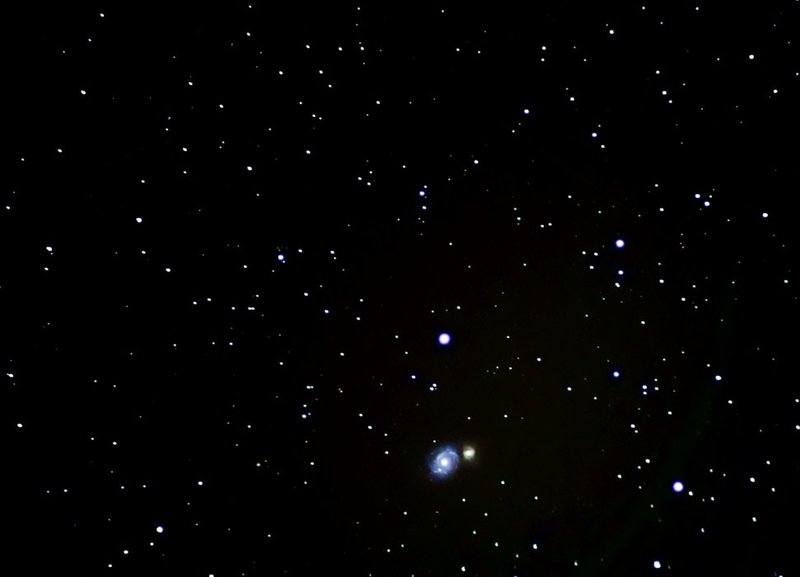
I tried M-51 again over the past weekend but this time using my 80mm refractor instead of a lens. Shots are a little better as the scope has an extra 100mm of reach but a ton of field curvature.
7x45sec ISO 3200 F5.6 Orion ST80 400mm, no darks or flats
Cropped image
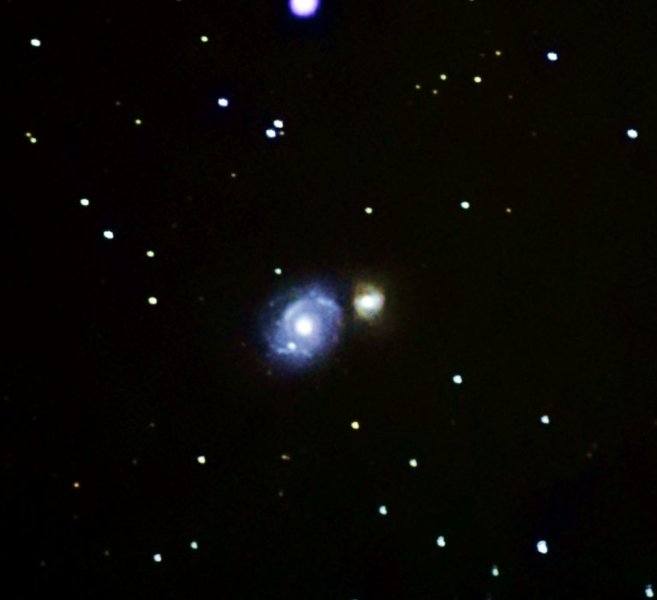
I tried M-51 again over the past weekend but this time using my 80mm refractor instead of a lens. Shots are a little better as the scope has an extra 100mm of reach but a ton of field curvature.
7x45sec ISO 3200 F5.6 Orion ST80 400mm, no darks or flats
Cropped image
Similar threads
- swampwiz
- · Replies 2 ·
- Astronomy, Astrophysics, Cosmology
- Replies
- 2
- Orion1
- · Replies 2 ·
- Astronomy, Astrophysics, Cosmology
- Replies
- 2
- russ_watters
- · Replies 3 ·
- Astronomy, Astrophysics, Cosmology
- Replies
- 3