Angle Size of Intersecting Circles at (4,3): 44.985

  • Topic:
  • Thread starter Thread starter veronica1999
  • Start date Start date
  • Tags Tags
    Angle
Join the discussion
Registration is free. Start your own thread to ask a follow-up.
7 replies · 5K views
veronica1999
Messages
61
Reaction score
0
7. Verify that the circles x^2+y^2 = 25 and (x−5)^2+(y−10)^2 = 50 intersect at A = (4, 3).
Find the size of the acute angle formed at A by the intersecting circles. You will first have
to decide what is meant by the phrase the angle formed by the intersecting circles.

My answer is 44.985.

I am not sure I got the point of the problem.(Worried)
I made an equation for the two tangent lines at (4.3)
Found the coordinates when they meet with the y axis.(made a triangle)

(0, 25/3) (0, 25/7) (4,3)

used the law of cosines and got 44.985.I wasn't sure what finding the size of the acute angle formed by the intersecting circles meant.
 
Mathematics news on Phys.org
veronica1999 said:
7. Verify that the circles x^2+y^2 = 25 and (x−5)^2+(y−10)^2 = 50 intersect at A = (4, 3).
Find the size of the acute angle formed at A by the intersecting circles. You will first have
to decide what is meant by the phrase the angle formed by the intersecting circles.

My answer is 44.985.

I am not sure I got the point of the problem.(Worried)
I made an equation for the two tangent lines at (4.3)
Found the coordinates when they meet with the y axis.(made a triangle)

(0, 25/3) (0, 25/7) (4,3)

used the law of cosines and got 44.985.
There is a standard formula for the angle between two intersecting lines with slopes $m_1~\&~m_2$:
$\phi = \arctan \left( {\left| {\frac{{{m_1} - {m_2}}}{{1 + {m_1}{m_2}}}} \right|} \right)$.
 
veronica1999 said:
My answer is 44.985.
In fact, the answer is precisely 45 degrees.

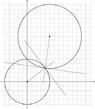
View attachment 275

I think your method is correct, but it is easier to find the angle between the radii of the two circles that intersect in (4,3). Since a radius is perpendicular to the tangent, the angle between radii is the same as the one between tangents. You can find the angle between radii using dot product.
 

Attachments

  • circles.png
    circles.png
    7 KB · Views: 160
Evgeny.Makarov said:
In fact, the answer is precisely 45 degrees.

https://www.physicsforums.com/attachments/275

I think your method is correct, but it is easier to find the angle between the radii of the two circles that intersect in (4,3). Since a radius is perpendicular to the tangent, the angle between radii is the same as the one between tangents. You can find the angle between radii using dot product.
Thanks!
I never thought of that.
 
veronica1999 said:
7. Verify that the circles x^2+y^2 = 25 and (x−5)^2+(y−10)^2 = 50 intersect at A = (4, 3).
Find the size of the acute angle formed at A by the intersecting circles. You will first have
to decide what is meant by the phrase the angle formed by the intersecting circles.

My answer is 44.985.

I am not sure I got the point of the problem.(Worried)
I made an equation for the two tangent lines at (4.3)
Found the coordinates when they meet with the y axis.(made a triangle)

(0, 25/3) (0, 25/7) (4,3)

used the law of cosines and got 44.985.I wasn't sure what finding the size of the acute angle formed by the intersecting circles meant.

First verify that \(x=4\), \(y=3\) satisfy both \(x^2+y^2=25\) and \((x-5)^2+(y-10)^2=50\) (it does).

Implicit differentiation first circle: \(2x+2y \frac{dy}{dx}=0 \Rightarrow \frac{dy}{dx}=-\frac{x}{y}\).

So at \((4,3)\) the vector \( {\bf{t}}_1=(3,-4)\) points along the tangent to the first circle.

Similarly we find that \( {\bf{t}}_2=(7,-1)\) points along the tangent to the second circle.

Now: \( {\bf{t}}_1.{\bf{t}}_2 = |{\bf{t}}_1||{\bf{t}}_2| \cos(\theta)\) ... etc

Solving this for \(\theta\) will give an angle which depending on the sense of the vectors will be either the obtuse or the acute angle between the tangents. This is trivial to sort out.(note the same method will work without calculus, all that calculus is being used for is to find the two gradients of the tangents at the given point, use any method you like to find the gradient.)

CB
 
Last edited:
CaptainBlack said:
First verify that \(x=4\), \(y=3\) satisfy both \(x^2+y^2=25\) and \((x-5)^2+(y-10)^2=50\) (it does).

Implicit differentiation first circle: \(2x+2y \frac{dy}{dx}=0 \Rightarrow \frac{dy}{dx}=-\frac{x}{y}\).

So at \((4,3)\) the vector \( {\bf{t}}_1=(3,-4)\) points along the tangent to the first circle.

Similarly we find that \( {\bf{t}}_2=(7,-1)\) points along the tangent to the second circle.

Now: \( {\bf{t}}_1.{\bf{t}}_2 = |{\bf{t}}_1||{\bf{t}}_2| \sin(\theta)\) ... etc

Solving this for \(\theta\) will give an angle which depending on the sense of the vectors will be either the obtuse or the acute angle between the tangents. This is trivial to sort out.(note the same method will work without calculus, all that calculus is being used for is to find the two gradients of the tangents at the given point, use any method you like to find the gradient.)

CB
$\sin \theta$ or $\cos \theta$?
 
Jester said:
$\sin \theta$ or $\cos \theta$?
Fixed.

(Wondering)