byronsakic
- 17
- 0
Hello,
i am having difficulty on a question involving chords i believe.
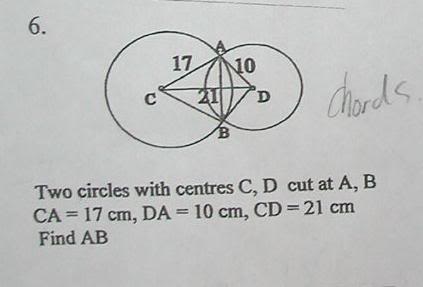
what i have so far is:
the length of CA is 17. therefore the length of CB is also 17 due to the fact that it is the radius of the first circle.
the length of AD is 10. Therefore BD is also 10 because it is the radius of the circle.
i can prove that AB is perpendicular to CD and forms a right angle since CD passes through the the centres of the circles, therefore it is a perpendicular bisector of the chord AB.
if you let the mid point between AB be M. you could solve for AM and BM using pythagoreom thoerem, however i would need CM and MD which i do not know how to find or at least cannot think of.
I could use cosine law, however i do not have any angles given.
can anyone help me proceed with this question in finding AB?
thanks
byron
i am having difficulty on a question involving chords i believe.
what i have so far is:
the length of CA is 17. therefore the length of CB is also 17 due to the fact that it is the radius of the first circle.
the length of AD is 10. Therefore BD is also 10 because it is the radius of the circle.
i can prove that AB is perpendicular to CD and forms a right angle since CD passes through the the centres of the circles, therefore it is a perpendicular bisector of the chord AB.
if you let the mid point between AB be M. you could solve for AM and BM using pythagoreom thoerem, however i would need CM and MD which i do not know how to find or at least cannot think of.
I could use cosine law, however i do not have any angles given.
can anyone help me proceed with this question in finding AB?
thanks
byron