Another nice mech problem

  • Thread starter Thread starter wrobel
  • Start date Start date
wrobel
Science Advisor
Insights Author
Messages
1,287
Reaction score
1,117
subj from an old Polish physics olympiad problem book

A thin, light, and flexible paper tape is wound around a spool that has the shape of a uniform cylinder (shaft). The end of the tape is attached to the clamp of a spring dynamometer. At the initial moment, the system is positioned as shown in Fig. Then the tape begins to unwind — the spool falls downward. What does the dynamometer read during the fall of the spool? Is the unwound part of the tape directed vertically at all times? The mass of the spool is ##M##. Neglect the oscillations of the spring
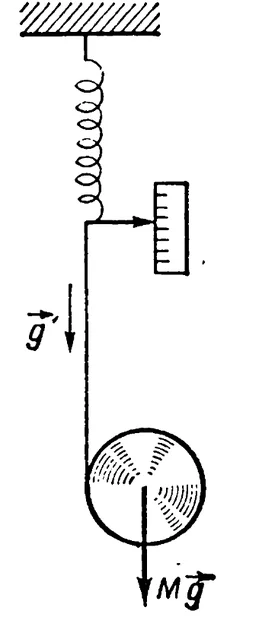
1.webp

the last question is not as simple as it seems
 
Last edited:
Engineering news on Phys.org
If you assume that the paper tape is zero mass and zero thickness, then the force applied to the left side of the spool can only be the result of tension in the tape. That force will be directly up and tangent to the surface of the spool.
We can deduce the tension on paper tape by noting that had there been a second tape attached to the right, the spool would be supported symmetrically between them - with each tape supporting exactly half the weight. The tension on the left tape can be expressed as a portion of the weight and as a function of time: L=f(t), where t=0 at the moment that the right tape is removed. So, for t<=0, L=f(t)=0.5.
For t>0, we need to look at what horizontal motion we should expect from the spool. And what we notice is that there are only two forces acting on it, both without a horizontal component. So, if that spool wasn't swaying at the start, nothing will make it sway once the drop starts. Of course, these two misaligned vertical forces on the spool will add angular momentum to the spool. But that continuous ramping up of spin will exactly match the continuous downward acceleration.
There's a very dynamic version of "steady state" here. If we put our origin {0,0} on the center of the falling spool, then we will see a steady pull in one direction from gravity, a steady pull of equal magnitude in the other from the tape, and a steady build up of spin.

So f(t)=0.5 for all t. And, except as part of spin, nothing moves horizontally at all.
 
What do you think: if you were a participant in the Physics Olympiad and you handed in such an explanation, would the examination board accept it as a solution?
 
wrobel said:
subj from an old Polish physics olympiad problem book

Can you tell which book is it from? Or maybe in which year it appeared on the olympiad (if it did).
 
  • Like
Likes   Reactions: wrobel
Waldemar Gorzkowski

25 LAT
OLIMPIAD
FIZYCZNYCH

Warszawa 1979
 
  • Love
Likes   Reactions: weirdoguy
wrobel said:
Waldemar Gorzkowski

Yep, I have it :oldbiggrin: Thank you.