ANSYS: What are vibrating feeder's boundary conditions?

Click For Summary
SUMMARY

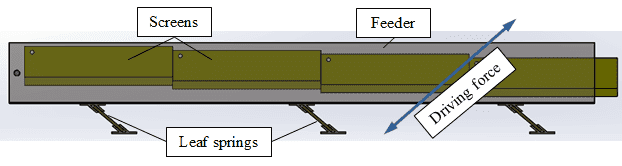
The discussion focuses on setting up boundary conditions for a vibrating feeder model in ANSYS. Key considerations include the use of elastic supports, fixed supports, and remote displacements during modal analysis. Participants emphasize the importance of understanding the model's structure, which consists of a frame supported by six leaf springs and four waved plates. Additionally, the discussion touches on the need to input frequency parameters to assess fatigue in the system.

PREREQUISITES
  • Understanding of ANSYS software for structural analysis
  • Knowledge of modal analysis techniques
  • Familiarity with boundary conditions in mechanical modeling
  • Basic concepts of fatigue analysis in engineering
NEXT STEPS
  • Research how to set up elastic supports in ANSYS for modal analysis
  • Learn about fixed and remote displacement boundary conditions in ANSYS
  • Investigate the impact of frequency parameters on fatigue analysis in ANSYS
  • Explore best practices for modeling complex structures in ANSYS
USEFUL FOR

Mechanical engineers, structural analysts, and anyone involved in the design and analysis of vibrating feeders or similar mechanical systems.

Butters
Messages
75
Reaction score
1
I have created such vibrating feeder model on SW but on ANSYS I'm only analyzing the frame.
upload_2015-4-26_22-58-12.png

1)How do I set up boundary conditions, I think I need elastic supports?
2)In modal analysis I have elastic, fixed supports, remote displacement - which should I use and in what directions?
3)Do I perform modal analysis with the screens or without?
4)Is there any way to input frequency parameters and find out fatigue?
 
Last edited:
Hi Butters,

I would love to help you.
But I don't understand your model. Can you upload more links or videos on what exactly is your "feeder"
 
RKD89, really the model is not that complicated. It consists of a simple through frame which is supported by 6 leaf springs at the bottom. Inside the through we have 4 waved plates (for transferred material alignment) which are fixed by the sides to the walls of the frame. The serrated plates are positioned in a way that each one is lower than the previous one creating down sloping steps.

model1.png
 

Similar threads

  • · Replies 7 ·
Replies
7
Views
3K
  • · Replies 3 ·
Replies
3
Views
3K
  • · Replies 4 ·
Replies
4
Views
3K
  • · Replies 1 ·
Replies
1
Views
2K
  • · Replies 5 ·
Replies
5
Views
8K
Replies
9
Views
6K
Replies
5
Views
2K
  • · Replies 1 ·
Replies
1
Views
2K
  • · Replies 7 ·
Replies
7
Views
3K
  • · Replies 1 ·
Replies
1
Views
4K