AP Calculus AB Free Response Question

Click For Summary

Discussion Overview

The discussion revolves around an AP Calculus AB Free Response Question concerning the motion of a particle along the x-axis, where its velocity is defined by the function $v(t) = \sin(t^2)$. Participants explore various aspects of the problem, including acceleration, total distance traveled, position at a specific time, and the time at which the particle is farthest to the right. The scope includes mathematical reasoning and conceptual understanding related to calculus.

Discussion Character

  • Homework-related
  • Mathematical reasoning
  • Conceptual clarification
  • Debate/contested

Main Points Raised

  • Some participants express confidence in calculating the acceleration at a specific time but are uncertain about the remaining parts of the question.
  • One participant suggests considering when the particle changes direction to understand the relationship between displacement and total distance traveled.
  • Another participant notes the difficulty of integrating $\sin(t^2)$ directly and questions how to determine displacement without integration.
  • Some participants discuss the need for absolute values in calculating total distance versus displacement, emphasizing the difference between signed and unsigned areas under the velocity-time graph.
  • There are multiple suggestions regarding the use of the fundamental theorem of calculus to find the position function based on the given velocity.
  • Participants debate the correct limits and forms of integrals related to the position function and express confusion over the application of the fundamental theorem of calculus.
  • One participant humorously notes that they provided an integral expression for $x(t)$ to illustrate the relationship between the derivative and the given velocity function.

Areas of Agreement / Disagreement

Participants generally agree on the need to distinguish between total distance and displacement but have differing views on how to approach the calculations and the implications of the fundamental theorem of calculus. The discussion remains unresolved regarding the best methods to solve the problem.

Contextual Notes

Some participants express uncertainty about the correct application of integrals and the fundamental theorem of calculus, indicating potential gaps in understanding that may affect their ability to solve the problem accurately.

Who May Find This Useful

This discussion may be useful for students preparing for AP Calculus exams, particularly those seeking to understand the application of calculus concepts to motion problems and the nuances of integrating functions related to velocity and position.

scottshannon
Messages
46
Reaction score
0
I needed help on this AB Calculus Free Response Question:

A particle moves along the x-axis do that its velocity $v$ at time $t \ge 0$ is given by $v(t) = \sin( t^2)$ for the interval $0 \le t \le \sqrt{5\pi}$. The position of the particle at time $t$ is $x(t)$ and its position at time $t = 0$ is $x(0) = 5$ .

a) Find the acceleration of the particle at time $t = 3$.
b) Find the total distance traveled by the particle from time $t = 0$ to $t = 3$.
c) Find the position of the particle at time $t =3$.
d) For $0 \le t \le \sqrt{5\pi}$, find the time $t$ at which the particle is farthest to the right. Explain your answer.

I believe that I can do a) but I am not sure about the rest.
 
Physics news on Phys.org
For part b, can you think about a particle changing direction? When would that occur? If a particle goes only in one direction, then what's the relationship between displacement and total distance traveled? If a particle changes direction, what's the relationship between displacement and total distance traveled?

For part d, is there some aspect of differential calculus you can think of that you could bring to bear on find the biggest value of the position function?
 
scottshannon said:
I needed help on this AB Calculus Free Response Question:

A particle moves along the x-axis do that its velocity $v$ at time $t \ge 0$ is given by $v(t) = \sin( t^2)$ for the interval $0 \le t \le \sqrt{5\pi}$. The position of the particle at time $t$ is $x(t)$ and its position at time $t = 0$ is $x(0) = 5$ .

a) Find the acceleration of the particle at time $t = 3$.
b) Find the total distance traveled by the particle from time $t = 0$ to $t = 3$.
c) Find the position of the particle at time $t =3$.
d) For $0 \le t \le \sqrt{5\pi}$, find the time $t$ at which the particle is farthest to the right. Explain your answer.

I believe that I can do a) but I am not sure about the rest.

My problem is that I don't know how to figure displacement unless I can integrate. If you could tell me how to work the problem rather than give me a question, I would be most appreciative.
 
So between $0$ and $\sqrt{\pi}$ the velocity is positive. Between $\sqrt{\pi}$ and $\sqrt{2\pi}$ the velocity is negative. How does that help me if I cannot integrate $\sin\left({t^2}\right)$?
 
Last edited by a moderator:
scottshannon said:
I needed help on this AB Calculus Free Response Question:

A particle moves along the x-axis do that its velocity $v$ at time $t \ge 0$ is given by $v(t) = \sin( t^2)$ for the interval $0 \le t \le \sqrt{5\pi}$. The position of the particle at time $t$ is $x(t)$ and its position at time $t = 0$ is $x(0) = 5$ .

a) Find the acceleration of the particle at time $t = 3$.
b) Find the total distance traveled by the particle from time $t = 0$ to $t = 3$.
c) Find the position of the particle at time $t =3$.
d) For $0 \le t \le \sqrt{5\pi}$, find the time $t$ at which the particle is farthest to the right. Explain your answer.

I believe that I can do a) but I am not sure about the rest.

Hi scottshannon,

For b), the total distance traveled from $t = 0$ to $t = 3$ is $\int_0^3 v(t)\, dt$. You have $v(t)$, but note that you cannot simplify the integral any further.

For c), use the fundamental theorem of calculus to get $x(3) = x(0) + \int_0^3 v(t)\, dt = 5 + \int_0^3 \sin(t^2)\, dt$.

Finally for d), use the first (or second) derivative test to find the time $t$ that maximizes $x(t)$.
 
Euge said:
For b), the total distance traveled from $t = 0$ to $t = 3$ is $\int_0^3 v(t)\, dt$.
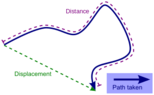
If we believe in the distinction between distance and displacement as on this figure from Wikipedia,

View attachment 3984

then the total distance is $\int_0^3 \lvert v(t)\rvert\, dt$.
 

Attachments

  • 323px-Distancedisplacement.svg.png
    323px-Distancedisplacement.svg.png
    4.2 KB · Views: 153
Evgeny.Makarov said:
If we believe in the distinction between distance and displacement as on this figure from Wikipedia,
then the total distance is $\int_0^3 \lvert v(t)\rvert\, dt$.

Yes, I should have added that comment. Thanks for adding that point. I think the picture is slightly misleading though. It doesn't quite illustrate that in one-dimensional motion, the displacement under a given time interval is signed area of the velocity-time graph over that interval, whereas the distance is the unsigned area of the velocity-time graph over that interval.
 
Thank you...I understand the need for absolute value so as to calculate the total distance, so that the be negative will not subtract from the positive displacement.

Short of writing the infinite series for $\sin\left(t^2\right)$ and then integrating term by term, I don't know if there is a way to come up with a numerical value for . If $f(t)=\sin\left(t^2\right)$ then

$$F(t) = \int_{t}^{0} \,\sin({t}^{2}) +5$$

I am not sure that I am using latex right. Is my latex being translated to symbols? If not can you help me use latex?
 
Last edited by a moderator:
On part d I am not sure how to take the first derivative.
 
  • #10
Should the integral be written $\int_{0}^{{t}^{2}} \,sin(u)$ or
$\int_{0}^{t} \,sin({u}^{2}$
 
  • #11
I am thinking you need:

$$x(t)=\frac{1}{2t}\int_0^{t^2}\sin(u)\,du$$

Do you see why?
 
  • #12
Hello again scottshannon,

The derivative of $x(t)$ is $v(t)$, which is already given. You won't need to worry about finding an approximate value for $\int_0^3 |\sin t^2|\, dt$. However, if you need it, the value is approximately $1.702$.
 
  • #13
I don't see why.. I am sorry

- - - Updated - - -

I don't think that having the integrand sin(u) with limits t^2 and 0 is the same as sin(u^2) with limits t and 0 (I am too stupid to use latex sorry)
 
  • #14
how do you get the cursive letters that you use for x(t) and v(t)..I can't do that
 
  • #15
$\int_{0}^{u} \,\sin\left({{t}^{2}}\right)dt$
 
  • #16
scottshannon said:
how do you get the cursive letters that you use for x(t) and v(t)..I can't do that

If you put v(t) in between two dollars signs, you get $v(t)$. Similarly for $x(t)$. Try it and see what you get.
 
  • #17
The function is $v(t) = \sin\left({{t}^{2}}\right)$ , so it seems that the integral

should be $\int_{0}^{u} \,\sin\left({{t}^{2}}\right)dt$ not

$\int_{0}^{{t}^{2}} \,\sin\left({u}\right)du$

- - - Updated - - -

Perhaps I do not understand the fundamental theorem of calculus well enough
 
  • #18
I purposefully gave you an integral expression for $x(t)$ so that when you tried maximizing by differentiating, you would realize that you already had the derivative of $x(t)$ in the given $v(t)$. :D
 
  • #19
MarkFL said:
I am thinking you need:

$$x(t)=\frac{1}{2t}\int_0^{t^2}\sin(u)\,du$$
Indeed, [math]\frac{d}{dt}\int_0^{t^2}\sin(u)\,du=2t\sin(t^2)[/math], but [math]\frac{d}{dt}\left(\frac{1}{2t}\int_0^{t^2}\sin(u)\,du\right)\ne \sin(t^2)[/math].
 
  • #20
Evgeny.Makarov said:
Indeed, [math]\frac{d}{dt}\int_0^{t^2}\sin(u)\,du=2t\sin(t^2)[/math], but [math]\frac{d}{dt}\left(\frac{1}{2t}\int_0^{t^2}\sin(u)\,du\right)\ne \sin(t^2)[/math].

You mean we can't just ignore the product rule this one time?(Wasntme)
 

Similar threads

  • · Replies 4 ·
Replies
4
Views
2K
Replies
4
Views
2K
  • · Replies 5 ·
Replies
5
Views
2K
  • · Replies 1 ·
Replies
1
Views
2K
  • · Replies 6 ·
Replies
6
Views
2K
  • · Replies 2 ·
Replies
2
Views
2K
  • · Replies 6 ·
Replies
6
Views
2K
  • · Replies 3 ·
Replies
3
Views
2K
  • · Replies 1 ·
Replies
1
Views
2K
  • · Replies 4 ·
Replies
4
Views
2K