Are There Dative Bonds In Isocyanides ?

  • Thread starter Thread starter Navin
  • Start date Start date
  • Tags Tags
    Bonds
Click For Summary
SUMMARY

The discussion centers on the representation of isocyanides and HNC (hydrogen isocyanide) with dative bonds in various publications, particularly in Indian educational contexts. While some sources, such as "Mtg-Interactive Inorganic Chemistry" by Girijesh Dubey, suggest the use of dative bonds, the predominant representation in reputable sources like Wikipedia and Chem Libre Texts is a triple bond with formal charges. The consensus is that while dative bonds can be used for clarity, they are not commonly adopted in standard chemical representations.

PREREQUISITES
  • Understanding of chemical bonding concepts, specifically dative bonds.
  • Familiarity with resonance structures in organic chemistry.
  • Knowledge of isocyanides and their properties.
  • Basic grasp of formal charge calculations in molecular structures.
NEXT STEPS
  • Research the concept of resonance hybrid structures in organic chemistry.
  • Study the properties and bonding of isocyanides in coordination chemistry.
  • Explore the representation of functional groups like nitro (-NO2) and their bonding characteristics.
  • Investigate the role of dative bonds in metal-ligand interactions.
USEFUL FOR

Chemistry students, educators, and professionals interested in molecular structure representations, particularly those focusing on organic and inorganic chemistry.

Navin
Messages
112
Reaction score
34
TL;DR
Can We represent Isocyanides (RNC) with a dative bond ?
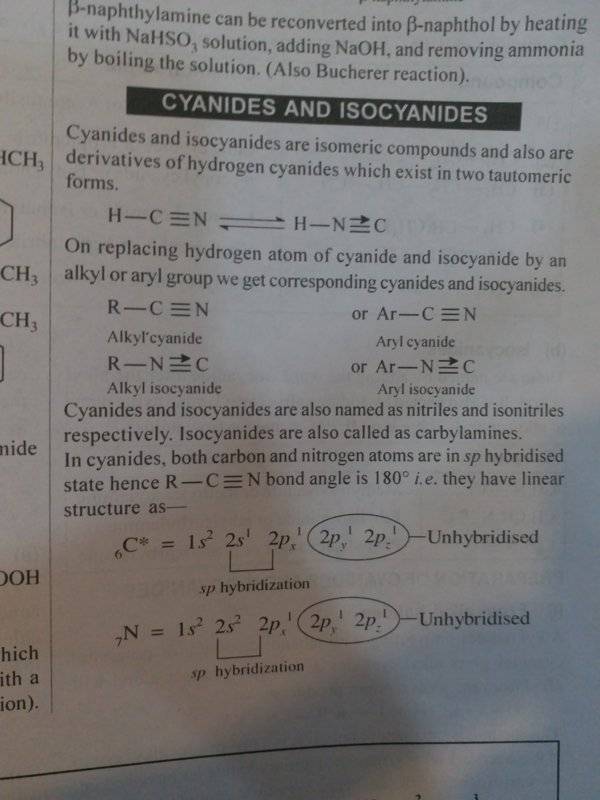
Okay guys, i had a question. Now in many indian publications and lecture rooms they say that we can represent HNC and isocyanides with a dative(coordinate) bond, but when i looked it up online, almost no one used such a structure. Wikipedia, Quora, Chem libre texts, etc, they describe it having a triple bond with charges.

Uh is the dative structure even correct ? Or is it an error that has been persistent is a bunch of indian publications ?Sources
With Dative Bond
1)Mtg-Interactive Irganic Chemistry by Girijesh Dubey (pg 623)
2)Resonance KVPY-SX Stream : Chemistry
1571210566226716413443.jpg
 
Chemistry news on Phys.org
The structure can be represented as a resonance hybrid, as on the Wikipedia page:
1571222499839.png

The double-bonded form has a lone pair on nitrogen and an empty orbital on carbon (1 lone pair rather than 2). N can use its lone pair to bond with the empty C orbital to make a triple bond, then N has a formal positive charge and C a formal negative charge. (You can draw the third bond as dative with an arrow, but that is not usual.)
The triple-bonded structure can be considered as related conceptually to the cyanide by removing a proton (and a neutron, but we don't worry about that) from the N atom of the cyanide and adding it to the C atom. This produces an isoelectronic molecule, but with charges as shown. The charges are not always drawn, especially when we are not focussing on the bonding but just representing the compound (e.g. saying A reacts with B to give C).
 
  • Like
Likes   Reactions: Navin
Ah, okay . So we can use a dative bond, but it aint a common format right ?

Also thank you for explaing the structure of the molecule, i have a tendency of getting confused with the nitrogen lone pair while solving reaction based questions, this helped clear some doubts about it
 
I admit, I've never seen an isocyanide drawn that way. It seems like a recipe for confusion, especially because isocyanides themselves are really good at forming dative bonds with metal centers (as @mjc123 's vinyl carbene resonance structure suggests).
 
  • Like
Likes   Reactions: Navin
TeethWhitener said:
I admit, I've never seen an isocyanide drawn that way. It seems like a recipe for confusion, especially because isocyanides themselves are really good at forming dative bonds with metal centers (as @mjc123 's vinyl carbene resonance structure suggests).
Oh and that's not all

We represent the Nitro group(-NO2) the same way too, istead of showing charges, we show one dative bond with one oxygen and a double bond for the other

There were some other compounds too, i can't recollect though. Basically all those compunds with formal charges were represented with dative bonds. I guess its an Indian thingie
 
It seems to be a general thing, e.g. ammonia-boron trifluoride may be drawn as
H3N→BF3
or H3N+-B-F3
 
  • Like
Likes   Reactions: Navin