Design Tool for Compression Testing of Small Samples

Click For Summary
SUMMARY

This discussion focuses on designing a tool for compression testing of small samples, specifically those measuring 3mm by 2.4mm, within 5mm by 5mm platens. Participants suggest various methods for sample positioning and alignment, including the use of a magnetic clip for secure placement, cyanoacrylate glue for adhesion, and a fixture with a cut-out to hold the sample. These design ideas aim to simplify the alignment process and enhance testing accuracy.

PREREQUISITES
  • Understanding of compression testing principles
  • Familiarity with 3D printing techniques
  • Knowledge of materials used in sample testing (ferrous and non-ferrous)
  • Basic skills in mechanical design and jig creation
NEXT STEPS
  • Research 3D modeling software for designing custom jigs
  • Explore different adhesives suitable for small sample applications
  • Investigate the properties of ferrous and non-ferrous materials for compression testing
  • Learn about fixture design principles for precision alignment
USEFUL FOR

Engineers, materials scientists, and researchers involved in compression testing and sample preparation will benefit from this discussion. Additionally, those interested in 3D printing applications for mechanical design will find valuable insights.

Andromeda1992
Messages
1
Reaction score
0
TL;DR
I need to design a tool to appropriately position and align my compression samples
Hello all,

I am looking for some design ideas. I need to do some compression testing and here is my testing platens:
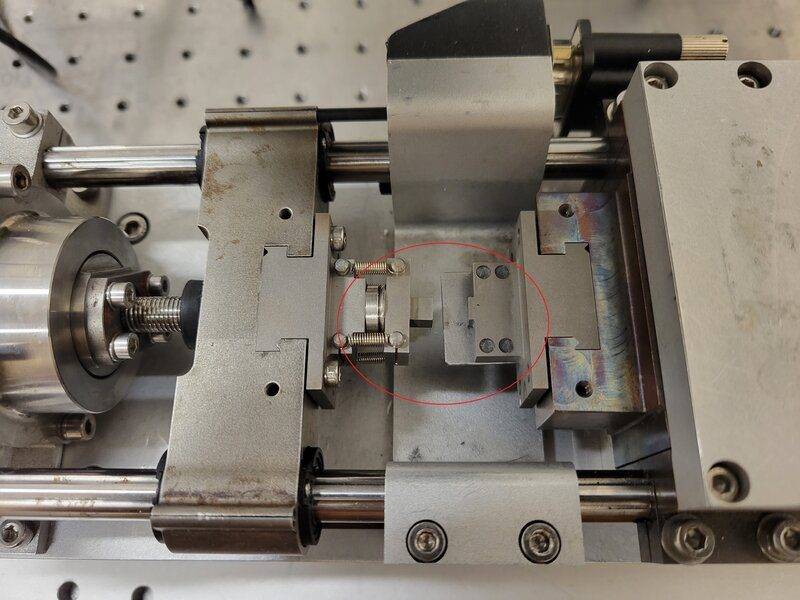
20220429_100629.jpg


The platens are small (5mm*5 mm) and my samples are even smaller with the cross section of 3mm*2.4mm, so it would be difficult to both position them within the platens and align them with the center of the platens. I need to design a simple tool like a jig or something to help me position and align my samples. I can print that with a 3D printer. Does anyone have any design idea for such a tool. I'd really appreciate your ideas.
 
Last edited by a moderator:
Engineering news on Phys.org
Welcome to PF.

What material(s) will your samples be made of? Ferrous or non-ferrous?

It looks like the right platen is stationary, so you could make a small magnetic clip that sits on the top surface of the right platen and holds the sample either magnetically or with a dab of adhesive. You can then position the clip left-right to put the sample against the right platen surface, and you can have some sort of up-down adjustment as part of the clip's sample holding mechanism.
 
61aC9CqeMBL._AC_SX679_.jpg


Only half joking here. How complex are your requirements?
 
More ideas:

1) Stick the sample in place with cyanoacrylate glue.

2) Cut a (rectangular?) hole in a sheet of paper/plastic/rubber/thin sheet of something, press the sample into the hole, clamp the thin sheet in a larger fixture to position the sample.

3) Superglue the side of the sample to the end of a rod. Clamp the rod in an external fixture.
 
  • Like
Likes   Reactions: berkeman

Similar threads

Replies
9
Views
2K
  • · Replies 5 ·
Replies
5
Views
4K
Replies
3
Views
2K
  • · Replies 16 ·
Replies
16
Views
3K
  • · Replies 9 ·
Replies
9
Views
3K
  • · Replies 6 ·
Replies
6
Views
2K
Replies
13
Views
2K
  • · Replies 3 ·
Replies
3
Views
2K
Replies
22
Views
2K
  • · Replies 2 ·
Replies
2
Views
5K