Math Amateur
Gold Member
MHB
- 3,920
- 48
I am reading D. J. H. Garling: "A Course in Mathematical Analysis: Volume I Foundations and Elementary Real Analysis ... ...
I am currently focused on Garling's Section 1.7 The Foundation Axiom and the Axiom of Infinity ... ...
I need some help with Theorem 1.7.4 ... and in particular with the notion of a successor set ##Z^+## ... ...... ... the relevant text from Garling is as follows:
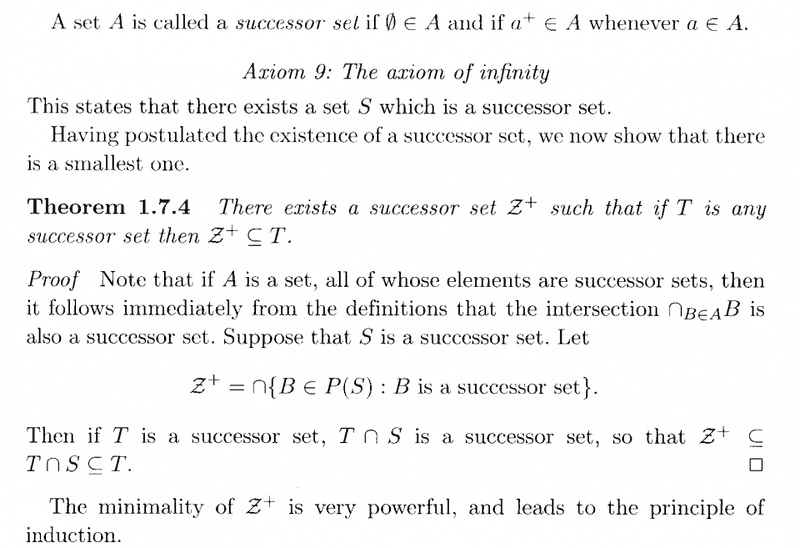
In the above text we read the following:
" ... ... Suppose that ##S## is a successor set. Let
##Z^+ = \cap \{ B \in P(S) : B \text{ is a successor set } \} ## ... "
Note also that Garling defines a successor set as follows:
" ... ... A set ##A## is called a successor set if ##\emptyset \in A## and if ##a^+ \in A## whenever ##a \in A## ... ... "and
Garling defines ##a^+## as follows:
" ... ... If ##a## is a set, we define ##a^+## to be the set ##a \cup \{ a \}## ... ... "
Now my problem is that I do not understand the definition of ##Z^+## ... ... in each example I construct I seem to get ##Z^+ = \emptyset## ... ... and this cannot be right ...For example ...
Suppose that a successor set S is such that:
##S = \{ \emptyset , a , a \cup \{ a \} , \{ a , b \}, \{ a , b \} \cup \{ \{ a , b \} \} \}##
... then we have ...
##Z^+ = \cap B_i ## where ##B_i \in P(S)## and each ##B_i## is a successor set ...
then we have ..
##B_1 = \{ \emptyset, a , a \cup \{ a \} \}##
##B_2 = \{ \emptyset, \{ a , b \} , \{ a , b \} \cup \{ \{ a , b \} \} \}##
and
##B_3 = S##Indeed,
##B_1, B_2, B_3## seem to me to be the only subsets of ##P(S)## that are successor setsand##\cup B_i = \emptyset##BUT ... surely this cannot be right ...Can someone clarify this issue and show me how ##Z^+## is meant to be constructed ...
Hope someone can help ...
Peter====================================================
In order to enable readers to get a better understanding of Garling's notation and approach I am providing the first two pages of Section 1.7 ... as follows:
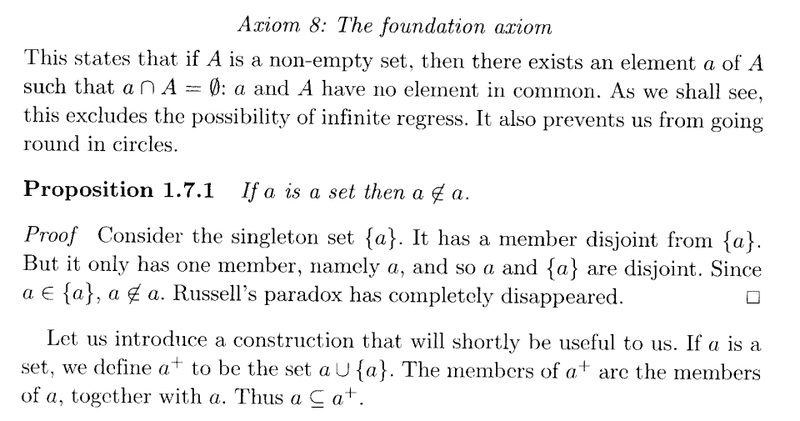
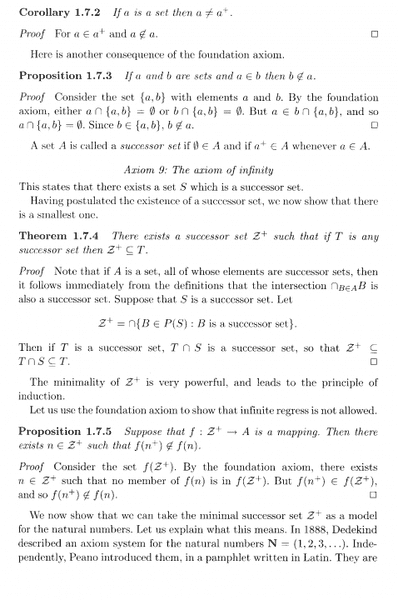
I am currently focused on Garling's Section 1.7 The Foundation Axiom and the Axiom of Infinity ... ...
I need some help with Theorem 1.7.4 ... and in particular with the notion of a successor set ##Z^+## ... ...... ... the relevant text from Garling is as follows:
In the above text we read the following:
" ... ... Suppose that ##S## is a successor set. Let
##Z^+ = \cap \{ B \in P(S) : B \text{ is a successor set } \} ## ... "
Note also that Garling defines a successor set as follows:
" ... ... A set ##A## is called a successor set if ##\emptyset \in A## and if ##a^+ \in A## whenever ##a \in A## ... ... "and
Garling defines ##a^+## as follows:
" ... ... If ##a## is a set, we define ##a^+## to be the set ##a \cup \{ a \}## ... ... "
Now my problem is that I do not understand the definition of ##Z^+## ... ... in each example I construct I seem to get ##Z^+ = \emptyset## ... ... and this cannot be right ...For example ...
Suppose that a successor set S is such that:
##S = \{ \emptyset , a , a \cup \{ a \} , \{ a , b \}, \{ a , b \} \cup \{ \{ a , b \} \} \}##
... then we have ...
##Z^+ = \cap B_i ## where ##B_i \in P(S)## and each ##B_i## is a successor set ...
then we have ..
##B_1 = \{ \emptyset, a , a \cup \{ a \} \}##
##B_2 = \{ \emptyset, \{ a , b \} , \{ a , b \} \cup \{ \{ a , b \} \} \}##
and
##B_3 = S##Indeed,
##B_1, B_2, B_3## seem to me to be the only subsets of ##P(S)## that are successor setsand##\cup B_i = \emptyset##BUT ... surely this cannot be right ...Can someone clarify this issue and show me how ##Z^+## is meant to be constructed ...
Hope someone can help ...
Peter====================================================
In order to enable readers to get a better understanding of Garling's notation and approach I am providing the first two pages of Section 1.7 ... as follows:


