Basic theory behind conservation of momentum and impulse.

Click For Summary

Homework Help Overview

The discussion revolves around the conservation of momentum and impulse in a scenario involving a rod and a table during an impact event. The original poster questions the validity of the conservation of momentum due to the observed momentum values before and after the impact, particularly in light of the coefficient of restitution provided.

Discussion Character

  • Exploratory, Assumption checking, Conceptual clarification

Approaches and Questions Raised

  • Participants explore the implications of momentum conservation in the context of an eccentric impact and question the assumptions regarding the table's velocity. There is discussion about potential approximations that could simplify the analysis, particularly regarding the relative masses of the rod and table.

Discussion Status

Participants are actively engaging with the problem, raising questions about the assumptions made in the conservation equations. Some guidance has been offered regarding the significance of the table's velocity change and the implications of using approximations in the analysis.

Contextual Notes

There is an ongoing debate about the appropriateness of assuming momentum conservation in this scenario, particularly given the eccentric nature of the impact and the mass differences involved. The original poster's understanding of the problem is still developing, as they seek clarification on the implications of their assumptions.

theBEAST
Messages
361
Reaction score
0
Conservation of momentum does not hold true?

Homework Statement


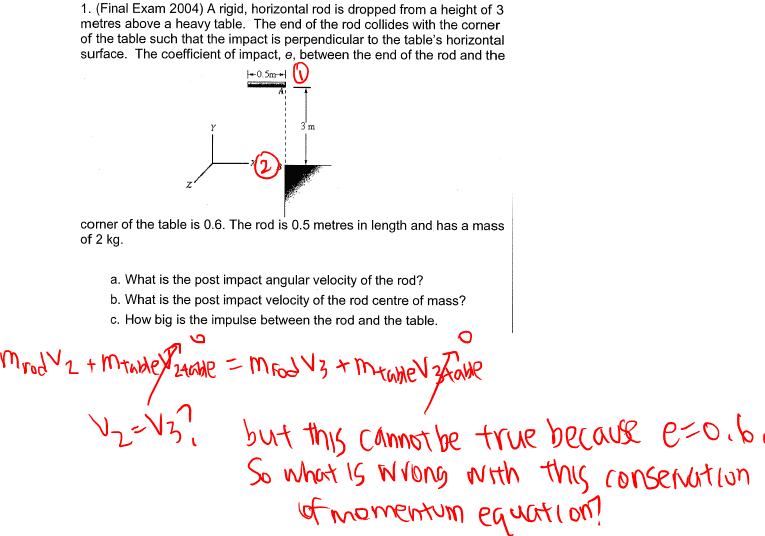
Here is the problem. State 2 is shown in the picture, it is right before impact. State 3 is after impact.
Wx4wt.png


I used conservation of momentum of the entire system (rod and table. However as you can see it shows us that the rod has the same momentum before and after the impact. This is impossible because e=0.6. Why is it that my conservation equation does not hold?
 
Last edited:
Physics news on Phys.org
Because you have said the speed of the table does not change. In reality, it would change. This makes the equation for v3 more complicated, but luckily you can use an approximation. Think about the mass of the table compared to that of the rod. What approximation should you use?
 
Hmmm I'm not sure what approximation to use. I thought that linear momentum is not conservated because the impact
Is eccentric (the line of impact
does not cross the center of gravity).
 
momentum is conserved. For the approximation, think about a real-life situation where something strikes a table. Is the change in velocity of the table significant? The answer to this suggests what your approximation should be. Don't be surprised is momentum is not conserved in the approximated equation. (That is because the equation is only approximately true).
 
BruceW said:
momentum is conserved. For the approximation, think about a real-life situation where something strikes a table. Is the change in velocity of the table significant? The answer to this suggests what your approximation should be. Don't be surprised is momentum is not conserved in the approximated equation. (That is because the equation is only approximately true).

Alright, so the mv3_table term should not be zero. Because you have a huge mass and a tiny velocity. And thus you make the approximation that velocity is zero so you can solve for the final velocity of the ball using the restitution constant equation? Am I right?
 
exactly :)

Edit: yep, so that gives you the velocity of the edge of the rod after impact, so then you can use this to answer part a
 

Similar threads

Replies
17
Views
2K
  • · Replies 19 ·
Replies
19
Views
3K
  • · Replies 17 ·
Replies
17
Views
1K
  • · Replies 13 ·
Replies
13
Views
1K
  • · Replies 9 ·
Replies
9
Views
2K
Replies
5
Views
1K
  • · Replies 5 ·
Replies
5
Views
2K
  • · Replies 8 ·
Replies
8
Views
2K
Replies
10
Views
3K
  • · Replies 18 ·
Replies
18
Views
4K