Undergrad Bloch Analysis proof of Theorem 2.5.5 (Definition by recursion)

  • Thread starter Thread starter BugKingpin
  • Start date Start date
  • Tags Tags
    Proof Set Theorem
Click For Summary
The discussion revolves around understanding the relationship between set C, which contains the Cartesian product of natural numbers and set H. The key point is that if (n,y) is in the product N x H, then the recursive definitions involving functions s and k ensure that (s(n), k(y)) also belongs to N x H, confirming that this product is an element of C. The confusion arises in proving that B equals H, as the properties of H need to be established without knowing its contents. Ultimately, it is concluded that H is populated by elements defined through the function k, which maps elements of H to themselves, thereby satisfying the necessary conditions. The discussion highlights the subtleties of combinatorial definitions and recursive functions in set theory.
BugKingpin
Messages
2
Reaction score
1
TL;DR
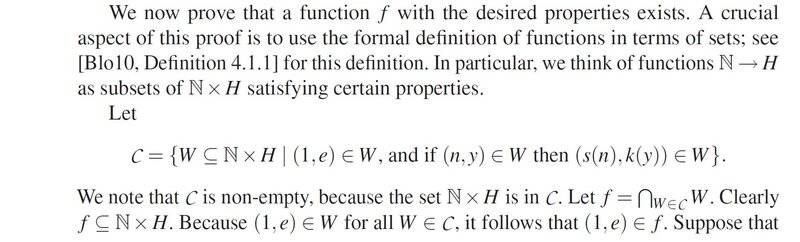
Not sure why ##N## X H ##\epsilon## C in the existence proof of theorem 2.5.5 in Bloch.
Want to understand how set C contains ##N## x H. H is only defined to be a set with element e and as the domain/range of function k. Is this enough information to conclude that the second set in the cartesian product W is H and not a subset of H?

My thinking is to show that ##N## and H satisfy the definition of sets A and B in an element W = A x B ##\epsilon## C. Then ##N## x H ##\epsilon##. Since 1 ##\epsilon## A so A ##\subseteq N##. If n ##\epsilon## A then s(n) ##\epsilon## A then by Peano Axioms/induction A = ##N##. Then we have to show that B = H. This is the part I am confused by.

Let e ##\epsilon## B. By the set builder rule of C, if (n,y) ##\epsilon## W then (s(n),k(y)) ##\epsilon## W which means if y ##\epsilon## B then k(y) ##\epsilon## B. This means that k(1) ##\epsilon## B and k^{n}(1) ##\epsilon## B. But according to this definition, B is infinite as there are infinite n ##\epsilon## N.

To show that B = H, I either need to use some theorem or show that H and B are subsets of each other. But if I don't know what's in H how do I show that every element of B is also in H and vice versa?

ph_forum2.jpg
ph_forum1.jpg
 
Last edited:
Physics news on Phys.org
I don't fully understand your post but I think you've missed the point because it's trivial. ##\mathbb{N}\times H## just simply satisfy that if ##(x,y) \in \mathbb{N}\times H## then ##(s(x),k(y))\in \mathbb{N}\times H##. But s and k by definition return elements of ##\mathbb{N}## and ##H## so of course it's true.

Also we need ##(1,e)\in \mathbb{N}\times H## which is similarly trivial, since we already know they belong to these sets. Hence ##\mathbb{N}\times H## is an element of ##C##
 
Office_Shredder said:
I don't fully understand your post but I think you've missed the point because it's trivial. ##\mathbb{N}\times H## just simply satisfy that if ##(x,y) \in \mathbb{N}\times H## then ##(s(x),k(y))\in \mathbb{N}\times H##. But s and k by definition return elements of ##\mathbb{N}## and ##H## so of course it's true.

Also we need ##(1,e)\in \mathbb{N}\times H## which is similarly trivial, since we already know they belong to these sets. Hence ##\mathbb{N}\times H## is an element of ##C##
I really overthought this. So that condition is really just the definition of a function H->H; H contains every element in the domain and range of k and there must be a k(y) in H for every element y in H. So that definition starting with the element e completely populates H as I mentioned above?

Great signature btw. Combinatorics is indeed very subtle.
 
We all know the definition of n-dimensional topological manifold uses open sets and homeomorphisms onto the image as open set in ##\mathbb R^n##. It should be possible to reformulate the definition of n-dimensional topological manifold using closed sets on the manifold's topology and on ##\mathbb R^n## ? I'm positive for this. Perhaps the definition of smooth manifold would be problematic, though.

Similar threads

  • · Replies 16 ·
Replies
16
Views
2K
  • · Replies 2 ·
Replies
2
Views
2K
  • · Replies 1 ·
Replies
1
Views
2K
  • · Replies 2 ·
Replies
2
Views
2K
  • · Replies 1 ·
Replies
1
Views
2K
  • · Replies 1 ·
Replies
1
Views
5K
  • · Replies 2 ·
Replies
2
Views
2K
Replies
2
Views
2K
  • · Replies 20 ·
Replies
20
Views
2K
  • · Replies 2 ·
Replies
2
Views
2K