Boom Angle of Crane: Is High Extension Necessary?

  • Thread starter Thread starter DaveC426913
  • Start date Start date
  • Tags Tags
    Angle Crane
Click For Summary

Discussion Overview

The discussion revolves around the necessity of high boom extension in boat hauling cranes, exploring its implications for maneuverability, safety, and structural integrity. Participants examine the mechanics involved in crane operation, particularly in relation to the forces at play and the materials used in boom construction.

Discussion Character

  • Exploratory
  • Technical explanation
  • Conceptual clarification
  • Debate/contested

Main Points Raised

  • Some participants question whether the high extension of crane booms serves a practical purpose in terms of effort or safety.
  • One participant suggests that high boom extension facilitates easier maneuvering of the boat for the ground crew.
  • Another participant elaborates that moving the boat can create a restoring force based on the angle of deflection of the suspension wire, which is influenced by the length of the wire.
  • A participant raises a concern about the potential for the boat to hit the boom if it pivots too high.
  • Discussion includes insights on the evolution of boom design, noting that composite booms require full extension to achieve rigidity, a principle that may also apply to modern steel booms.
  • It is mentioned that boom angle and safe operation are managed by an onboard computer system to prevent unsafe crane operation.

Areas of Agreement / Disagreement

Participants express varying views on the necessity and implications of high boom extension, with no consensus reached on whether it is essential for safety or operational efficiency.

Contextual Notes

Participants discuss the mechanics of crane operation without resolving the implications of boom height on safety or efficiency. The discussion includes assumptions about the forces involved and the design principles of different boom materials.

DaveC426913
Gold Member
2025 Award
Messages
24,465
Reaction score
8,723
TL;DR
Is there a reason why a boom crane operator would extend the boom higher than physically necessary?
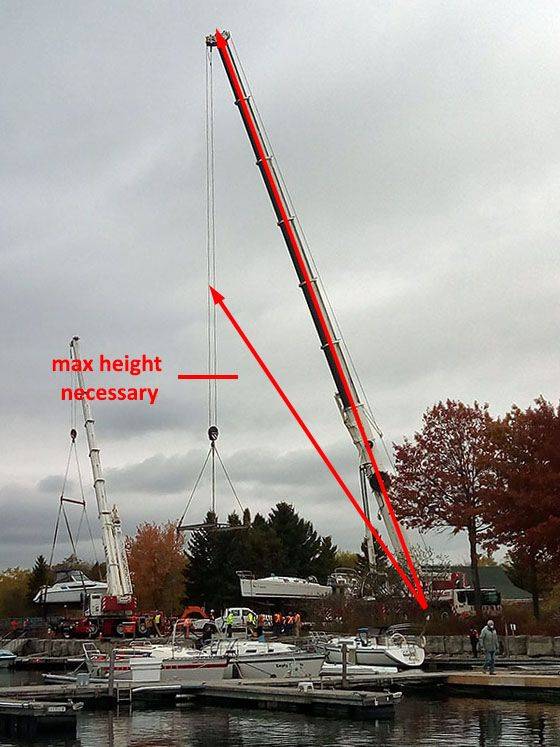
These boat hauling cranes seem to extend their booms as high as possible. Much higher than necessary for the max height of the boat lifting rig.

Does this accomplish something effort or safety-wise?

It's not like a simple torque situation - the force applied is gravity - straight down - not perpendicular to the boom as it might be in a simple setup.
crane.jpg
 
Engineering news on Phys.org
It would make manoevring the boat easier for the ground crew.
 
tech99 said:
It would make manoevring the boat easier for the ground crew.
Why/how?
 
It is possible for the ground crew to move the boat around to a limited extent, which pulls the suspension wire out of vertical. When they do this, there is a restoring force equal to Weight x Sin (angle of deflection).
If the wire is very long, the angle of deflection is smaller, so the restoring force is less.
For example, a boat weighs 1t and the wire is 2 degs out of vertical. Restoring force = 1 x sin 2 = 0.03t.
By the same token, if the wire is 20m long, then the boat has been moved by 20 sin 2 = 0.7m.
 
  • Informative
  • Like
Likes   Reactions: Lnewqban and berkeman
Another factor, how high can that boat get before it could hit the boom if it pivots?
 
When they began to build booms from composites, rather than the heavy and difficult to work HT steel, all the sections were extended by an internal tensile wire. The boom had no real strength while being extended as the composite tube walls were too light to carry a large moment at part extension. The composite sections must be fully extended for the tube ends (where there are a pair of internal pulleys) to lock, and so become rigid, and able to carry a side force. The telescopic tubes are under compression, the wire is under tension.

I believe that steel booms are now designed using the same philosophy, as they must compete with composite booms. So, now all booms are operated fully extended.

The boom angle is controlled, and the safe operating envelope managed by a dedicated on-board computer, to prevent the operator from "taking the crane out-of-survey", to put it nicely.
 
  • Informative
  • Like
Likes   Reactions: Dullard, berkeman and anorlunda

Similar threads

  • · Replies 1 ·
Replies
1
Views
2K
  • · Replies 1 ·
Replies
1
Views
3K
  • · Replies 7 ·
Replies
7
Views
3K
  • · Replies 27 ·
Replies
27
Views
11K
  • · Replies 1 ·
Replies
1
Views
2K
  • · Replies 4 ·
Replies
4
Views
7K
  • · Replies 1 ·
Replies
1
Views
4K
  • · Replies 6 ·
Replies
6
Views
4K
  • · Replies 12 ·
Replies
12
Views
5K
  • · Replies 4 ·
Replies
4
Views
9K