Bridge Beam Shapes: Why Are They Different?

  • Thread starter Thread starter rollingstein
  • Start date Start date
  • Tags Tags
    Beam Bridge Shape
Click For Summary

Discussion Overview

The discussion revolves around the differing designs of two bridges spanning a river, focusing on the shapes and structural principles of their beams. Participants explore the implications of these designs in terms of material distribution, structural integrity, and engineering practices, touching on concepts such as bending moments and the types of bridge construction.

Discussion Character

  • Exploratory
  • Technical explanation
  • Debate/contested

Main Points Raised

  • Some participants note that the newer concrete bridge appears to utilize a shallow arch design based on the cantilever principle, which allows it to remain in compression under load.
  • Others describe the older bridge as a type of deck truss, questioning whether its design is indeed a truss or a plate girder, and express confusion over the rationale for placing more material at mid-span.
  • One participant explains that the bending moment in a simple beam is maximum at the midpoint, suggesting this is why the newer design has maximum material there, while for cantilevers, the maximum occurs at the support.
  • Another participant clarifies that the structural principle of a plate girder is similar to that of a deck truss, emphasizing the importance of increasing depth at points of maximum bending moment to reduce stress.

Areas of Agreement / Disagreement

Participants express varying interpretations of the bridge designs, with some agreeing on the structural principles involved while others contest the classification of the older bridge's design. The discussion remains unresolved regarding the specific reasons for the differing material distributions in the two bridges.

Contextual Notes

Participants mention various factors influencing bridge design, such as span length, clearance, aesthetics, and cost, indicating that structural considerations may not always be the primary focus.

rollingstein
Messages
644
Reaction score
16
I pass a river with two bridges on it, right next to each other. One older, one newer.

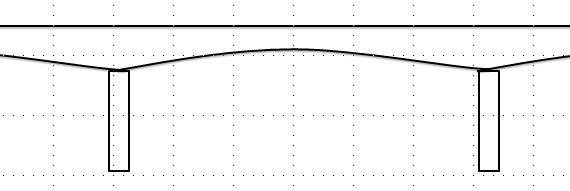
The newer one is all concrete construction & the shape of its spans makes intuitive sense to me i.e. minimum thickness at mid span. Like this sketch:
xjSJmI1.jpg


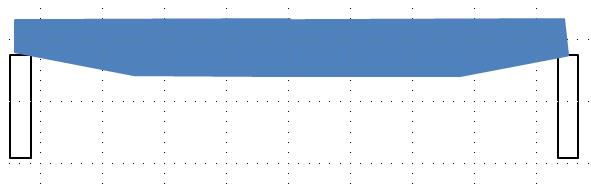
The older one has sort of the opposite shape with max girder thickness at mid span. Intuitively I cannot figure why this would be chosen so? Any thoughts? I have a sketch below.
BOERZpl.jpg


If it matters the girders in the older bridge are steel with concrete piers.

Basically, does it make sense to have a beam that is thickest (deepest?) at the center? I find odd that two bridges will have the optimal beam shape exactly opposite.
 
Engineering news on Phys.org
rollingstein said:
I pass a river with two bridges on it, right next to each other. One older, one newer.

The newer one is all concrete construction & the shape of its spans makes intuitive sense to me i.e. minimum thickness at mid span. Like this sketch:

xjSJmI1.jpg

This newer concrete bridge appears to be constructed as a shallow arch on the cantilever principle. As a load moves between the piers of this type of bridge, the bridge structure is designed to remain in compression, which concrete can withstand quite well. If concrete is put into tension, things get trickier, and steel must be added to take the tension, as concrete has very low tensile strength, and the design of the structure is more complicated.

Arch bridges have traditionally had a very solid and heavy appearance. With new pre-stressed concrete construction techniques becoming available over the last century or so, bridge engineers have been able to develop arch bridge designs which are quite light in appearance, while maintaining great strength.

http://en.wikipedia.org/wiki/Cantilever_bridge

The older one has sort of the opposite shape with max girder thickness at mid span. Intuitively I cannot figure why this would be chosen so? Any thoughts? I have a sketch below.

BOERZpl.jpg


If it matters the girders in the older bridge are steel with concrete piers.
This older bridge appears to be a type of deck truss, where the truss work is built below the road surface. There are a dizzying array of different types of truss bridge construction, which can be seen in this article:

http://en.wikipedia.org/wiki/Truss_bridge

Truss bridges can be fabricated from a number of simple parts and erected rather quickly, in comparison with other methods of construction.

Basically, does it make sense to have a beam that is thickest (deepest?) at the center? I find odd that two bridges will have the optimal beam shape exactly opposite.

There are many factors which go into the design of a bridge. The length of span, amount of clearance below midspan for any other road or water traffic, aesthetics, cost, etc. Sometimes, the structural considerations wind up down the list.
 
SteamKing said:
This older bridge appears to be a type of deck truss, where the truss work is built below the road surface. There are a dizzying array of different types of truss bridge construction, which can be seen in this article:

Didn't seem like a truss to me. At least not what I think of as a truss. This below is what I think of as a truss:

atlas-884-ho-oo-scales-deck-truss-bridge-kit-code-100-21890-p.jpg


But if it looks like a single solid steel plate from the side, is that a truss too? The older bridge spans looks more like this element below but in that trapezoidal shape. The main question I had was why one might want to put most metal at mid span instead of at the support.

Capitol-Steel-Girder-004.jpg
 
rollingstein said:
Didn't seem like a truss to me. At least not what I think of as a truss. This below is what I think of as a truss:

atlas-884-ho-oo-scales-deck-truss-bridge-kit-code-100-21890-p.jpg


But if it looks like a single solid steel plate from the side, is that a truss too? The older bridge spans looks more like this element below but in that trapezoidal shape. The main question I had was why one might want to put most metal at mid span instead of at the support.

Capitol-Steel-Girder-004.jpg

No, that's a regular plate girder. The structural principle is similar, though, to a deck truss. The plate girder supports the loads on the bridge as a beam, which means that a bending moment is generated in the span, which will be a maximum midway between supports. The way to reduce bending stress in a beam is to increase its depth in way of where the maximum bending moment will occur.
 
SteamKing said:
No, that's a regular plate girder. The structural principle is similar, though, to a deck truss. The plate girder supports the loads on the bridge as a beam, which means that a bending moment is generated in the span, which will be a maximum midway between supports. The way to reduce bending stress in a beam is to increase its depth in way of where the maximum bending moment will occur.

Ah! That makes sense then.

I think I get where my confusion arose from:

The Bending Moment of a simple beam maxes out at its midpoint whereas for a cantilever it maxes out at the support. Correct?

If so, that explains intuitively why one bridge design needed max material at mid-span & the other at the support.
 
rollingstein said:
Ah! That makes sense then.

I think I get where my confusion arose from:

The Bending Moment of a simple beam maxes out at its midpoint whereas for a cantilever it maxes out at the support. Correct?

Correct.

If so, that explains intuitively why one bridge design needed max material at mid-span & the other at the support.

The bridge over the Firth of Forth in Scotland is one of the crowning achievements of Victorian engineering which is still in use today:

http://en.wikipedia.org/wiki/Forth_Bridge

This photo of the the 2 men supporting a third man suspended between them is a striking illustration of the cantilever concept:

800px-Cantilever_bridge_human_model.jpg
 
  • Like
Likes   Reactions: BrentS

Similar threads

  • · Replies 2 ·
Replies
2
Views
2K
Replies
2
Views
6K
  • · Replies 4 ·
Replies
4
Views
8K
Replies
4
Views
4K
  • · Replies 21 ·
Replies
21
Views
6K
  • · Replies 6 ·
Replies
6
Views
4K
  • · Replies 6 ·
Replies
6
Views
3K
  • · Replies 4 ·
Replies
4
Views
15K
  • · Replies 1 ·
Replies
1
Views
4K
  • · Replies 2 ·
Replies
2
Views
4K