Broadly spiralling shape from partial sums of Zeta (0.5 + i t)

  • Context: Undergrad 
  • Thread starter Thread starter Swamp Thing
  • Start date Start date
  • Tags Tags
    Partial Shape Sums
Click For Summary
SUMMARY

The discussion centers on the behavior of the Riemann zeta function, specifically the partial sums of Zeta(0.5 + i t) for t = 778948.517. It highlights the aliasing effects that lead to a spiraling pattern in the plots, including a Cornu spiral. The conversation also addresses the validity of discussing partial sums of divergent series and their relationship to analytic continuation, concluding that while it is not incorrect to refer to partial sums, they do not relate to Zeta(s) when Re(s) ≤ 1. The participants express interest in exploring these concepts further, particularly in the context of educational content.

PREREQUISITES
  • Understanding of the Riemann zeta function and its properties
  • Familiarity with complex analysis and analytic continuation
  • Knowledge of series convergence and divergence
  • Basic calculus concepts related to complex numbers
NEXT STEPS
  • Investigate the properties of the Dirichlet eta function and its relation to the Riemann zeta function
  • Learn about aliasing effects in mathematical series and their graphical representations
  • Explore numerical methods for evaluating divergent series and their partial sums
  • Study the implications of analytic continuation in complex analysis
USEFUL FOR

Mathematicians, educators, and students interested in complex analysis, particularly those exploring the Riemann zeta function and its applications in number theory and mathematical visualization.

Swamp Thing
Insights Author
Messages
1,047
Reaction score
780
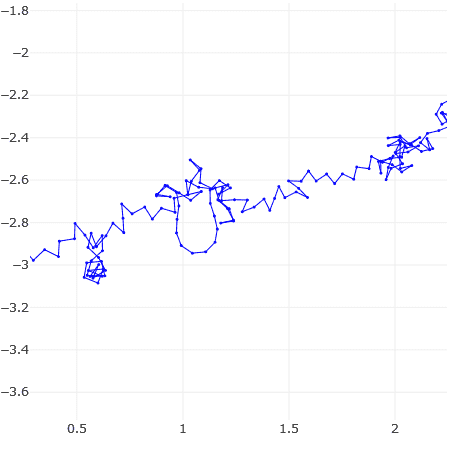
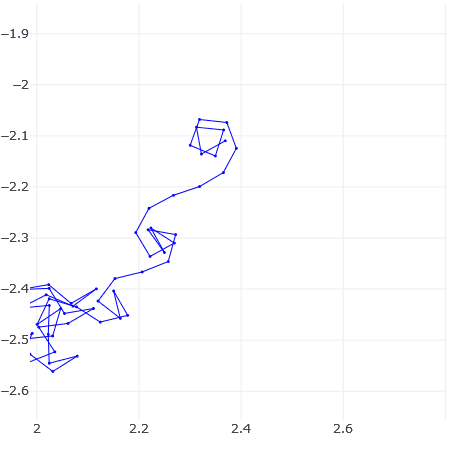
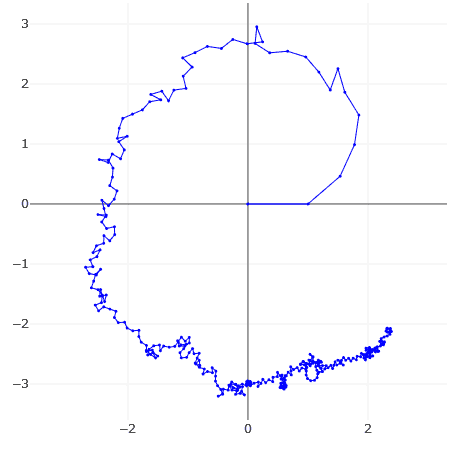
The first plot shows a large number of terms of Zeta(0.5 + i t) plotted end to end for t = 778948.517. The other plots are two zoomed-in regions, including one ending in a Cornu spiral. Despite all sorts of vicissitudes, the plot generally spirals outwards in a "purposeful" sort of way. It is not hard to find values of t that give such plots.

What causes this phenomenon?

Now for the first few terms, it can be explained as an aliasing effect where successive terms have approximately the same phase (angle) modulo 2 Pi. Similarly, the Cornu spiral is also an aliasing / sampling effect where the angle modulo 2Pi changes gradually.

But what about the emergence of a broad trend from a really long series of terms that seem to be changing randomly in angle?
1637037402750.png
1637037428533.png
1637038042197.png
 
Last edited:
Physics news on Phys.org
Swamp Thing said:
The first plot shows a large number of terms of Zeta(0.5 + i t)
I assume you are referring to the Riemann zeta function? How are you defining a 'term' of ## \zeta(s) ##?
 
Yes, it's the Riemann zeta function.
So the Nth term would be N^( -s ) ?
 
Ah, I thought that might be the case. That definition only holds for ## \mathfrak{Re}(s) > 1 ##.
 
pbuk said:
Ah, I thought that might be the case. That definition only holds for ## \mathfrak{Re}(s) > 1 ##.
This has been nagging at my mind. Is it technically wrong to talk of "partial sums" (and their "terms"), for a divergent series that has to be evaluated by analytical continuation?
 
Update: shortly after posting the OP, I realized that by tweaking the "t" value a bit, the spiral can be straightened out so that it runs in an approximately straight path. This happens whenever the magnitude of zeta(s) goes through a particularly tall peak.

This doesn't quite answer my original question, though.
 
Swamp Thing said:
This has been nagging at my mind. Is it technically wrong to talk of "partial sums" (and their "terms"), for a divergent series that has to be evaluated by analytical continuation?
It is not wrong to talk about partial sums of a divergent series, however the analytic continuation of ## \zeta(s) ## does not relate to that series. Or to put it another way, the partial sums of the series ## \displaystyle\sum_{n = 1}^{\infty} \frac{1}{n^s} ## may or may not be interesting in their own right but they have nothing to do with ## \zeta(s) ## when ## \mathfrak{Re}(s) \le 1 ##.
 
  • Like
Likes   Reactions: Swamp Thing
pbuk said:
partial sums of the series ... have nothing to do with ζ(s) when Re(s)≤1.
Would it be considered startling or original if this disconnect could be bridged?

The reason I ask is that for a couple of years I have been doing numerical experiments and stuff, based on which I hope to make some YouTube videos that will explain how to understand analytic continuation by starting with the partial sums and some of their properties. The aim is to target people with very basic calculus and complex number prerequisites. (Maybe I will write an Insights article on PhysicsForums at some point).
 
Swamp Thing said:
Would it be considered startling or original if this disconnect could be bridged?
If by 'bridging' you mean subtracting ## \displaystyle\sum_{n = 1}^{\infty} \frac{1}{(2n)^s} ## so that you get the Dirichlet eta function and an extension of the region of convergence to ## \mathfrak{Re}(s) \gt 0, s \ne 1 ## then that would not be startling or original. It might be interesting to see how the partial sums of ## \eta(s) ## behave, but the partial sums of ## \eta(s) ## don't look like the partial sums of ## \displaystyle\sum_{n = 1}^{\infty} \frac{1}{n^s}
## in the region we are interested in.
 

Similar threads

  • · Replies 3 ·
Replies
3
Views
3K
  • · Replies 2 ·
Replies
2
Views
2K
  • · Replies 1 ·
Replies
1
Views
4K
  • · Replies 16 ·
Replies
16
Views
5K
  • · Replies 2 ·
Replies
2
Views
3K
  • · Replies 2 ·
Replies
2
Views
4K