Calculate the minimum uncertainty

Click For Summary
The discussion revolves around calculating the minimum uncertainty in the vertical momentum of photons passing through a narrow slit. The original poster seeks help with the equations and concepts from their textbook, specifically regarding the uncertainty principle and diffraction. They initially calculated an incorrect value for the uncertainty but received guidance on the relevant equations and dimensions. After further clarification and discussion, the poster successfully solved their problem. The thread highlights the importance of understanding wave-particle duality and the application of uncertainty in physics.
Kaspar
Messages
3
Reaction score
1
Hello,
can anybody help me with solving the problem.

Homework Statement

:[/B]
Calculate minimum uncertainty?

A horizontal beam of laser light of wavelength 604 nm passes through a narrow slit that has width 0.0600 mm . The intensity of the light is measured on a vertical screen that is 2.40 m from the slit.

a.) What is the minimum uncertainty in the vertical component of the momentum of each photon in the beam after the photon has passed through the slit?
∆p_y=?

b.)Use the result of part A to estimate the width of the central diffraction maximum that is observed on the screen.
d=?

Homework Equations

and

The Attempt at a Solution

:
[/B][/B]

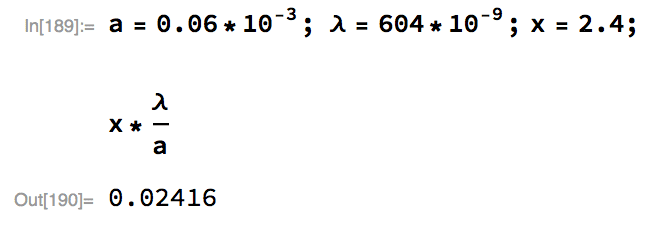
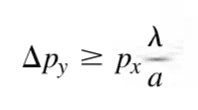
a.) I tried using this equation and I got for ∆p_y=0.02416m
But it was wrong. :frown:

See in picture.

Can anybody help me?
Thank you.
M
pic.png

pic2.png


Attachments

  • pic2.png
    pic2.png
    4.4 KB · Views: 3,307
  • pic.png
    pic.png
    1.7 KB · Views: 3,062
Physics news on Phys.org
Hello Kaspar, :welcome:

Kaspar said:
I tried using this equation
I suppose you tried ##\Delta p_y = p_x{\lambda\over a}## ? Where does that come from ? And for ##p_x## you use the distance to the screen ?

I got for ∆p_y=0.02416 m
A ##\Delta p## with the dimension of m ?

In what context is this exercise ? Does the textbook mention uncertainty somewhere ?
 
BvU said:
Hello Kaspar,
I suppose you tried ##\Delta p_y = p_x{\lambda\over a}## ? Where does that come from ? And for ##p_x## you use the distance to the screen ?

Hi BvU, thanks for your reply. The equation comes from the textbook "University of Physics - Modern physics" by Zemansky (https://drive.google.com/drive/folders/13rAnc_ryXgKa3YQOXms2AGnbpFvqeXXd , book page 1268)

A ##\Delta p## with the dimension of m ?
In what context is this exercise? Does the textbook mention uncertainty somewhere ?

Yes its the chapter "38.4 WAVE–PARTICLE DUALITY, PROBABILITY, AND UNCERTAINTY"
But I still don't know how to calculate: ##\Delta p_y##
Dimension should be kg*m/s .
 
Kaspar said:
The equation comes from the textbook "University of Physics - Modern physics" by Zemansky
Ok, but the story continues on the next page !
 
BvU said:
And for pxpxp_x you use the distance to the screen ?
The distance to the screen cannot be relevant for part a). Isn't it just a matter of ΔyΔpy≥ etc?
 
haruspex said:
The distance to the screen cannot be relevant for part a). Isn't it just a matter of ΔyΔpy≥ etc?

You are right.

I solved my problem. Here you can see. Thank you.
solved.png
 

Attachments

  • solved.png
    solved.png
    14.5 KB · Views: 2,799
  • Informative
Likes skycutter
The book claims the answer is that all the magnitudes are the same because "the gravitational force on the penguin is the same". I'm having trouble understanding this. I thought the buoyant force was equal to the weight of the fluid displaced. Weight depends on mass which depends on density. Therefore, due to the differing densities the buoyant force will be different in each case? Is this incorrect?

Similar threads

  • · Replies 10 ·
Replies
10
Views
9K
Replies
1
Views
1K
  • · Replies 1 ·
Replies
1
Views
1K
  • · Replies 16 ·
Replies
16
Views
2K
  • · Replies 8 ·
Replies
8
Views
6K
  • · Replies 57 ·
2
Replies
57
Views
6K
  • · Replies 1 ·
Replies
1
Views
3K
Replies
6
Views
2K
  • · Replies 2 ·
Replies
2
Views
2K
  • · Replies 8 ·
Replies
8
Views
3K