Calculating F, V and C: Why Can It Not Be Obtained This Way?

  • Thread starter Thread starter hidemi
  • Start date Start date
Join the discussion
Registration is free. Ask a follow-up in this thread, or start your own.
4 replies · 2K views
hidemi
Messages
206
Reaction score
36
Homework Statement
A 0.20-kg particle moves along the x axis under the influence of a conservative force. The potential energy is given by

U(x) = (8.0 J/m^2)x^2 + (2.0 J/m^4)x^4,

where x is in coordinate of the particle. If the particle has a speed of 5.0 m/s when it is at x = 1.0 m, its speed when it is at the origin is:

a) 0 m/s
b) 2.5 m/s
c) 5.7 m/s
d) 7.9 m/s
e) 11 m/s

The answer is E.
Relevant Equations
K1 + U1 = K2 + U2
The correct answer can be obtained by the calculation as attached.
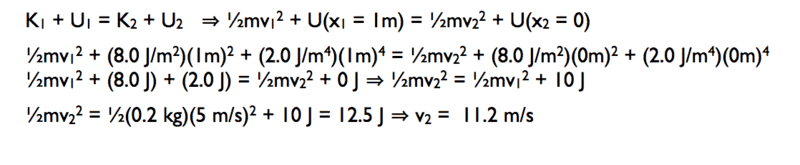
12.png

However it can not be gotten by the following way. Why?
F = -∇U = -[ 16x + 8x^3] = ma
Since m = 0.2, a = -80x - 40x^3
V = -40x^2 - 10x^4 +C =5
c= 50 + 5 =55
 
Physics news on Phys.org
You have treated acceleration as if it were the derivative of velocity with respect to position when it is the derivative of velocity with respect to time.
 
Your mistake is that the velocity is the integral of acceleration with respect to time t , not with respect to the distance or x-coordinate. So your line

hidemi said:
V=-40x^2-10x^4+C
is wrong. To continue with your way, you should set ##a=\frac{dv}{dt}=\frac{dv}{dx}\frac{dx}{dt}=\frac{dv}{dx}v## and solve the ODE $$-16x-8x^3=m\frac{dv}{dx}v$$ by the separating variables technique.
 
Delta2 said:
Your mistake is that the velocity is the integral of acceleration with respect to time t , not with respect to the distance or x-coordinate. So your lineis wrong. To continue with your way, you should set ##a=\frac{dv}{dt}=\frac{dv}{dx}\frac{dx}{dt}=\frac{dv}{dx}v## and solve the ODE $$-16x-8x^3=m\frac{dv}{dx}v$$ by the separating variables technique.
Thanks for your remider :)
 
Similar technique, but slightly different on execution is to let a dot denote derivative with respect to time, i.e., ##a = \ddot x## and ##v = \dot x##. The equation of motion becomes
$$
\ddot x = -80x - 40 x^3.
$$
Multiplying both sides with ##v = \dot x## leads to
$$
v \dot v = \ddot x \dot x = -80 x \dot x - 40 x^3 \dot x.
$$
Noting that for any function ##g(t)##, it holds that ##d(g^n)/dt = n g^{n-1} \dot g## therefore leads to
$$
\frac{d}{dt} \left[\frac 12 v^2\right] = \frac{d}{dt}\left[ - 40 x^2 - 10 x^4\right],
$$
which means the expressions being differentiated differ by a constant, which is essentially the conservation of energy equation.