Calculating F, V and C: Why Can It Not Be Obtained This Way?

  • Thread starter Thread starter hidemi
  • Start date Start date
Click For Summary
SUMMARY

The discussion focuses on the correct method for calculating force (F), velocity (V), and constant (C) in the context of motion equations. It highlights the error in treating acceleration as the derivative of velocity with respect to position rather than time. The correct approach involves using the relationship between acceleration, velocity, and time, specifically through the ordinary differential equation (ODE) -16x - 8x^3 = m(dv/dx)v. The conservation of energy principle is also emphasized, demonstrating that the differentiated expressions differ by a constant.

PREREQUISITES
  • Understanding of classical mechanics, specifically Newton's laws of motion.
  • Familiarity with calculus concepts, including derivatives and integrals.
  • Knowledge of ordinary differential equations (ODEs) and their solutions.
  • Basic principles of energy conservation in physics.
NEXT STEPS
  • Study the derivation and application of ordinary differential equations in physics.
  • Learn about the conservation of energy and its implications in mechanical systems.
  • Explore the relationship between acceleration, velocity, and time in motion equations.
  • Review calculus techniques for solving integrals and derivatives in motion analysis.
USEFUL FOR

Students and professionals in physics, engineering, and applied mathematics who are interested in understanding motion dynamics and solving related equations accurately.

hidemi
Messages
206
Reaction score
36
Homework Statement
A 0.20-kg particle moves along the x axis under the influence of a conservative force. The potential energy is given by

U(x) = (8.0 J/m^2)x^2 + (2.0 J/m^4)x^4,

where x is in coordinate of the particle. If the particle has a speed of 5.0 m/s when it is at x = 1.0 m, its speed when it is at the origin is:

a) 0 m/s
b) 2.5 m/s
c) 5.7 m/s
d) 7.9 m/s
e) 11 m/s

The answer is E.
Relevant Equations
K1 + U1 = K2 + U2
The correct answer can be obtained by the calculation as attached.
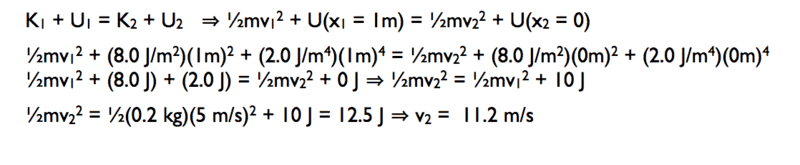
12.png

However it can not be gotten by the following way. Why?
F = -∇U = -[ 16x + 8x^3] = ma
Since m = 0.2, a = -80x - 40x^3
V = -40x^2 - 10x^4 +C =5
c= 50 + 5 =55
 
Physics news on Phys.org
You have treated acceleration as if it were the derivative of velocity with respect to position when it is the derivative of velocity with respect to time.
 
  • Love
Likes   Reactions: Delta2
Your mistake is that the velocity is the integral of acceleration with respect to time t , not with respect to the distance or x-coordinate. So your line

hidemi said:
V=-40x^2-10x^4+C
is wrong. To continue with your way, you should set ##a=\frac{dv}{dt}=\frac{dv}{dx}\frac{dx}{dt}=\frac{dv}{dx}v## and solve the ODE $$-16x-8x^3=m\frac{dv}{dx}v$$ by the separating variables technique.
 
  • Like
Likes   Reactions: hidemi
Delta2 said:
Your mistake is that the velocity is the integral of acceleration with respect to time t , not with respect to the distance or x-coordinate. So your lineis wrong. To continue with your way, you should set ##a=\frac{dv}{dt}=\frac{dv}{dx}\frac{dx}{dt}=\frac{dv}{dx}v## and solve the ODE $$-16x-8x^3=m\frac{dv}{dx}v$$ by the separating variables technique.
Thanks for your remider :)
 
  • Like
Likes   Reactions: Delta2
Similar technique, but slightly different on execution is to let a dot denote derivative with respect to time, i.e., ##a = \ddot x## and ##v = \dot x##. The equation of motion becomes
$$
\ddot x = -80x - 40 x^3.
$$
Multiplying both sides with ##v = \dot x## leads to
$$
v \dot v = \ddot x \dot x = -80 x \dot x - 40 x^3 \dot x.
$$
Noting that for any function ##g(t)##, it holds that ##d(g^n)/dt = n g^{n-1} \dot g## therefore leads to
$$
\frac{d}{dt} \left[\frac 12 v^2\right] = \frac{d}{dt}\left[ - 40 x^2 - 10 x^4\right],
$$
which means the expressions being differentiated differ by a constant, which is essentially the conservation of energy equation.
 

Similar threads

  • · Replies 1 ·
Replies
1
Views
753
  • · Replies 2 ·
Replies
2
Views
664
  • · Replies 7 ·
Replies
7
Views
2K
Replies
1
Views
1K
  • · Replies 4 ·
Replies
4
Views
3K
  • · Replies 6 ·
Replies
6
Views
1K
  • · Replies 64 ·
3
Replies
64
Views
6K
Replies
4
Views
2K
  • · Replies 25 ·
Replies
25
Views
2K
  • · Replies 3 ·
Replies
3
Views
855