Calculating Force and Direction of Coulomb's Law Problems

Click For Summary
SUMMARY

This discussion focuses on calculating the force and direction of charges using Coulomb's Law. The user provided three charges: q1 = 2.0x10^-6 C, q2 = 8.0x10^-6 C, and Q = 4.0x10^-6 C, arranged in a triangular formation. The calculations yielded a force from q1 on Q of 0.288 N and from q2 on Q of 1.152 N, leading to a resultant force magnitude of 1.311 N and a direction of 25.43 degrees. The user demonstrated a solid understanding of the mathematical steps involved in the calculations.

PREREQUISITES
  • Coulomb's Law (F = (k * q1 * q2) / r²)
  • Trigonometric functions (sine, cosine, tangent)
  • Vector decomposition into components (X and Y)
  • Basic algebra for solving equations
NEXT STEPS
  • Practice additional Coulomb's Law problems using different charge configurations.
  • Explore vector addition and subtraction in physics for more complex force interactions.
  • Learn about electric field concepts and their relation to Coulomb's Law.
  • Study the implications of charge placement on force magnitude and direction.
USEFUL FOR

Students studying physics, particularly those focusing on electrostatics, as well as educators seeking to provide practical examples of Coulomb's Law applications.

roy_ament
Messages
2
Reaction score
0
I'm new in this forum, so i don't know if this is in the correct place..

Homework Statement


I got 3 charges
q1= 2.0x10^-6C
q2=8.0x10^-6C
Q=4.0x10^-6C
They're placed in the corners of a triangle like in this draw
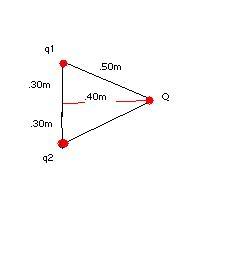
Dibujo.jpg


I have to know the force that q1 and q2 act on Q, the magnitude, and the direction

Homework Equations


F=(kq1q2)/r2
for the angle which is 38.65 i do the tan-1 of .40/.50

The Attempt at a Solution


Fq1Q=( (9x10⁹ Nm2/c2) (2.0x10⁻⁶ C) (4.0x10⁻⁶C))/(.50m)2

Fq1Q= .288N

So know i split in the components of X and Y right?
x= .288(cos38.65) Y= .288 (sin38.65)
x=.22N Y= .1798

Fq2Q=( (9x10⁹ Nm2/c2) (8.0x10⁻⁶ C) (4.0x10⁻⁶C))/(.50m)2

Fq2Q= 1.152N

x=1.152 (cos 38.65) Y=1.152 (sin38.65)
x=.8999n y=.7119n
Now for the magnitude

x= .22+.899=1.119N
y=-.1798+.7119= .5321N

sqrt((1.119)2(.5321)2)= 1.311N
as for the direction
tan-1 = (.5321/1.119)= 25.43°so.. am I right?
all sugetionts are really apreciated, tips and stuff.. hope anyone can help me

sry if my descriptions are wrong, I'm from mexico and my english is not perfect:shy:
if someone also could give me other exercises for practice... it will be perfect!
 
Last edited:
Physics news on Phys.org
roy_ament said:
I'm new in this forum, so i don't know if this is in the correct place..

Homework Statement


I got 3 charges
q1= 2.0x10^-6C
q2=8.0x10^-6C
Q=4.0x10^-6C
They're placed in the corners of a triangle like in this draw
Dibujo.jpg


I have to know the force that q1 and q2 act on Q, the magnitude, and the direction

Homework Equations


F=(kq1q2)/r2
for the angle which is 38.65 i do the tan-1 of .40/.50

The Attempt at a Solution


Fq1Q=( (9x10⁹ Nm2/c2) (2.0x10⁻⁶ C) (4.0x10⁻⁶C))/(.50m)2

Fq1Q= .288N

So know i split in the components of X and Y right?
x= .288(cos38.65) Y= .288 (sin38.65)
x=.22N Y= .1798

Fq2Q=( (9x10⁹ Nm2/c2) (8.0x10⁻⁶ C) (4.0x10⁻⁶C))/(.50m)2

Fq2Q= 1.152N

x=1.152 (cos 38.65) Y=1.152 (sin38.65)
x=.8999n y=.7119n
Now for the magnitude

x= .22+.899=1.119N
y=-.1798+.7119= .5321N

sqrt((1.119)2(.5321)2)= 1.311N
as for the direction
tan-1 = (.5321/1.119)= 25.43°


so.. am I right?
all sugetionts are really apreciated, tips and stuff.. hope anyone can help me

sry if my descriptions are wrong, I'm from mexico and my english is not perfect:shy:
if someone also could give me other exercises for practice... it will be perfect!

Not quite finished. Without doing all the math, it looks like you understand the steps involved. I will presume that the magnitude and angle are correct. But what direction is the angle off of?
 
As to more problems you can look through this thread. At the bottom of this thread are some links to Coulombs Law problems. You can also search the thread for other topics of interest.

Good Luck.
 
LowlyPion said:
As to more problems you can look through this thread. At the bottom of this thread are some links to Coulombs Law problems. You can also search the thread for other topics of interest.

Good Luck.

thanks for your help!, I am looking the other threads right know, trying to solve them:approve:
 

Similar threads

Replies
4
Views
6K