Calculating force on a syringe plunger for a viscous fluid?

Click For Summary

Discussion Overview

The discussion revolves around calculating the force required to operate a syringe plunger for dispensing a viscous fluid, specifically glue or resin. Participants explore the relationship between flow rate, fluid viscosity, and the geometry of the syringe and needle, utilizing the Poiseuille equation as a basis for their calculations.

Discussion Character

  • Technical explanation
  • Mathematical reasoning
  • Debate/contested

Main Points Raised

  • One participant derives a force equation based on the Poiseuille equation, questioning the validity of combining two pipe sections in their calculations.
  • Another participant suggests that while applying Poiseuille's law to the needle is appropriate, the flow behavior in the syringe barrel may not conform to Poiseuille flow due to flow contraction.
  • Concerns are raised about the impact of flow acceleration on pressure, with a suggestion to consider dynamic pressure in the calculations.
  • Participants discuss the significance of the pressure drop in the needle, with one noting that atmospheric pressure cancels out in the calculations.
  • Details about the viscosity of the resin and the dimensions of the syringe and needle are shared, with specific values provided for viscosity and expected flow rates.
  • One participant updates their calculations to exclude atmospheric pressure, resulting in a force estimate that varies with different flow rates.
  • There is a request for confirmation on whether shear rate calculations align with the derived force values from the Poiseuille equation.

Areas of Agreement / Disagreement

Participants express differing views on the applicability of the Poiseuille equation to the syringe barrel and the influence of dynamic pressure. While some agree on the importance of the pressure drop in the needle, there is no consensus on the overall accuracy of the initial calculations or the treatment of atmospheric pressure.

Contextual Notes

Limitations include potential inaccuracies in applying Poiseuille flow assumptions to the syringe barrel, the need for further exploration of dynamic pressure contributions, and the dependence on specific fluid and syringe parameters.

Who May Find This Useful

This discussion may be of interest to those involved in fluid dynamics, engineering applications related to syringe design, or anyone working with viscous fluids in dispensing systems.
DadoNoah
Messages
6
Reaction score
0
TL;DR
Trying to derive an equation for the force applied to a syringe plunger as a function of desired flow rate, fluid viscosity, and syringe geometry. Am I using the Poiseuille equation correctly?
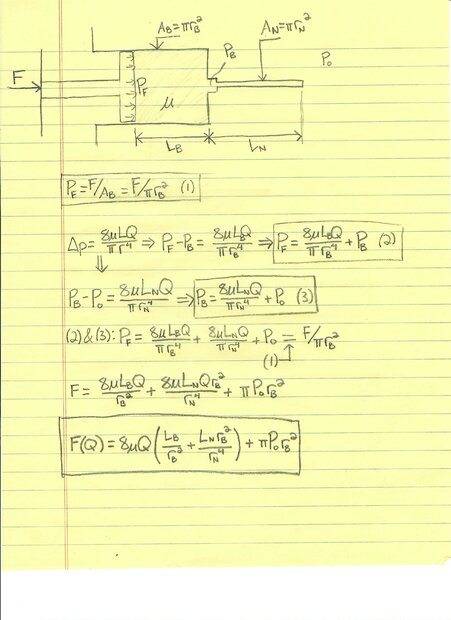
I'm currently working on a precise glue/resin dispenser, and I'm trying to derive an equation for the force one must exert on a syringe plunger as a function of the desired flow rate Q, and also accounting for the fluid viscosity and the syringe barrel and needle geometry. I've attached a scan of my calculations using the Poiseuille equation, but it's been quite a while since I've used it, so I've got no idea if I'm doing it correctly. Are you even allowed to daisy-chain the two pipe sections together like I have? If someone could take a look and tell me if I'm on the right track, I'd really appreciate it!
syringe_equation.jpg

If you're having trouble with my handwriting, the final equation I came up with is:
F(Q) = 8μQ ( LB/rB2 + LNrB2/rN4 ) + πP0rB2
 
Engineering news on Phys.org
I think applying Poisseuille on the needle is correct, but on the first part is a bit dodgy since the flow will contract towards the needle and becomes far removed from Poisseuille flow. However, the contribution of that part also might be low.

What you are now forgetting is the acceleration of the flow. This might have a significant contribution (although, for high viscosity fluids maybe not, but you should at least check). By forcing the fluid through the needle you are accelerating it significantly which give rise to a dynamic pressure (0.5*rho*v^2) that will lead to an extra force.

Otherwise I think it is pretty ok.
 
  • Like
  • Informative
Likes   Reactions: DadoNoah and berkeman
Arjan82 said:
I think applying Poisseuille on the needle is correct, but on the first part is a bit dodgy since the flow will contract towards the needle and becomes far removed from Poisseuille flow. However, the contribution of that part also might be low.

What you are now forgetting is the acceleration of the flow. This might have a significant contribution (although, for high viscosity fluids maybe not, but you should at least check). By forcing the fluid through the needle you are accelerating it significantly which give rise to a dynamic pressure (0.5*rho*v^2) that will lead to an extra force.

Otherwise I think it is pretty ok.
Thanks for the reply Arjan! So if I'm understanding correctly, my current solution will underestimate pressure PB, and by extension will underestimate force F?

If it helps, I'll be using this setup to apply very small quantities of resin at a time, so my target flow rate Q will likely be very small-- Something under 0.5 mL/s, which, for most syringes I'm considering, translates to a flow speed on the scale of 1 to 2.5 mm/s in the barrel and around .2 to 1 m/s in the needle. For such low fluid velocities, would I be safe in considering the contribution of dynamic pressure to be negligible, or am I just falling victim to wishful thinking?

EDIT: I should also clarify that my solution doesn't need to be exact, it really only needs to tell me whether the syringe will be usable, e.g. F < 30N will be a breeze, 31-50N should be easy enough, 51-60N will take some firm pressure, 61-75N will cramp the hell out of my hand after a few minutes, and 76+N will probably call for superhuman thumbs.
 
Last edited:
Well, I was already expecting something like that. You are probably right, but it never hurts to check I guess.
 
Arjan82 said:
Well, I was already expecting something like that. You are probably right, but it never hurts to check I guess.
I couldn't agree more, and I thank you for making me double-check! I feel much more confident now picking out a syringe and taking the plunge *ba-dum tiss*
 
The pressure drop in the needle is going to dominate (by far). And you don't need to include the atmospheric pressure because that is going to cancel out.

What is the viscosity, the needle length, and needle diameter?
 
  • Informative
  • Like
Likes   Reactions: DadoNoah and berkeman
Chestermiller said:
The pressure drop in the needle is going to dominate (by far). And you don't need to include the atmospheric pressure because that is going to cancel out.
Yeah, I see what you mean about the pressure drop in the needle. That 1/rN4 term really blows up. But could you elaborate about atmospheric pressure balancing out? Am I missing an additional P0 term acting on the plunger?
Chestermiller said:
What is the viscosity, the needle length, and needle diameter?
The viscosity of the resin is around ~930 cP, or ~0.93 Pa*s. I'm still shopping around for which syringe I'll be using, but most of them are 2-3 cm long, and the gauge can be any standard needle gauge:
6192oSnVBxL._SL1006_.jpg

Based on the numbers I've plugged in so far, it seems unlikely that anything over 18ga will work.
 
DadoNoah said:
Yeah, I see what you mean about the pressure drop in the needle. That 1/rN4 term really blows up. But could you elaborate about atmospheric pressure balancing out? Am I missing an additional P0 term acting on the plunger?
Sure. Without pushing on the plunger, your thumb is already exerting a pressure of 1 bar on the surrounding air, and the air is already exerting a force of 1 bar on the plunger. The force your thumb feels when you press on the plunger is the part that exceeds the atmospheric pressure force.
DadoNoah said:
The viscosity of the resin is around ~930 cP, or ~0.93 Pa*s. I'm still shopping around for which syringe I'll be using, but most of them are 2-3 cm long, and the gauge can be any standard needle gauge: View attachment 292063
Based on the numbers I've plugged in so far, it seems unlikely that anything over 18ga will work.
At 0.5 cc/sec, for 18 gauge, the shear rate at the wall will be 8600 sec^-1, and the shear stress at the wall will be 80000 dynes/cm^2. So the pressure drop for a 2 cm long needle will be ##7.6\times 10^6\ dynes/cm^2=760000\ Pa=7.6\ bars##. That seems like a pretty high pressure. For a 1 cm^2 piston, that would give a force of 76 N (if I did the math correctly).
 
  • Informative
Likes   Reactions: DadoNoah
Chestermiller said:
At 0.5 cc/sec, for 18 gauge, the shear rate at the wall will be 8600 sec^-1, and the shear stress at the wall will be 80000 dynes/cm^2. So the pressure drop for a 2 cm long needle will be ##7.6\times 10^6\ dynes/cm^2=760000\ Pa=7.6\ bars##. That seems like a pretty high pressure. For a 1 cm^2 piston, that would give a force of 76 N (if I did the math correctly).
Yeah, I think you're right-- I updated my formula to cancel out the P0 term per your advice, and it gives me about 79 N for a 1 cm2 piston. However, I should note that 0.5 cc/sec is the absolute maximum flow rate I foresee needing. Plugging 0.4 cc/sec into my Poiseuille-based formula gives me a much more reasonable force of 59 N, and .25 cc/sec gives an even more reasonable 37 N. Does that jive with your shear rate-based calculations as well?
 
  • #10
DadoNoah said:
Yeah, I think you're right-- I updated my formula to cancel out the P0 term per your advice, and it gives me about 79 N for a 1 cm2 piston. However, I should note that 0.5 cc/sec is the absolute maximum flow rate I foresee needing. Plugging 0.4 cc/sec into my Poiseuille-based formula gives me a much more reasonable force of 59 N, and .25 cc/sec gives an even more reasonable 37 N. Does that jive with your shear rate-based calculations as well?
Well, the force is directly proportional to the flow rate.
 
  • #11
Chestermiller said:
Well, the force is directly proportional to the flow rate.
Certainly, but I meant more like, do your shear rate calculations yield similar force values to my Poiseuille calculations at 0.4 cc/sec and 0.25 cc/sec?
 

Similar threads

  • · Replies 5 ·
Replies
5
Views
17K
  • · Replies 5 ·
Replies
5
Views
15K
  • · Replies 9 ·
Replies
9
Views
2K
Replies
2
Views
4K
  • · Replies 6 ·
Replies
6
Views
16K
  • · Replies 6 ·
Replies
6
Views
2K
  • · Replies 15 ·
Replies
15
Views
5K
  • · Replies 5 ·
Replies
5
Views
2K
Replies
9
Views
16K
Replies
1
Views
4K