Calculating Forces and Acceleration Between Charged Particles

  • Thread starter Thread starter thst1003
  • Start date Start date
  • Tags Tags
    Charges Forces
Click For Summary
SUMMARY

The discussion focuses on calculating the resultant force and acceleration on an electron influenced by a positive ion of charge +9e and a negative ion of charge -8e. The forces were calculated using Coulomb's law, F = kqq'/r², yielding values of 3.96e-19 N and 6.137e-18 N. The direction of the forces was determined, with one pointing in the -x-direction and the other at an angle of -54.9 degrees from the +x-axis. To find the resultant force, participants suggested resolving the forces into their x and y components and summing them.

PREREQUISITES
  • Coulomb's Law for calculating electrostatic forces
  • Vector resolution techniques for force components
  • Basic knowledge of charge interactions and units (e.g., e = 1.6e-19 C)
  • Understanding of Newton's second law for acceleration calculations
NEXT STEPS
  • Study vector addition and resolution techniques in physics
  • Learn about the implications of charge interactions in electrostatics
  • Explore Newton's second law and its application in particle dynamics
  • Investigate the effects of different charge configurations on force calculations
USEFUL FOR

Physics students, educators, and professionals involved in electrostatics, particle dynamics, and force calculations will benefit from this discussion.

thst1003
Messages
15
Reaction score
0
An electron is near a positive ion of charge +9e and a negative ion of charge −8e (see the figure below). (Take a = 5.23 µm, b = 4.28 µm, and θ = 54.9°.)
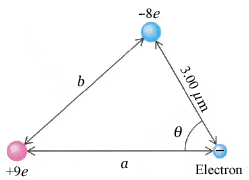
17-p-009-alt.gif


(a) Find the magnitude and direction of the resultant force on the electron. (Let right be the +x-direction. Measure the angle counter-clockwise from the +x-axis.)

(b) Find the magnitude and direction of the electron's instantaneous acceleration (Let right be the +x-direction. Measure the angle counter-clockwise from the +x-axis.)

I used the equation F=kqq'/r2 and I got the forces that came in and out of the single electron (Remember e=1.6e-19 C). I got those values to be 3.96e-19 N from the bottom left charge to the single electron and 6.137e-18 N from the top charge to the single electron. I am having difficulty making sure those are correct and solving for the actual answers. I don't even know how to do part b. I am assuming it deals with the force calculated and the mass of the electron.
 
Last edited:
Physics news on Phys.org
The force due to the bottom left charge points in the -x-direction. The force due to the top charge points at an angle of 54.9 degrees from the -x axis (which means it points at an angle of 180 minus that as measured from the +x axis). You have to find the vector sum of these two forces. One easy way of doing this is to resolve each of them into x and y-components, add up these components separately, and then compute the magnitude of the result.

I don't get the same answers as you for the magnitudes of the forces. Can you post your calculations?

EDIT: No, sorry, I messed up on that slightly. The second force points at an angle of 54.9 degrees *below* the +x-axis. I.e. you start from the +x-axis and rotate clockwise by 54.9 degrees. So, using the convention they asked you to use, this angle is interpreted as -54.9 degrees.
 
Last edited:

Similar threads

  • · Replies 2 ·
Replies
2
Views
2K
  • · Replies 1 ·
Replies
1
Views
962
Replies
5
Views
4K
Replies
22
Views
4K
  • · Replies 1 ·
Replies
1
Views
2K
  • · Replies 5 ·
Replies
5
Views
1K
  • · Replies 1 ·
Replies
1
Views
2K
Replies
4
Views
913
  • · Replies 3 ·
Replies
3
Views
2K
  • · Replies 2 ·
Replies
2
Views
3K