Calculating Gravitational Time Dilation in black hole/Future Time Travel

Click For Summary
SUMMARY

This discussion centers on the concept of Gravitational Time Dilation (GTD) as described by Einstein's theory, particularly in relation to black holes. It clarifies that time passes more slowly in strong gravitational fields, such as near a black hole, but emphasizes that black holes do not possess infinite mass; rather, they have infinite density at their singularity. The formula for GTD applies only outside the Schwarzschild radius (R = 2GM/c²), and using values within this radius leads to nonsensical results. The conversation also distinguishes between the concepts of mass and density in the context of black hole formation.

PREREQUISITES
  • Understanding of Einstein's theory of General Relativity
  • Familiarity with the concept of Schwarzschild radius
  • Knowledge of gravitational time dilation principles
  • Basic grasp of mass versus density in astrophysics
NEXT STEPS
  • Research the Schwarzschild radius and its implications for black holes
  • Explore the mathematical formulation of Gravitational Time Dilation
  • Study the differences between mass and density in astrophysical contexts
  • Investigate the effects of strong gravitational fields on time perception
USEFUL FOR

Astronomers, physicists, and students of astrophysics interested in the effects of gravity on time and the nature of black holes will benefit from this discussion.

aaron35510
Messages
6
Reaction score
0
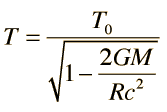
First of all, (following Einstein's theory of Gravitational Time Dilation (I'll just call it GTD,)) objects (such as us) age slower near strong gravitational fields than in empty space. The higher the local distortion of spacetime due to gravity, the more slowly time passes. So according to GTD, we should pretty much not age at all if were able to survive in a black hole.
gtim1.gif
is the formula for GTD, so in that case, a black hole has INFINITE mass (m=infinity), which means that the formula is (original time outside/ infinity.) Therefore, if let's say the time OUTSIDE of the black hole was 50 years, then the time you spent INSIDE the black hole (dilated time) was an infinite amount of time? That doesn't make sense.
 

Attachments

  • gtim1.gif
    gtim1.gif
    1.3 KB · Views: 2,303
Physics news on Phys.org
aaron35510 said:
First of all, (following Einstein's theory of Gravitational Time Dilation (I'll just call it GTD,)) objects (such as us) age slower near strong gravitational fields than in empty space. The higher the local distortion of spacetime due to gravity, the more slowly time passes. So according to GTD, we should pretty much not age at all if were able to survive in a black hole.
gtim1.gif
is the formula for GTD, so in that case, a black hole has INFINITE mass (m=infinity), which means that the formula is (original time outside/ infinity.) Therefore, if let's say the time OUTSIDE of the black hole was 50 years, then the time you spent INSIDE the black hole (dilated time) was an infinite amount of time? That doesn't make sense.
You're talking as though that formula compares time "inside" a black hole with time "outside", but that isn't true. Rather, it compares the rate of a clock at hovering radius R from the gravitating object (which could be a black hole), with the rate of a clock at infinite distance from the gravitating object (or large enough so that gravitational time dilation is negligible). The event horizon of a black hole, which divides "inside" from "outside", is the Schwarzschild radius of R = 2GM/c^2. And the formula really only seems to work for a choice of R that's larger than 2GM/c^2 (i.e. for a radius that puts you 'outside' the black hole)--if you plug in a value of R smaller than that, you get an imaginary number!

Also, are you imagining that all black holes have infinite mass, or do you just want to imagine we are dealing with a hypothetical black hole that does? Black holes don't have infinite mass, though the singularity at the center has infinite density. And if you try to imagine one with infinite mass, then since the formula only works for values of R larger than 2GM/c^2, your radius would have to be larger than infinity for the formula to apply, which doesn't make sense.
 
JesseM said:
You're talking as though that formula compares time "inside" a black hole with time "outside", but that isn't true. Rather, it compares the rate of a clock at hovering radius R from the gravitating object (which could be a black hole), with the rate of a clock at infinite distance from the gravitating object (or large enough so that gravitational time dilation is negligible).

if what i stated is not true, then please tell me what "T" stands for and what "T_0" stands for

but then aren't black holes created when a star's mass becomes infinitely big so that it collapses on itself and creates a rip in spacetime? Anyways, if the mass of a black hole is NOT infinity, then the equation makes a lot more sense.
 
aaron35510 said:
if what i stated is not true, then please tell me what "T" stands for and what "T_0" stands for
T0 would be the tick of a clock at infinite distance from the gravitating object, T would be tick of a clock at radius R > 2GM/c^2 from the object (and for a non black hole R should also be larger than or equal to the radius of the object's object's surface). T is larger than T0 because the tick of the clock closer to the object takes longer.
aaron35510 said:
but then aren't black holes created when a star's mass becomes infinitely big so that it collapses on itself and creates a rip in spacetime?
No, as I said it's the density that goes to infinity, which also causes the curvature of spacetime in the immediate vicinity of the matter (at R=0) to go to infinity, but the mass stays the same as that of the original star.
 
from the point of view of an accelerating rocket there is a sort of black hole somewhere behind it. a point in space where time stands still and nothing not even light from that place can ever reach the rocket.

beyond that point time would seem to run backwards to people on the rocket (if they could detect it)
 

Similar threads

  • · Replies 40 ·
2
Replies
40
Views
3K
  • · Replies 5 ·
Replies
5
Views
2K
  • · Replies 12 ·
Replies
12
Views
3K
  • · Replies 2 ·
Replies
2
Views
2K
  • · Replies 29 ·
Replies
29
Views
3K
  • · Replies 14 ·
Replies
14
Views
2K
  • · Replies 20 ·
Replies
20
Views
2K
  • · Replies 1 ·
Replies
1
Views
1K
  • · Replies 35 ·
2
Replies
35
Views
4K
  • · Replies 8 ·
Replies
8
Views
7K