Haku
- 30
- 1
- Homework Statement
- If the joint reaction force at the ankle in the x direction is -125N, calculate the joint reaction force at the knee in the x direction (assuming those are the only two horizontal forces acting on it)
- Relevant Equations
- Summation
I have this question in my biomechanics class, and the way the teacher has solved it raised some questions with me.
This is the snippet of work from the lecture slides:
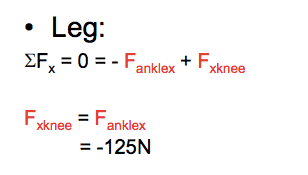
But, if we see the red variables acting as 'placeholders' for the value of respective forces, and the value of the force at the ankle in x direction is -125N.
When summing all ankle forces in x direction it looks like the direction is accounted for twice, because what the summation is if you leave the variables as placeholders for the actual values is:
Fax + Fkx = 0.
=>
Fkx = -Fax = -(-125N) = 125N.
What I get from the calculation done in the picture is the following:
-Fax + Fkx = 0
<=>
-(-125N) + Fkx = 0
=>
Fkx = -125N
But in this case, you have applied the direction of the joint reaction force at the ankle twice right?
Which calculation is correct? Imo the former calculation is more mathematically sound, but I am not sure since it is contradictory to calculation given in class.
This is the snippet of work from the lecture slides:
But, if we see the red variables acting as 'placeholders' for the value of respective forces, and the value of the force at the ankle in x direction is -125N.
When summing all ankle forces in x direction it looks like the direction is accounted for twice, because what the summation is if you leave the variables as placeholders for the actual values is:
Fax + Fkx = 0.
=>
Fkx = -Fax = -(-125N) = 125N.
What I get from the calculation done in the picture is the following:
-Fax + Fkx = 0
<=>
-(-125N) + Fkx = 0
=>
Fkx = -125N
But in this case, you have applied the direction of the joint reaction force at the ankle twice right?
Which calculation is correct? Imo the former calculation is more mathematically sound, but I am not sure since it is contradictory to calculation given in class.