Calculating Land Area for an Olympic Track: A Linear Equation Application

Click For Summary

Discussion Overview

The discussion revolves around calculating the land area required for an Olympic track, specifically focusing on the geometry of the track, which includes straightaways and semicircular turns. Participants explore the mathematical relationships involved in determining the dimensions of the rectangular lot needed for the track.

Discussion Character

  • Mathematical reasoning
  • Technical explanation
  • Homework-related

Main Points Raised

  • One participant presents the problem of calculating the land area needed for an eight-lane Olympic track, seeking assistance on how to start.
  • Another participant suggests denoting the radius of the outside edge of the semicircular turn as $R$ and outlines a method to express the length of the outside edge in terms of $R$.
  • A participant calculates the total perimeter of the two semicircles and derives an equation relating the perimeter to the radius, but uses $R$ ambiguously.
  • Another participant critiques the notation used in the calculations and suggests clearer variable definitions to avoid confusion.
  • One participant asks for a demonstration of how to solve the problem, indicating uncertainty in the process.
  • A later reply provides a calculation leading to a value for $R$ and derives the dimensions of the lot based on that value.
  • Another participant reiterates the calculation and concludes that the area is approximately 2 hectares.

Areas of Agreement / Disagreement

While some participants agree on the calculations leading to the dimensions of the lot, there is no consensus on the notation used or the clarity of the explanations. The discussion contains multiple perspectives on how to approach the problem and the definitions of variables.

Contextual Notes

Participants express uncertainty regarding variable definitions and the clarity of mathematical expressions. There are unresolved issues related to the notation and the assumptions made in the calculations.

bergausstein
Messages
191
Reaction score
0
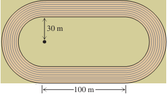
Olympic Track. To host the Summer Olympics, a city plans to
build an eight-lane track. The track will consist of parallel 100-m
straightaways with semicircular turns on either end as shown in
the figure. The distance around the outside edge of the oval track
is 514 m. If the track is built on a rectangular lot as shown in
the drawing, then how many hectares (1 hectare = 10,000 m^2)
of land are needed in the rectangular lot?

I've got no Idea where to start first. please help me. thanks!
 

Attachments

  • image algebra.png
    image algebra.png
    4.9 KB · Views: 104
Mathematics news on Phys.org
Let's denote the radius of the outside edge of the semicircular turn by $R$. (According to the picture, the similar radius of the inner edge of the turn is 30m, but this is not used in the solution.) Express the length of the outside edge of the turn through $R$. Next, express the length of the whole outside edge (it consists of two straight segments with length 100m each and two semicircular turns). Equate the result to 514m and find $R$ from the equation.
 
let r = the total perimeter of the two semicircles
the distance of the outside edge of the track is

514=200+r

r = 314

since C=2pi*R

314 = 2pi*(30+R)

the radius of the outer edge is R = (314-60pi)/2pi

what's next?
 
bergausstein said:
let r = the total perimeter of the two semicircles
It's kinder to the reader to denote the perimeter by something like $p$ and radius by something like $r$.

bergausstein said:
the distance of the outside edge of the track is

514=200+r

r = 314

since C=2pi*R

314 = 2pi*(30+R)
In the last two lines, you used $R$ in two different senses. I undersand that $C$ and $R$ in $C=2\pi R$ are probably generic circumference and radius, i.e., not necessarily from this problem, but still it's a bad style. Besides, in writing $314 = 2\pi(30+R)$ you denoted by $R$ the total width of the lanes, while my suggestion was to use it to denote the external (greater) radius of the turn. The width could be denoted by something like $w$.

Anyway, I believe the number 314 is used on purpose to suggest diving both sides by $\pi$. From this you get $30+R$--the external radius of the turn. Then finding the width and length of the lot should be obvious.
 
Can you show me how you would solve it. :confused:
 
If $R$ is the external radius, then $314=2\pi R$. Dividing by $\pi$, we get approximately $100=2R$, or $R=50$. Therefore, the length of the lot is $100+2 R=200$, and the width is $2R=100$.
 
Evgeny.Makarov said:
If $R$ is the external radius, then $314=2\pi R$. Dividing by $\pi$, we get approximately $100=2R$, or $R=50$. Therefore, the length of the lot is $100+2 R=200$, and the width is $2R=100$.

yes the answer is approximately 2 hectares. thanks!
 

Similar threads

  • · Replies 1 ·
Replies
1
Views
3K
  • · Replies 7 ·
Replies
7
Views
4K
  • · Replies 9 ·
Replies
9
Views
4K