Discussion Overview
The discussion revolves around calculating probabilities using the binomial and normal distributions. Participants explore the notation and formulas associated with these distributions, as well as specific probability calculations for given scenarios.
Discussion Character
- Technical explanation
- Mathematical reasoning
- Debate/contested
- Homework-related
Main Points Raised
- Some participants express uncertainty about the notation $$X \sim B(8,0.3)$$ and its implications for calculating probabilities.
- One participant states that the binomial distribution is defined by the formula $$P(X=k)={n \choose k}p^k(1-p)^{n-k}$$ and attempts to apply it to find $$P(X=5)$$.
- Another participant questions the meaning of the parameters in the notation, suggesting that if 'B' represents binomial, then the mean and variance should satisfy certain conditions that appear not to hold in this case.
- Several participants attempt to calculate $$P(X=5)$$ using the binomial formula, arriving at slightly different numerical results.
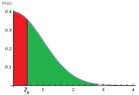
- Discussion shifts to the normal distribution with $$X \sim N(15,9)$$, where participants explore how to standardize values and find probabilities using z-scores.
- There is a discussion about the ambiguity in the notation for standard deviation and variance, with participants trying to clarify the correct interpretation.
- Participants calculate various probabilities for the normal distribution, including $$P(X < 16)$$ and $$P(X \geq 17)$$, and discuss how to interpret z-scores and areas under the curve.
- One participant mentions the need to find the z-score associated with a specific area and how to derive the value of $$k$$ from the normal distribution.
Areas of Agreement / Disagreement
There is no consensus on the interpretation of the notation for the binomial distribution, and participants express differing views on the parameters involved. The calculations for probabilities using both distributions show some agreement on methods but yield slightly different numerical results, indicating ongoing debate and refinement of ideas.
Contextual Notes
Participants express uncertainty regarding the definitions of parameters in the distributions, particularly the distinction between variance and standard deviation in the context of the normal distribution. There are also unresolved questions about the correct application of formulas and the interpretation of results.
Who May Find This Useful
This discussion may be useful for students or individuals interested in understanding the application of binomial and normal distributions in probability calculations, particularly in a homework or academic context.