Calculating the force in suspension as a car hits the brakes

Click For Summary

Discussion Overview

The discussion revolves around calculating the forces acting on a car's suspension system during braking and cornering maneuvers. Participants explore the dynamics involved in a go-kart scenario, specifically focusing on the forces transmitted through the suspension springs and dampers when the vehicle decelerates and turns.

Discussion Character

  • Exploratory
  • Technical explanation
  • Debate/contested
  • Mathematical reasoning

Main Points Raised

  • One participant asks how to calculate the force on the suspension when a go-kart stops from 120 kph in 3 seconds and also when turning at 80 kph.
  • Another participant emphasizes the importance of tire characteristics and track conditions in determining braking force, suggesting that these factors must be considered before calculating suspension forces.
  • A participant applies Newton's second law (F=MA) to estimate the total force during braking, calculating a force of approximately 3889 N, but notes uncertainty about how this force is distributed in the suspension system.
  • A crew chief shares a formula for longitudinal load transfer during braking, highlighting the significance of the center of gravity and vehicle weight in calculating load transfer effects on suspension dynamics.
  • One participant mentions expected braking forces of 3500 N to 4000 N and seeks guidance on calculating diagonal load transfer during cornering, referencing a previous thread for additional information.
  • Another participant points to a specific post in the forum that discusses weight transfer calculations, suggesting it can help approximate required spring rates for handling weight during turns.

Areas of Agreement / Disagreement

Participants express various viewpoints on the factors influencing suspension forces, with no consensus reached on the exact calculations or methods to be used. The discussion includes multiple competing perspectives on the importance of tire data, load transfer, and the dynamics of braking and cornering.

Contextual Notes

Participants mention various assumptions, such as the vehicle's mass, braking duration, and cornering radius, but do not resolve the complexities involved in the calculations or the dependencies on specific tire and track conditions.

Who May Find This Useful

This discussion may be of interest to automotive engineers, racing enthusiasts, and students studying vehicle dynamics or suspension systems.

Ben Reade
Messages
11
Reaction score
0
Hello,
Firstly thank you for reading my post.
This is an interesting question I was wondering if anyone here could teach me how to work out.

Say if you had a large go-kart (FSAE/Formula Student if anyone knows of that) and you were driving at 120kph and hit the brakes and stopped in 3 seconds, how much force is going through the suspension spring/dampener.

Similarly what if it is going around a corner with a radius of 7.7kph at 80kph.

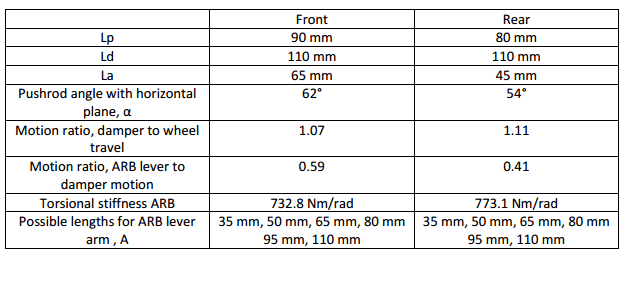
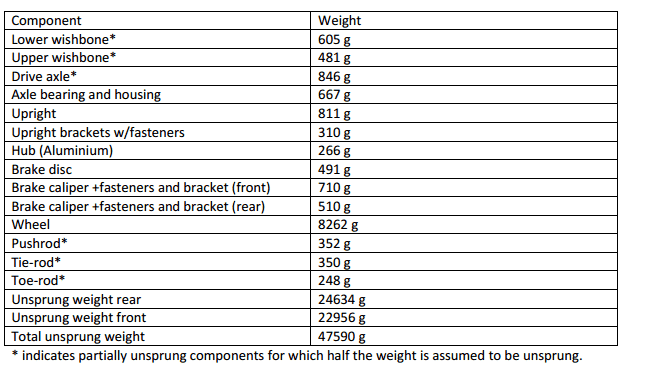
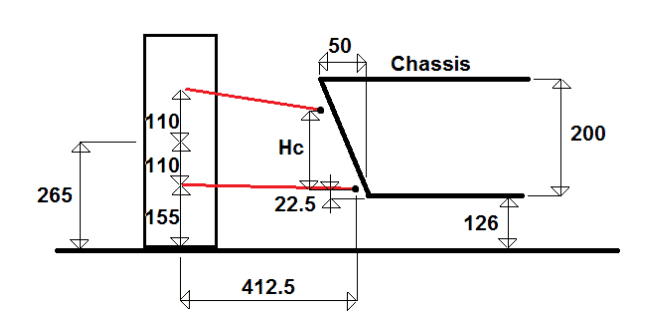
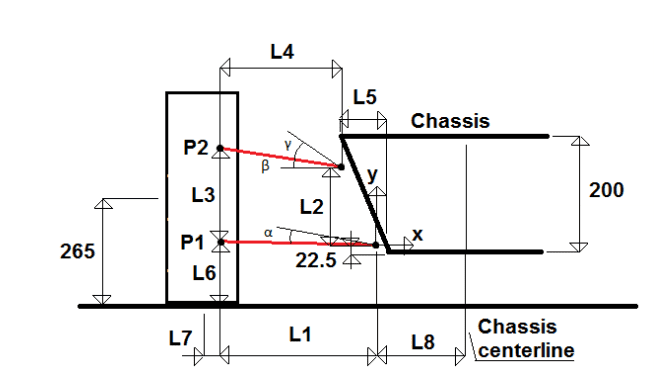
Here is a diagram of what I am talking about. Its double A-Arm wishbone suspension, along with any data you will need, such as weights and dimensions.
upload_2016-2-3_21-53-11.png

upload_2016-2-3_21-53-31.png

upload_2016-2-3_21-53-57.png

upload_2016-2-3_21-55-35.png

upload_2016-2-3_21-56-5.png


upload_2016-2-3_21-56-20.png

upload_2016-2-3_21-56-40.png

cough cough http://brage.bibsys.no/xmlui/bitstream/handle/11250/183058/Master oppgave-endelig.pdf?sequence=1
 
Engineering news on Phys.org
Ben..nice question...you are not addressing one HUGE part of the question...
in racing, its all about tires, Tires, TIRES..
tires are what interfaces between the immovable asphalt ( could be dirt but i digress) track and the moving object ( in this case..the race car).
also the tire compound must be addressed. these things are covered in the slip angle charts for tire adhesion by the tire manufacturer. Other factors involved are track conditions..i.e. is track slick due to sum light or is track cold due to cloudy conditions..all impact the brakes...and what compound brake pads are you using or is it drum brakes?

so you can not properly calculate the force going thru the suspension until you know the force countering the momentum...
i suggest you read Race CAR Suspension Class in Mechanical Engineering section of this fine forum
 
  • Like
Likes   Reactions: Ben Reade and billy_joule
F=MA
Force = mass x Acceleration (in this scenario, deceleration)
M=350kg
A= (120km/h)/3s = 11.1 m/s^2
F= (350kg )11.1m/s^2
= 3889N
Now that's the total force from the car stopping from 120kph to 0 in 3 s. How it gets distributed throughout the suspension, I wouldn't be able to tell you.
 
  • Like
Likes   Reactions: Ben Reade
from a crew chief prospective

Longitudinal Load transfer (LT) – Braking at 1.2 G retardation
Vehicle weight x Center of Gravity Height / wheelbase
An Indy car weighing 1760 lbs. total with 100” wheelbase and CG at 13” would have
LT = 1.2g [ 1760x 13 / 100] = 275 lbs.

the 1.2 G needs to be known..
this is considering LOAD transfer as the front suspension would "feel" if it was possible to place this car on scales at speed..it is used to calculate spring rate required to reach maximum handling. Other factors are diagonal load transfer in a turn or while cornering but that is a whole new topic.
 
upload_2016-2-8_9-27-59.png

upload_2016-2-8_9-29-55.png

Tire data on request from manufacturer.
upload_2016-2-8_10-1-12.png

upload_2016-2-8_10-2-9.png

upload_2016-2-8_10-2-34.png

upload_2016-2-8_10-2-52.png

upload_2016-2-8_10-3-14.png

Tire PSI of 22.
A value of 3,500N to 4,000N from braking is roughly what I was expecting. Perhaps a bit lower.

Ranger Mike said:
Other factors are diagonal load transfer in a turn
Ranger Mike here is what data I have for the tires and I'm working on getting extra information from a team mate. Yes how would I calculate the diagonal load transfer in a 7m radius turn during flat cornering. I read your MEGA-thread. Excellent writing. I couldn't find any section about diagonal loading though, especially on actually calculating , aside from the software you mentioned. Is the software free to download?

Thanks
 
Last edited:
Race car suspension class, page 37 post # 676 tells you how to figure the total amount of " weight transfer" as well as the amount going forward. Subtracting the amount going forward from the total will approximate the diagonal amount of " weight " transfer. This calculation is used to approximate the required spring rate to handle this.. " weight". It is a good way to begin to understand the dynamics of the suspension in a turn.

On page 41 the true definition of LOAD transfer is for the purist who wants to understand the physics behind the process.
 
  • Like
Likes   Reactions: Ben Reade

Similar threads

  • · Replies 3 ·
Replies
3
Views
2K
Replies
36
Views
12K
Replies
1
Views
3K
  • · Replies 5 ·
Replies
5
Views
2K
  • · Replies 8 ·
Replies
8
Views
4K
Replies
4
Views
2K
Replies
8
Views
15K
Replies
15
Views
12K
  • · Replies 16 ·
Replies
16
Views
6K
  • · Replies 8 ·
Replies
8
Views
8K