Calculating the half maximum point of a function

Click For Summary

Homework Help Overview

The discussion revolves around calculating the half-maximum point of a function defined by a specific equation involving parameters \( r \) and \( \tau \). Participants are exploring the implications of equating the function to half of its maximum value and the challenges associated with deriving an analytic expression for the angle \( \varphi \) at this point.

Discussion Character

  • Exploratory, Assumption checking, Conceptual clarification

Approaches and Questions Raised

  • Participants discuss the validity of equating the function to \( 1/2 \) to find the half-maximum point and question whether this approach is feasible. There are attempts to manipulate the function using small-angle approximations and to derive expressions for \( \varphi \). Some participants express uncertainty about the physical interpretation of the parameters and the conditions under which the function behaves as expected.

Discussion Status

The discussion is ongoing, with participants sharing insights and questioning the assumptions made about the function's behavior. Some have pointed out potential errors in the original formula and are exploring alternative methods to derive the half-maximum point. There is no explicit consensus yet, but various interpretations and approaches are being examined.

Contextual Notes

Participants note that the parameters \( r \) and \( \tau \) should be dimensionless and discuss the implications of this on the function's behavior. There are references to specific cases where the parameters take on certain values, affecting the function's characteristics, and the discussion includes considerations of the function's maxima and minima.

roam
Messages
1,265
Reaction score
12
Homework Statement
I want to calculate the half maximum point of the following function.
Relevant Equations
The function is given by

$$T(\varphi)=\frac{r^{2}+\tau^{2}-2\tau\cos\varphi}{1+\tau^{2}r^{2}-2\tau r\cos\varphi}. \tag{1}$$

where ##|\varphi| \ll 1##, and ##r, \tau## are constants in the range [0,1].

I want to show that the condition at which this function decreases to half its peak value is:

$$\varphi\approx\frac{1-r\tau}{\sqrt{r\tau}}. \tag{2}$$
This is the form of the function above:
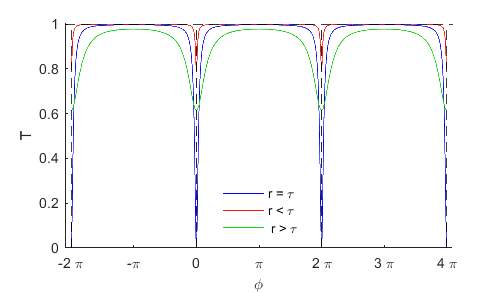
243497


I started by equating (1) to 1/2:

$$T(\varphi)=\frac{r^{2}+\tau^{2}-2\tau\cos\varphi}{1+\tau^{2}r^{2}-2\tau r\cos\varphi} = \frac{1}{2},$$

which can be rearranged to:

$$2r^{2}+2\tau^{2}-1-\tau^{2}r^{2}=2\tau\left[2-r\right]\cos\varphi$$

using small-angle approximation we obtain:

$$2r^{2}+2\tau^{2}-1-\tau^{2}r^{2}=2\tau\left[2-r\right]\left(1-\frac{\varphi^{2}}{2}\right)$$

or:

$$\varphi^{2}=\frac{-2r^{2}-2\tau^{2}+1+\tau^{2}r^{2}+4\tau-2\tau r}{\tau\left(2-r\right)}.$$

I don't know how to proceed from here. Is it possible to manipulate this further to arrive at (2)? Or has there been a mistake in my calculations?

Any help would be greatly appreciated.
 
Physics news on Phys.org
The peak value is not always 1 (and the value at phi=0 is not always zero, not sure if you want to consider this).
 
  • Like
Likes   Reactions: roam
mfb said:
The peak value is not always 1 (and the value at phi=0 is not always zero, not sure if you want to consider this).

I see. So I guess we can't find an analytic expression for the half-maximum point by simply equating the function to ##1/2##. In such situations how else can you calculate this point?

The minima (dips) are centered on ##\varphi =0, 2\pi k, \ k \in \mathbb{Z}##. The value at these points is only zero if the two constants are equal (##\tau =r##).
 
The function reaches its maximum for example at ##\varphi=0##, so at the maximum point the function reduces to the expression

$$T_{\text{max}}=\frac{\tau^{2}+r^{2}}{1+r^{2}\tau^{2}}$$

We are interested in half of this value (i.e., the half-maximum point):

$$T_{\text{Half}}=\frac{\tau^{2}+r^{2}}{2\left(1+r^{2}\tau^{2}\right)}$$

So, equating the function (Eqn. (1)) to this value:

$$\frac{r^{2}+\tau^{2}-2\tau\cos\varphi}{1+\tau^{2}r^{2}-2\tau r\cos\varphi}=\frac{\tau^{2}+r^{2}}{2+2r^{2}\tau^{2}}$$

Is this the right approach? :oldconfused:

When I try solving for ##\varphi## I get a complicated expression which is not reducible to Eqn. (2).
 
Last edited:
Do ##r## and ##t## have physical units? If they do, then I do not understand

roam said:
$$T(\varphi)=\frac{r^{2}+\tau^{2}-2\tau\cos\varphi}{1+\tau^{2}r^{2}-2\tau r\cos\varphi}. \tag{1}$$
 
George Jones said:
Do ##r## and ##t## have physical units? If they do, then I do not understand

No, the parameters should be dimensionless. But I think there is a mistake in the formula, it should be
##T(\varphi)=\frac{r^{2}+\tau^{2}-2\tau r\cos\varphi}{1+\tau^{2}r^{2}-2\tau r\cos\varphi}. \tag{1}##
with maximum ##T_{max}=\frac{(\tau+r)^2}{(1+\tau r)^2}## at cos(φ)=-1.
 
  • Like
Likes   Reactions: roam
Hi Ehild,

Thanks a lot for pointing this out. Yes, the formula is:

$$T\left(\varphi\right)=\frac{r^{2}+\tau^{2}-2\tau r\cos\varphi}{1+\tau^{2}r^{2}-2\tau r\cos\varphi}.$$

I then tried to solve for ##\varphi## by equating this to half of the maximum value that you gave:

$$\frac{r^{2}+\tau^{2}-2\tau r\cos\varphi}{1+\tau^{2}r^{2}-2\tau r\cos\varphi}=\frac{(\tau+r)^{2}}{2(1+\tau r)^{2}} =\frac{T_{max}}{2}.$$

Do you believe it is feasible to get the required expression for ##\varphi## using this approach?

So, I had:

$$\cos\varphi=\frac{\left(1+r\tau\right)^{2}}{\tau r\left(\tau+r\right)^{2}-2\tau r\left(1+r\tau\right)^{2}}\left[\frac{\left(\tau+r\right)^{2}}{2\left(1+r\tau\right)^{2}}\left(1+\tau^{2}r^{2}\right)-r^{2}-\tau^{2}\right],$$

which using the small-angle approximation becomes:

$$1-\frac{\varphi^{2}}{2}=\left[\frac{\left(\tau+r\right)^{2}\left(1+\tau^{2}r^{2}\right)-2\left(1+r\tau\right)^{2}\left(r^{2}+\tau^{2}\right)}{2\left(\tau r\left(\tau+r\right)^{2}-2\tau r\left(1+r\tau\right)^{2}\right)}\right]$$

When I write everythig out explicitly and simplify I get:

$$\varphi^{2}=\frac{8\tau r^{3}-6\tau r-6\tau^{3}r^{3}-4\tau^{2}r^{2}+r^{2}+\tau^{2}-\tau^{2}r^{4}+2\tau r^{4}+\tau^{4}r^{2}+4\tau^{3}r}{\tau r\left(r^{2}+\tau^{2}-2-2\tau^{2}r^{2}-2\tau r\right)}$$

Am I on the right track? The paper that I am trying to verify arrived at ##\varphi = 1-r \tau## (they give ##\mathcal{F} \approx \pi/(1-\tau r)## and we know that ##\varphi \approx \pi/\mathcal{F}##). But I believe this has to be a mistake/typo. The correct answer must be ##\varphi\approx\frac{1-r\tau}{\sqrt{r\tau}}##.
 
roam said:
Am I on the right track? The paper that I am trying to verify arrived at ##\varphi = 1-r \tau## (they give ##\mathcal{F} \approx \pi/(1-\tau r)## and we know that ##\varphi \approx \pi/\mathcal{F}##). But I believe this has to be a mistake/typo. The correct answer must be ##\varphi\approx\frac{1-r\tau}{\sqrt{r\tau}}##.
I do not get what half-maximum point is. How was the half-maximum defined? (Sorry, I can not read the whole article, can you explain it in a few words?)
The shape of the curve depends on the values of r and tau. it is as "peaky " as shown when both parameters are close to 1, and it looks like a sine function if they are small. Usually, half-maximum is defined for peaks.
 
Hi Ehild,

Sure. Half-maximum is the point at which the function reduces to half its peak value. Here is a plot that I made where these points are shown with the red "x"s:

243617


I am trying to derive the analytic expression that gives the value of ##\varphi## at these points in terms of the constants ##\tau, r##.
 
  • #10
roam said:
Hi Ehild,

Sure. Half-maximum is the point at which the function reduces to half its peak value. Here is a plot that I made where these points are shown with the red "x"s:

View attachment 243617

I am trying to derive the analytic expression that gives the value of ##\varphi## at these points in terms of the constants ##\tau, r##.
But the T function does not look like that for any tau and r, and the maximum is not a peak, and the maximum is not 1, and the minimum is zero only when r=tau.
 
  • #11
ehild said:
But the T function does not look like that for any tau and r, and the maximum is not a peak, and the maximum is not 1, and the minimum is zero only when r=tau.

Yes, the shape of the carve is variable. I plotted a special case of T where ##\tau=r=0.95## so there is a complete extinction at the minimum.

But shouldn't we still be able to write an analytic expression that gives ##\varphi## for any given r and tau?

Because, in various textbooks, for a lossless cavity (##\tau = 1##) they obtain

$$\varphi \approx \frac{1-r}{\sqrt{r}}$$

However, to derive this, they use the complementary function ##1-T##, where the minima are now the maxima. I am not sure why the math doesn't work when you use ##T## instead of ##1-T##.
 
  • #12
roam said:
Yes, the shape of the carve is variable. I plotted a special case of T where ##\tau=r=0.95## so there is a complete extinction at the minimum.

But shouldn't we still be able to write an analytic expression that gives ##\varphi## for any given r and tau?

Because, in various textbooks, for a lossless cavity (##\tau = 1##) they obtain

$$\varphi \approx \frac{1-r}{\sqrt{r}}$$

However, to derive this, they use the complementary function ##1-T##, where the minima are now the maxima. I am not sure why the math doesn't work when you use ##T## instead of ##1-T##.
Do they use the same function you cited in your original post?
When tau=1, your T function is identically 1.
It is usual to speak about the width of a peak, the values of the independent variable where the function height falls to half of the maximum value. But the height is counted with respect to a base. In the following figure, for example, the function is completely above its half-maximum value.

243625
 
Last edited:
  • Like
Likes   Reactions: roam
  • #13
Hi Ehild,

Thanks for the explanation.

I've managed to get the answer I wanted for the special case of ##r=\tau##, where the maximum height (from the base) is ##1##. We can rewrite the equation as:

$$T\left(\varphi\right)=\frac{r^{2}+\tau^{2}-2\tau r\cos\varphi}{1+\tau^{2}r^{2}-2\tau r\cos\varphi}=\frac{2\tau r-2\tau r\cos\varphi}{1+\tau^{2}r^{2}-2\tau r\cos\varphi}=\frac{F\sin^{2}\varphi/2}{1+F\sin^{2}\varphi/2} \tag{i}$$

with ##F:=4r\tau/\left(1-r\tau\right)^{2}##. Now setting the last equation equal to ##1/2## we can solve for ##\varphi##:

$$\frac{F\sin^{2}\varphi/2}{1+F\sin^{2}\varphi/2}=\frac{1}{2} \implies \varphi=\frac{1-r\tau}{\sqrt{r\tau}}$$

Do you think this might hold for situations when ##r \neq \tau##? If not, how could I find a more generalized expression?

P.S. The textbooks define the function same as the last form presented in my equation (i) and then set ##\tau =1## (so this term is not seen in the equations).
 
  • #14
Hi @roam,
Find the half-maximum point of the curve 1-T. It has real peaks and you will get the desired expression for φ, assuming it is small.
 
  • Like
Likes   Reactions: roam and SammyS

Similar threads

  • · Replies 11 ·
Replies
11
Views
3K
  • · Replies 3 ·
Replies
3
Views
2K
  • · Replies 0 ·
Replies
0
Views
2K
  • · Replies 2 ·
Replies
2
Views
2K
  • · Replies 8 ·
Replies
8
Views
3K
Replies
11
Views
2K
  • · Replies 11 ·
Replies
11
Views
2K
  • · Replies 14 ·
Replies
14
Views
3K
Replies
5
Views
2K