Calculating the half maximum point of a function

Join the discussion
Registration is free. Ask a follow-up in this thread, or start your own.
13 replies · 3K views
roam
Messages
1,265
Reaction score
12
Homework Statement
I want to calculate the half maximum point of the following function.
Relevant Equations
The function is given by

$$T(\varphi)=\frac{r^{2}+\tau^{2}-2\tau\cos\varphi}{1+\tau^{2}r^{2}-2\tau r\cos\varphi}. \tag{1}$$

where ##|\varphi| \ll 1##, and ##r, \tau## are constants in the range [0,1].

I want to show that the condition at which this function decreases to half its peak value is:

$$\varphi\approx\frac{1-r\tau}{\sqrt{r\tau}}. \tag{2}$$
This is the form of the function above:
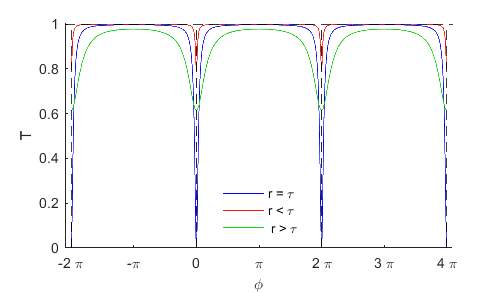
243497


I started by equating (1) to 1/2:

$$T(\varphi)=\frac{r^{2}+\tau^{2}-2\tau\cos\varphi}{1+\tau^{2}r^{2}-2\tau r\cos\varphi} = \frac{1}{2},$$

which can be rearranged to:

$$2r^{2}+2\tau^{2}-1-\tau^{2}r^{2}=2\tau\left[2-r\right]\cos\varphi$$

using small-angle approximation we obtain:

$$2r^{2}+2\tau^{2}-1-\tau^{2}r^{2}=2\tau\left[2-r\right]\left(1-\frac{\varphi^{2}}{2}\right)$$

or:

$$\varphi^{2}=\frac{-2r^{2}-2\tau^{2}+1+\tau^{2}r^{2}+4\tau-2\tau r}{\tau\left(2-r\right)}.$$

I don't know how to proceed from here. Is it possible to manipulate this further to arrive at (2)? Or has there been a mistake in my calculations?

Any help would be greatly appreciated.
 
Physics news on Phys.org
The peak value is not always 1 (and the value at phi=0 is not always zero, not sure if you want to consider this).
 
  • Like
Likes   Reactions: roam
mfb said:
The peak value is not always 1 (and the value at phi=0 is not always zero, not sure if you want to consider this).

I see. So I guess we can't find an analytic expression for the half-maximum point by simply equating the function to ##1/2##. In such situations how else can you calculate this point?

The minima (dips) are centered on ##\varphi =0, 2\pi k, \ k \in \mathbb{Z}##. The value at these points is only zero if the two constants are equal (##\tau =r##).
 
The function reaches its maximum for example at ##\varphi=0##, so at the maximum point the function reduces to the expression

$$T_{\text{max}}=\frac{\tau^{2}+r^{2}}{1+r^{2}\tau^{2}}$$

We are interested in half of this value (i.e., the half-maximum point):

$$T_{\text{Half}}=\frac{\tau^{2}+r^{2}}{2\left(1+r^{2}\tau^{2}\right)}$$

So, equating the function (Eqn. (1)) to this value:

$$\frac{r^{2}+\tau^{2}-2\tau\cos\varphi}{1+\tau^{2}r^{2}-2\tau r\cos\varphi}=\frac{\tau^{2}+r^{2}}{2+2r^{2}\tau^{2}}$$

Is this the right approach? :oldconfused:

When I try solving for ##\varphi## I get a complicated expression which is not reducible to Eqn. (2).
 
Last edited:
Do ##r## and ##t## have physical units? If they do, then I do not understand

roam said:
$$T(\varphi)=\frac{r^{2}+\tau^{2}-2\tau\cos\varphi}{1+\tau^{2}r^{2}-2\tau r\cos\varphi}. \tag{1}$$
 
George Jones said:
Do ##r## and ##t## have physical units? If they do, then I do not understand

No, the parameters should be dimensionless. But I think there is a mistake in the formula, it should be
##T(\varphi)=\frac{r^{2}+\tau^{2}-2\tau r\cos\varphi}{1+\tau^{2}r^{2}-2\tau r\cos\varphi}. \tag{1}##
with maximum ##T_{max}=\frac{(\tau+r)^2}{(1+\tau r)^2}## at cos(φ)=-1.
 
  • Like
Likes   Reactions: roam
Hi Ehild,

Thanks a lot for pointing this out. Yes, the formula is:

$$T\left(\varphi\right)=\frac{r^{2}+\tau^{2}-2\tau r\cos\varphi}{1+\tau^{2}r^{2}-2\tau r\cos\varphi}.$$

I then tried to solve for ##\varphi## by equating this to half of the maximum value that you gave:

$$\frac{r^{2}+\tau^{2}-2\tau r\cos\varphi}{1+\tau^{2}r^{2}-2\tau r\cos\varphi}=\frac{(\tau+r)^{2}}{2(1+\tau r)^{2}} =\frac{T_{max}}{2}.$$

Do you believe it is feasible to get the required expression for ##\varphi## using this approach?

So, I had:

$$\cos\varphi=\frac{\left(1+r\tau\right)^{2}}{\tau r\left(\tau+r\right)^{2}-2\tau r\left(1+r\tau\right)^{2}}\left[\frac{\left(\tau+r\right)^{2}}{2\left(1+r\tau\right)^{2}}\left(1+\tau^{2}r^{2}\right)-r^{2}-\tau^{2}\right],$$

which using the small-angle approximation becomes:

$$1-\frac{\varphi^{2}}{2}=\left[\frac{\left(\tau+r\right)^{2}\left(1+\tau^{2}r^{2}\right)-2\left(1+r\tau\right)^{2}\left(r^{2}+\tau^{2}\right)}{2\left(\tau r\left(\tau+r\right)^{2}-2\tau r\left(1+r\tau\right)^{2}\right)}\right]$$

When I write everythig out explicitly and simplify I get:

$$\varphi^{2}=\frac{8\tau r^{3}-6\tau r-6\tau^{3}r^{3}-4\tau^{2}r^{2}+r^{2}+\tau^{2}-\tau^{2}r^{4}+2\tau r^{4}+\tau^{4}r^{2}+4\tau^{3}r}{\tau r\left(r^{2}+\tau^{2}-2-2\tau^{2}r^{2}-2\tau r\right)}$$

Am I on the right track? The paper that I am trying to verify arrived at ##\varphi = 1-r \tau## (they give ##\mathcal{F} \approx \pi/(1-\tau r)## and we know that ##\varphi \approx \pi/\mathcal{F}##). But I believe this has to be a mistake/typo. The correct answer must be ##\varphi\approx\frac{1-r\tau}{\sqrt{r\tau}}##.
 
roam said:
Am I on the right track? The paper that I am trying to verify arrived at ##\varphi = 1-r \tau## (they give ##\mathcal{F} \approx \pi/(1-\tau r)## and we know that ##\varphi \approx \pi/\mathcal{F}##). But I believe this has to be a mistake/typo. The correct answer must be ##\varphi\approx\frac{1-r\tau}{\sqrt{r\tau}}##.
I do not get what half-maximum point is. How was the half-maximum defined? (Sorry, I can not read the whole article, can you explain it in a few words?)
The shape of the curve depends on the values of r and tau. it is as "peaky " as shown when both parameters are close to 1, and it looks like a sine function if they are small. Usually, half-maximum is defined for peaks.
 
Hi Ehild,

Sure. Half-maximum is the point at which the function reduces to half its peak value. Here is a plot that I made where these points are shown with the red "x"s:

243617


I am trying to derive the analytic expression that gives the value of ##\varphi## at these points in terms of the constants ##\tau, r##.
 
roam said:
Hi Ehild,

Sure. Half-maximum is the point at which the function reduces to half its peak value. Here is a plot that I made where these points are shown with the red "x"s:

View attachment 243617

I am trying to derive the analytic expression that gives the value of ##\varphi## at these points in terms of the constants ##\tau, r##.
But the T function does not look like that for any tau and r, and the maximum is not a peak, and the maximum is not 1, and the minimum is zero only when r=tau.
 
ehild said:
But the T function does not look like that for any tau and r, and the maximum is not a peak, and the maximum is not 1, and the minimum is zero only when r=tau.

Yes, the shape of the carve is variable. I plotted a special case of T where ##\tau=r=0.95## so there is a complete extinction at the minimum.

But shouldn't we still be able to write an analytic expression that gives ##\varphi## for any given r and tau?

Because, in various textbooks, for a lossless cavity (##\tau = 1##) they obtain

$$\varphi \approx \frac{1-r}{\sqrt{r}}$$

However, to derive this, they use the complementary function ##1-T##, where the minima are now the maxima. I am not sure why the math doesn't work when you use ##T## instead of ##1-T##.
 
roam said:
Yes, the shape of the carve is variable. I plotted a special case of T where ##\tau=r=0.95## so there is a complete extinction at the minimum.

But shouldn't we still be able to write an analytic expression that gives ##\varphi## for any given r and tau?

Because, in various textbooks, for a lossless cavity (##\tau = 1##) they obtain

$$\varphi \approx \frac{1-r}{\sqrt{r}}$$

However, to derive this, they use the complementary function ##1-T##, where the minima are now the maxima. I am not sure why the math doesn't work when you use ##T## instead of ##1-T##.
Do they use the same function you cited in your original post?
When tau=1, your T function is identically 1.
It is usual to speak about the width of a peak, the values of the independent variable where the function height falls to half of the maximum value. But the height is counted with respect to a base. In the following figure, for example, the function is completely above its half-maximum value.

243625
 
Last edited:
  • Like
Likes   Reactions: roam
Hi Ehild,

Thanks for the explanation.

I've managed to get the answer I wanted for the special case of ##r=\tau##, where the maximum height (from the base) is ##1##. We can rewrite the equation as:

$$T\left(\varphi\right)=\frac{r^{2}+\tau^{2}-2\tau r\cos\varphi}{1+\tau^{2}r^{2}-2\tau r\cos\varphi}=\frac{2\tau r-2\tau r\cos\varphi}{1+\tau^{2}r^{2}-2\tau r\cos\varphi}=\frac{F\sin^{2}\varphi/2}{1+F\sin^{2}\varphi/2} \tag{i}$$

with ##F:=4r\tau/\left(1-r\tau\right)^{2}##. Now setting the last equation equal to ##1/2## we can solve for ##\varphi##:

$$\frac{F\sin^{2}\varphi/2}{1+F\sin^{2}\varphi/2}=\frac{1}{2} \implies \varphi=\frac{1-r\tau}{\sqrt{r\tau}}$$

Do you think this might hold for situations when ##r \neq \tau##? If not, how could I find a more generalized expression?

P.S. The textbooks define the function same as the last form presented in my equation (i) and then set ##\tau =1## (so this term is not seen in the equations).