Calculating Torque Needed for a DIY Computer Desk

Click For Summary

Discussion Overview

The discussion revolves around the design and mechanics of a DIY computer desk that features a mechanism to raise monitors from within the desk. Participants explore various methods for calculating the required torque for motors, the feasibility of different lifting mechanisms, and the materials and components needed for construction.

Discussion Character

  • Exploratory
  • Technical explanation
  • Debate/contested
  • Mathematical reasoning

Main Points Raised

  • One participant seeks to understand how to calculate the torque needed for a motor to lift a weight of 20kg, with a specific lifting mechanism in mind.
  • Another suggests treating the screw mechanism like a ramp and mentions the potential benefits of a scissor lift design, which may require only one motor.
  • A participant expresses concern about the time it would take for a scissor lift to raise the desk and mentions using Arduino for motor control.
  • Several links to torque and lead screw calculators are shared to assist with calculations.
  • Participants discuss the possibility of using regular threaded rods instead of more expensive ACME rods, noting that 3D printers often use cheaper alternatives.
  • There is a suggestion to use a single motor to drive multiple rods via a toothed belt, which could simplify the design.
  • One participant notes that a larger pitch on the screw will require higher torque but allows for more tolerance in motor speed differences.
  • Concerns are raised about noise levels from faster motors, and the potential for using a scissor lift system is debated.
  • Participants discuss the need for robust joints in the scissor mechanism to support significant weight and share ideas for constructing these joints.
  • One suggestion is to fix the threaded posts and use a single motor to rotate nuts on each post, which could reduce complexity and cost.

Areas of Agreement / Disagreement

Participants express a range of opinions on the best lifting mechanism, with some favoring a scissor lift while others suggest a threaded rod approach. There is no consensus on the optimal design or method for achieving the desired functionality.

Contextual Notes

Participants mention various assumptions regarding load, speed, and design complexity, but these remain unresolved. The discussion includes differing views on the efficiency and practicality of various motor and lifting system configurations.

Who May Find This Useful

This discussion may be useful for DIY enthusiasts, engineers, or hobbyists interested in mechanical design, particularly those looking to create automated lifting mechanisms for furniture or similar applications.

ligazetom
Messages
5
Reaction score
0
Hello everyone,
I want to build my own computer desk for past few years and soon I will have enough money to do so. What I am trying to do is make it look like normal desk and by pressing "THE"button all monitors will raise up from inside of it. I quickly sketched some mechanism so you can imagine what it will work like.
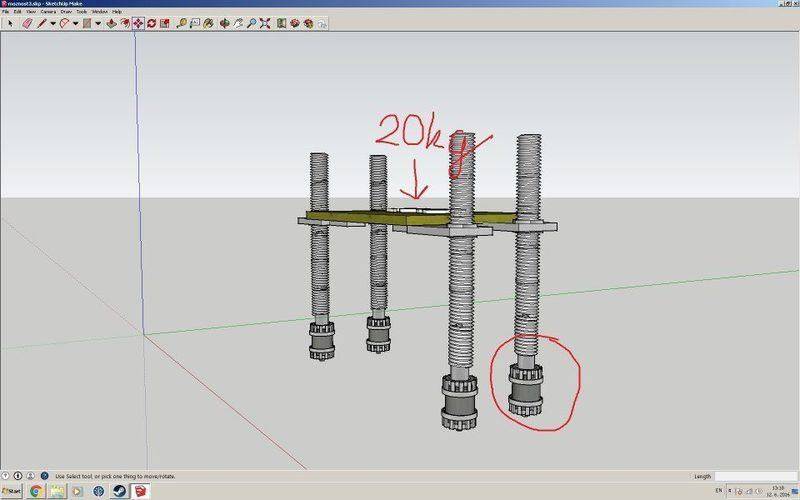
problem.jpg
It is only example, not final stage component, however I don't know how much torque does one motor need to be able to spin. Let's say I have 20kg on top so, one motor has to push up 5kgs. Now I am lost. One revolution of screw should lift it 1cm. I don't really want just the answer, but how can I figure it out later myself with different variables. If anyone of you has even better idea of how it can work with different mechanism, I will appreciate every single one. Thank you for your replies.
 
Engineering news on Phys.org
You can treat the screw like a ramp - but friction is also important.
It is usually easier to make a scissor lift instead, then there is only one motor needed.
 
  • Like
Likes   Reactions: ligazetom
Thank you for advice. I thought about that as well but it would take much more time to get to the top of the table doing it that way and I am not really sure if I would be able to do it right, now I don't really care about the slightly different speed of each single motor as it will be driven by arduino with rev sensor. Then I guess the best way is to try it out in practice anyway :)
 
Wow dude, that's awesome!
 
With such a (relatively) low load you could easily get away with regular threaded rod (much cheaper than ACME rod), like many 3D printers do.
Also, you could use a single motor driving all of the rods via a toothed belt. Or a single driven threaded rod in the centre and linear bearings at the edges/corners.
Consider using stepper motors, they can stay synchronized without feedback (you won't need encoders (rev counters)).

ligazetom said:
One revolution of screw should lift it 1cm.
That's a very large pitch, if you reduce it you won't need such a high torque motor/s. It'll also mean there's more tolerance to inter-motor rpm differences, before jamming.
 
  • Like
Likes   Reactions: Nidum
billy_joule said:
With such a (relatively) low load you could easily get away with regular threaded rod (much cheaper than ACME rod), like many 3D printers do.
Also, you could use a single motor driving all of the rods via a toothed belt. Or a single driven threaded rod in the centre and linear bearings at the edges/corners.
Consider using stepper motors, they can stay synchronized without feedback (you won't need encoders (rev counters)).That's a very large pitch, if you reduce it you won't need such a high torque motor/s. It'll also mean there's more tolerance to inter-motor rpm differences, before jamming.
Hey there,
well ACME rods I believe are more durable, I don't mind spending little more on something that I want to for work few years. Another thing, this was just an example, the whole thing might weight somewhere from 40 to 60kg. I am actuallty thinking now about scissors system but I have no idea where could I buy them. I need custom made and if I should make them myself, I am not sure if I could make the joints right. There is still much to be answered. The pitch will be around 0.5cm after I thought about it, and I need it to be high because I don't want it to take too long to get to the top. And yea, the stepper motors are what I am heading for (I needed more research on those). THANK YOU ALL SO MUCH. I am glad there is site like this one. Cheers :)
 
ligazetom said:
The pitch will be around 0.5cm after I thought about it, and I need it to be high because I don't want it to take too long to get to the top.
You can also have a small pitch with a fast motor.

In the end, you need a certain amount of power which will be F X v where F is the lifting force (i.e. the weight) and v is the the speed at which you are lifting it. That will be the power required by your motor, which could be high torque & low speed (i.e. large pitch) or low torque & high speed (i.e. small pitch). Though, I haven't explore which method could be more advantageous (efficiency or otherwise).
 
jack action said:
You can also have a small pitch with a fast motor.

In the end, you need a certain amount of power which will be F X v where F is the lifting force (i.e. the weight) and v is the the speed at which you are lifting it. That will be the power required by your motor, which could be high torque & low speed (i.e. large pitch) or low torque & high speed (i.e. small pitch). Though, I haven't explore which method could be more advantageous (efficiency or otherwise).
jack action said:
You can also have a small pitch with a fast motor.

In the end, you need a certain amount of power which will be F X v where F is the lifting force (i.e. the weight) and v is the the speed at which you are lifting it. That will be the power required by your motor, which could be high torque & low speed (i.e. large pitch) or low torque & high speed (i.e. small pitch). Though, I haven't explore which method could be more advantageous (efficiency or otherwise).
Well I think that faster motors make more noise which is something I don't really want. Anyway, I am still not sure if that 4 stepper vertical system or horizontal scissors system is the better option regarding the assembly. Another thing I am not sure about is, if I'll go with scissors I need parts which are making the scissors itself to be able withstand 30 kg each (side). Also rods. Do you guys have any idea how to make that scissor's joints? Anyway, thank you all very much so far.
 
  • #10
ligazetom said:
Well I think that faster motors make more noise which is something I don't really want.
It's entirely possible the motor will spin at the same RPM for both. Most (all?) small, low RPM DC motors are a high RPM motor with a gearbox attached, so you'll have the same motor noise but with the addition of the whine of the multistage gearbox.

Anyway, I am still not sure if that 4 stepper vertical system or horizontal scissors system is the better option regarding the assembly. Another thing I am not sure about is, if I'll go with scissors I need parts which are making the scissors itself to be able withstand 30 kg each (side). Also rods. Do you guys have any idea how to make that scissor's joints? Anyway, thank you all very much so far.
At the speed and loading you'll be dealing with you could get away with pretty much anything (with appropriate design). A living hinge from a scrap of old leather belt, the cheapest butt hinge at your local hardware store, a nut and bolt (a shoulder bolt if you're fancy), a wood screw, a dowel pin etc etc. You probably have a scissor jack in your car, take a look at it.
Looking at commercial and DIY TV lift stands will probably help. You could also look at other mechanisms; how double hung windows (or elevators) are counter balanced, or how gas stays counter balance hatches. There's plenty of ways to skin a cat.
 
  • #11
To avoid synchronization and wobble problems with the 4-post lift approach, you can make the threaded posts fixed and have a nut on each post that supports the table. You would have a single motor mounted on the table rotating the nuts with a toothed belt or a chain from the motor. Four nuts and a belt would be both cheaper and easier than four motors and supporting four rotating shafts so they don't wobble.
 

Similar threads

Replies
9
Views
2K
  • · Replies 17 ·
Replies
17
Views
4K
Replies
34
Views
5K
  • · Replies 14 ·
Replies
14
Views
5K
  • · Replies 5 ·
Replies
5
Views
5K
  • · Replies 58 ·
2
Replies
58
Views
9K
  • · Replies 8 ·
Replies
8
Views
3K
  • · Replies 11 ·
Replies
11
Views
4K
Replies
1
Views
3K
  • · Replies 19 ·
Replies
19
Views
4K